THE ADVENTURE COLLECTIVE® · Independent discovery and booking for outdoor travel

Two days in Cairo pack millennia into manageable sections: the Giza Plateau and Sakkara’s early pyramids, followed by the Grand Egyptian Museum and the maze of Khan El Khalili. Expect museum stewardship, desert walks, and lively market bargaining.
Two days in Cairo pack millennia into manageable sections: the Giza Plateau and Sakkara’s early pyramids, followed by the Grand Egyptian Museum and the maze of Khan El Khalili. Expect museum stewardship, desert walks, and lively market bargaining.
You arrive at dawn with the desert light flattening the horizon and the three pyramids cutting clean silhouettes against an open sky.
The wind pushes sand across broad hard-packed tracks, daring you toward the Panorama Point where Khufu, Khafre and Menkaure sit in quiet alignment. A camel breathes beside a path; its slow rhythm matches the ancient stones’ patient geometry.
Verified experiences and guided adventures in the surrounding area.
Operated by Cairo Portal Tours · Cairo, Cairo Governorate
You arrive at dawn with the desert light flattening the horizon and the three pyramids cutting clean silhouettes against an open sky.
The wind pushes sand across broad hard-packed tracks, daring you toward the Panorama Point where Khufu, Khafre and Menkaure sit in quiet alignment. A camel breathes beside a path; its slow rhythm matches the ancient stones’ patient geometry.
This two-day itinerary threads modern Cairo and pharaonic antiquity. Start on the Giza Plateau—4th Dynasty engineering that redefined monumental architecture—then cross to Sakkara where Imhotep’s Step Pyramid announces the birth of stone construction. The Grand Egyptian Museum, a new cultural anchor near Giza, brings Tutankhamun’s treasures and conservation labs into modern light.
Wander Islamic Cairo’s Al-Azhar precinct and Khan El Khalili’s alleys where merchants have traded spices, metalwork and stories for over six centuries. The Citadel’s alabaster mosque and El-Hussein Square show how faith and civic life shaped the city’s skyline.
Practical guidance: expect lots of walking on uneven stone and sand; temperatures can swing widely between morning and afternoon. Bring sun protection, a reusable water bottle, and patience for crowds and bargaining in the bazaar. Museum entry follows strict security and photography rules; guided access streamlines timing.
Timing your visit for early morning pyramid light and cooler museum hours reduces heat exposure and maximizes photography. Keep copies of travel documents, wear sturdy closed shoes for tomb steps and loose, respectful clothing for religious sites. With measured planning, this two-day loop delivers Cairo’s scale—ancient stones meeting a city still very much alive.
easy.
2 days (approx. 8–10 hours touring per day).
Suitable for most fitness levels but requires standing, walking on uneven surfaces, and climbing short tomb steps.
This tour lists admissions included for the Giza Plateau, Saqqara and the Grand Egyptian Museum—confirm specific entry points and any optional internal tomb fees with the operator.
Yes; the itinerary is described as suitable for all fitness levels but expect walking and some uneven surfaces—inform the operator of mobility needs in advance.
Camel rides are typically available near the Giza Plateau and often offered on-site; negotiate price beforehand and be clear about duration to avoid surprise costs.
Bring small bills in Egyptian pounds for purchases, a small daypack for valuables, and a sense of patience for bargaining and crowded lanes.
The Giza pyramids date to Egypt’s Old Kingdom (c. 26th century BCE); Sakkara’s Step Pyramid predates them as the first large-scale stone monument. The Grand Egyptian Museum centralizes artifacts including Tutankhamun’s collection.
Visitor pressure and pollution challenge preservation; stick to marked paths, don’t touch reliefs or artifacts, and use refillable bottles to reduce waste.
Cairo Portal Tours operates guided outdoor trips and adventures with an emphasis on safety, stewardship, and memorable experiences.
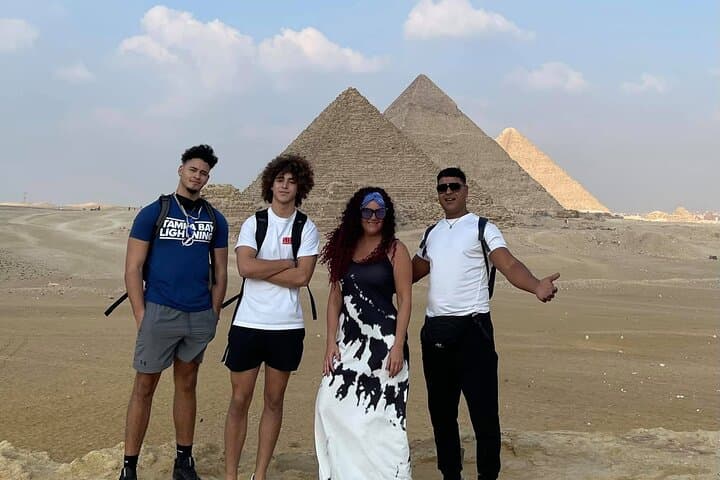


You arrive at dawn with the desert light flattening the horizon and the three pyramids cutting clean silhouettes against an open sky.
The wind pushes sand across broad hard-packed tracks, daring you toward the Panorama Point where Khufu, Khafre and Menkaure sit in quiet alignment. A camel breathes beside a path; its slow rhythm matches the ancient stones’ patient geometry.
This two-day itinerary threads modern Cairo and pharaonic antiquity. Start on the Giza Plateau—4th Dynasty engineering that redefined monumental architecture—then cross to Sakkara where Imhotep’s Step Pyramid announces the birth of stone construction. The Grand Egyptian Museum, a new cultural anchor near Giza, brings Tutankhamun’s treasures and conservation labs into modern light.
Wander Islamic Cairo’s Al-Azhar precinct and Khan El Khalili’s alleys where merchants have traded spices, metalwork and stories for over six centuries. The Citadel’s alabaster mosque and El-Hussein Square show how faith and civic life shaped the city’s skyline.
Practical guidance: expect lots of walking on uneven stone and sand; temperatures can swing widely between morning and afternoon. Bring sun protection, a reusable water bottle, and patience for crowds and bargaining in the bazaar. Museum entry follows strict security and photography rules; guided access streamlines timing.
Timing your visit for early morning pyramid light and cooler museum hours reduces heat exposure and maximizes photography. Keep copies of travel documents, wear sturdy closed shoes for tomb steps and loose, respectful clothing for religious sites. With measured planning, this two-day loop delivers Cairo’s scale—ancient stones meeting a city still very much alive.