THE ADVENTURE COLLECTIVE® · Independent discovery and booking for outdoor travel

Walk along the hardened 2002 lava flows on Etna’s north flank and trace a canyon carved by recent eruptions. This 2–3 hour guided trek mixes raw geology, ruined pine groves and dramatic volcanic terrain.
Walk along the hardened 2002 lava flows on Etna’s north flank and trace a canyon carved by recent eruptions. This 2–3 hour guided trek mixes raw geology, ruined pine groves and dramatic volcanic terrain.
The ground is black and alive beneath your boots — a coarse, broken crust of cooled lava that still smells faintly of sulfur. On Etna’s north flank, the path runs along the edge of a hardened flow that spilled from the 2002 lateral craters, a raw scar contrasting with nearby scrub and the stunted Ragabo pines that once stood here. Wind carves the channel’s rim; the trail angles and narrows as it follows a canyon cut by molten rock.
Verified experiences and guided adventures in the surrounding area.
The ground is black and alive beneath your boots — a coarse, broken crust of cooled lava that still smells faintly of sulfur. On Etna’s north flank, the path runs along the edge of a hardened flow that spilled from the 2002 lateral craters, a raw scar contrasting with nearby scrub and the stunted Ragabo pines that once stood here. Wind carves the channel’s rim; the trail angles and narrows as it follows a canyon cut by molten rock.
The eruption of 2002 reshaped this sector of Etna, sending lava down established channels and creating a row of lateral cones. Geologically, Etna is an active basaltic stratovolcano; the north-side fissures produced fast-moving, fluid flows that gouged deep channels and blackened centuries-old forest. Culturally the mountain is integral to local towns — guides often come from Linguaglossa and nearby villages with traditions tied to shepherding and viticulture on the lower slopes.
Expect a compact, striking itinerary: 2–3 hours on a route of roughly 3–5 km with 200–400 m of uphill walking in places; terrain is loose scoria, packed lava and rocky steps. Wear sturdy boots with good ankle support, bring 1–2 liters of water, a windproof layer and sun protection. Timing matters — morning light gives the best contrast on the lava while afternoons can blow colder winds and reduced visibility. Follow your guide closely: unstable edges and recent flows are unforgiving. With straightforward planning this trek delivers a visceral lesson in volcanic power and a rare close-up of a modern lava landscape.
moderate.
2–3 hours.
Moderate fitness; comfortable with steady uphill sections, loose volcanic rock and short rocky scrambles.
Most operators require a guide for safety and route knowledge; guides also interpret geology and control access near unstable areas.
The north-flank routes vary; this trek is typically 200–400 m of elevation change over 2–3 hours, rated moderate for those comfortable with uneven volcanic terrain.
The 2002 craters are from a recent eruption but current activity varies; hazards include unstable edges, fumarolic gas and sudden weather, so stay with the guide and follow instructions.
Trailheads on Etna’s north side are reached from towns like Linguaglossa or the Piano Provenzana area; many tours include pickup from local hubs or central meeting points.
The 2002 eruption produced a series of lateral fissures on Etna’s north flank that funneled fast basaltic lava into deep channels, altering forest and farmland below.
Stay on established routes — newly formed lava fields are fragile and vegetation recovery is slow; pack out all waste and respect local access rules.
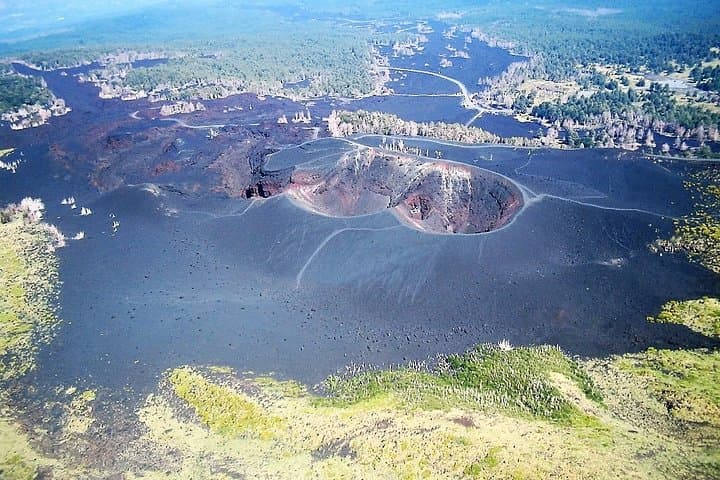
The ground is black and alive beneath your boots — a coarse, broken crust of cooled lava that still smells faintly of sulfur. On Etna’s north flank, the path runs along the edge of a hardened flow that spilled from the 2002 lateral craters, a raw scar contrasting with nearby scrub and the stunted Ragabo pines that once stood here. Wind carves the channel’s rim; the trail angles and narrows as it follows a canyon cut by molten rock.
The ground is black and alive beneath your boots — a coarse, broken crust of cooled lava that still smells faintly of sulfur. On Etna’s north flank, the path runs along the edge of a hardened flow that spilled from the 2002 lateral craters, a raw scar contrasting with nearby scrub and the stunted Ragabo pines that once stood here. Wind carves the channel’s rim; the trail angles and narrows as it follows a canyon cut by molten rock.
The eruption of 2002 reshaped this sector of Etna, sending lava down established channels and creating a row of lateral cones. Geologically, Etna is an active basaltic stratovolcano; the north-side fissures produced fast-moving, fluid flows that gouged deep channels and blackened centuries-old forest. Culturally the mountain is integral to local towns — guides often come from Linguaglossa and nearby villages with traditions tied to shepherding and viticulture on the lower slopes.
Expect a compact, striking itinerary: 2–3 hours on a route of roughly 3–5 km with 200–400 m of uphill walking in places; terrain is loose scoria, packed lava and rocky steps. Wear sturdy boots with good ankle support, bring 1–2 liters of water, a windproof layer and sun protection. Timing matters — morning light gives the best contrast on the lava while afternoons can blow colder winds and reduced visibility. Follow your guide closely: unstable edges and recent flows are unforgiving. With straightforward planning this trek delivers a visceral lesson in volcanic power and a rare close-up of a modern lava landscape.