THE ADVENTURE COLLECTIVE® · Independent discovery and booking for outdoor travel

Head east of Angkor for a two-day trek and overnight under the Cambodian sky. Explore lesser-visited Preah Khan Kompong Svay and Sambor Prei Kuk, sleep in a basic jungle camp, and experience remote Khmer ruins away from the crowds.
Head east of Angkor for a two-day trek and overnight under the Cambodian sky. Explore lesser-visited Preah Khan Kompong Svay and Sambor Prei Kuk, sleep in a basic jungle camp, and experience remote Khmer ruins away from the crowds.
You arrive before dawn with the road shrinking into a red-dust ribbon, the truck rattling past wetlands and scrub where the air already tastes of humidity and earth.
Verified experiences and guided adventures in the surrounding area.
Operated by Van Express Tours · Kampong Thom, Kampong Thom Province
You arrive before dawn with the road shrinking into a red-dust ribbon, the truck rattling past wetlands and scrub where the air already tastes of humidity and earth.
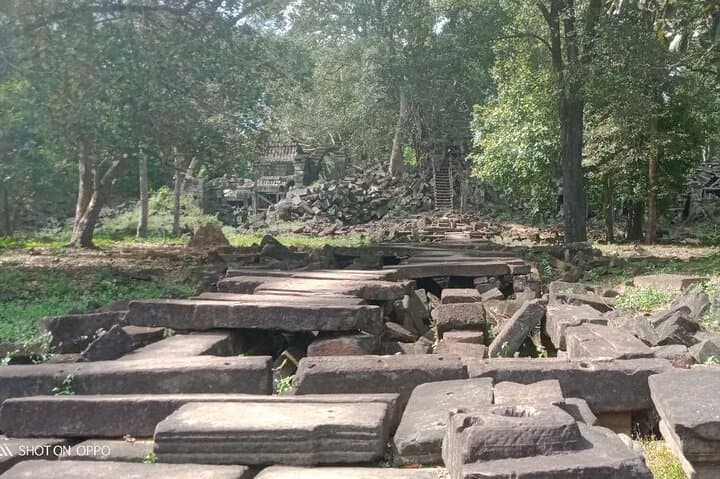
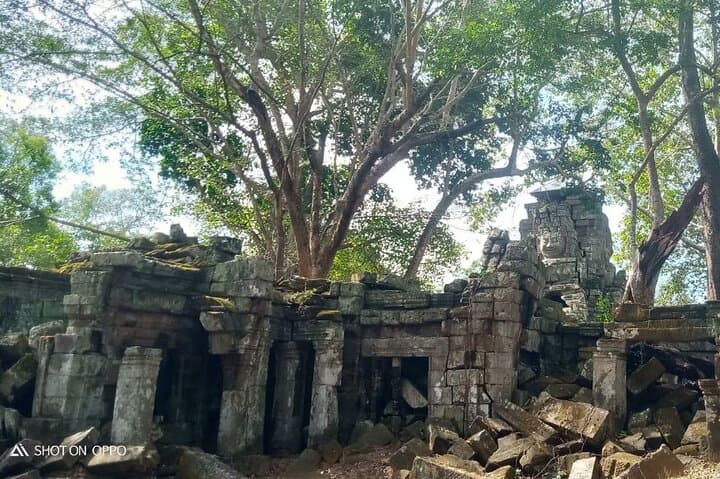
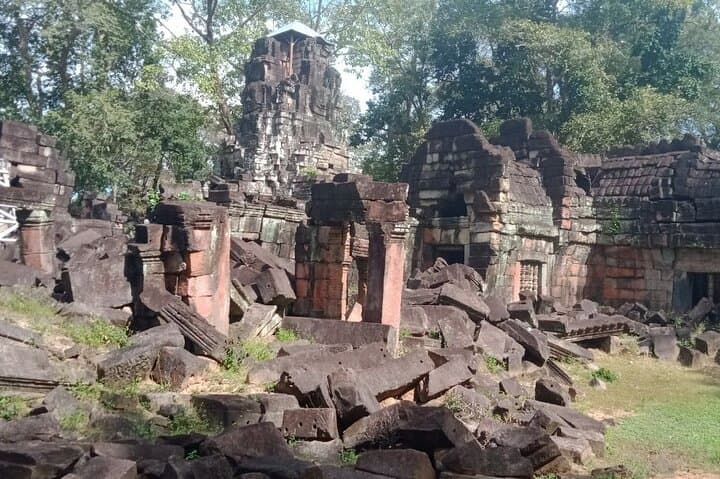
By mid-morning the car drops you at a scattering of laterite tracks; the guide points to a distant stone outline—Preah Khan Kompong Svay—its walls pressing quietly against a sky that feels bigger out here. The walk threads through scrub forest and old Khmer causeways, low rises rather than steep climbs, broken by temple courtyards where roots and moss have reclaimed carved stones.
Preah Khan Kompong Svay has contested origins—French scholars place parts in the 11th century, with later association to Suryavarman II and use as a military outpost under Jayavarman VII. Nearby, Sambor Prei Kuk predates Angkor as a 6th–8th century capital called Isanpura, its brick towers marking an earlier Khmer world.
Geology here is flat alluvial plain with lateritic soil; trails are hard-packed with seasonal mud. Culture is rural—small villages, rice paddies, and roadside markets where guides source cold drinks and wet towels.
Practical guidance: expect two days of guided trekking and an overnight jungle camp with basic sleeping arrangements—pack a headlamp, lightweight sleeping liner, and a mosquito-proof shelter. Footwear should be sturdy, breathable, and rinsed after muddy sections. Hydrate frequently; temperatures swing between hot afternoons and cooler nights, so layer lightweight clothes. Photography rewards close-up shots of temple lintels and the slow work of nature reclaiming stone.
This trip is for travelers comfortable with rustic conditions, curious about early Khmer sites beyond Angkor, and eager for quiet corners of Cambodia where history meets the slow pulse of the forest.
moderate.
2 days (approx. 48 hours).
Moderate fitness—able to walk several hours with short breaks and manage uneven surfaces; not suitable for those with significant back or heart issues.
The camp is basic—sleeping mats or roll mats, possible hammock or simple tent, shared sanitation facilities may be primitive depending on the route; guides provide water and a wet towel.
Children who are used to multi-hour walks and basic camping can join, but the operator notes it is not recommended for those with spinal, pregnancy, or serious heart conditions.
Guides on this itinerary are fluent in English and will handle navigation, local introductions, and basic safety throughout the trek.
Yes—entrance fees for the listed temple sites are included in the tour price, along with pick up, drop off, driver, guide, water, and wet towel.
Preah Khan Kompong Svay served at different times as a royal residence and a military outpost; Sambor Prei Kuk was the capital Isanpura in the 6th–8th centuries and predates Angkorian temple-building.
Sites face weathering from seasonal rains and vegetation growth; respect ruins by not removing fragments and follow your guide to minimize impact on fragile structures.
Van Express Tours operates guided outdoor trips and adventures with an emphasis on safety, stewardship, and memorable experiences.

You arrive before dawn with the road shrinking into a red-dust ribbon, the truck rattling past wetlands and scrub where the air already tastes of humidity and earth.
You arrive before dawn with the road shrinking into a red-dust ribbon, the truck rattling past wetlands and scrub where the air already tastes of humidity and earth.
By mid-morning the car drops you at a scattering of laterite tracks; the guide points to a distant stone outline—Preah Khan Kompong Svay—its walls pressing quietly against a sky that feels bigger out here. The walk threads through scrub forest and old Khmer causeways, low rises rather than steep climbs, broken by temple courtyards where roots and moss have reclaimed carved stones.
Preah Khan Kompong Svay has contested origins—French scholars place parts in the 11th century, with later association to Suryavarman II and use as a military outpost under Jayavarman VII. Nearby, Sambor Prei Kuk predates Angkor as a 6th–8th century capital called Isanpura, its brick towers marking an earlier Khmer world.
Geology here is flat alluvial plain with lateritic soil; trails are hard-packed with seasonal mud. Culture is rural—small villages, rice paddies, and roadside markets where guides source cold drinks and wet towels.
Practical guidance: expect two days of guided trekking and an overnight jungle camp with basic sleeping arrangements—pack a headlamp, lightweight sleeping liner, and a mosquito-proof shelter. Footwear should be sturdy, breathable, and rinsed after muddy sections. Hydrate frequently; temperatures swing between hot afternoons and cooler nights, so layer lightweight clothes. Photography rewards close-up shots of temple lintels and the slow work of nature reclaiming stone.
This trip is for travelers comfortable with rustic conditions, curious about early Khmer sites beyond Angkor, and eager for quiet corners of Cambodia where history meets the slow pulse of the forest.