THE ADVENTURE COLLECTIVE® · Independent discovery and booking for outdoor travel

A 2.5–3 hour guided workshop in Millcreek combining structured breathwork with a supervised ice plunge. Learn mindset tools, try cold exposure safely, and leave with a guided audio to continue practice.
A 2.5–3 hour guided workshop in Millcreek combining structured breathwork with a supervised ice plunge. Learn mindset tools, try cold exposure safely, and leave with a guided audio to continue practice.
You arrive at a backyard geodesic dome on a cool Salt Lake afternoon, the city’s hum held at bay by a stand of maples and the tentative slope of nearby hills. Inside, mats form a loose semicircle; the facilitator’s voice asks for nothing more than attention to the breath. Air draws in like a tide, then releases, and the group moves together through structured inhales, holds and long exhales until the room feels charged. Later, a tub of ice waits like a dare — cold, honest, immediate.
Verified experiences and guided adventures in the surrounding area.
Operated by Inner Alchemy · Millcreek, Utah
You arrive at a backyard geodesic dome on a cool Salt Lake afternoon, the city’s hum held at bay by a stand of maples and the tentative slope of nearby hills. Inside, mats form a loose semicircle; the facilitator’s voice asks for nothing more than attention to the breath. Air draws in like a tide, then releases, and the group moves together through structured inhales, holds and long exhales until the room feels charged. Later, a tub of ice waits like a dare — cold, honest, immediate.
The practice threads contemporary breathwork with cold-water exposure techniques that draw on Scandinavian and Wim Hof traditions. Millcreek sits on the eastern bench of the Salt Lake Valley; its foothills are young — uplifted by Basin-and-Range tectonics — and the area has shifted from pioneer farmland into an urban-wild edge where wellness communities gather.
Expect a 2.5–3 hour session that combines guided breath cycles, coaching on mindset and a supervised ice plunge. The work is sensory and confrontational: breath raises heart rate, cold clamps it down, and integration periods let the body and mind settle. Facilitators typically provide instruction, a post-plunge cooldown, and take-home audio to continue practice.
Plan to hydrate well before arrival, wear easily removable layers, and arrive with realistic expectations — cold exposure is progressive and not a performance. People with cardiovascular issues, pregnancy, seizures, or on BP meds should avoid the ice plunge. Bring a towel, warm layers for after the plunge, and an open attitude: the payoff is practical — improved stress tolerance and a recalibrated relationship to discomfort — delivered in a compact, community-focused format.
easy.
2–3 hours.
Suitable for most fitness levels, though participants should be able to tolerate brief cardiovascular stress and sudden temperature change.
No — many workshops let you observe or participate in graduated exposures; facilitators encourage listening to your body and opting out if needed.
Temperatures vary but typically range from 0–10°C (32–50°F); staff supervise timing and safety throughout the immersion.
People with cardiovascular disease, uncontrolled high blood pressure, pregnancy, epilepsy/seizure disorders, or those on certain medications should not participate in the ice plunge and should consult a doctor before attending.
You may feel energized and alert, or quietly fatigued; warming up gradually, hydrating and resting are recommended. Many participants report reduced stress and clearer focus for hours afterward.
Millcreek evolved from 19th-century agricultural homesteads to a residential corridor at the valley’s eastern edge; contemporary wellness events are part of a local shift toward outdoor-oriented health culture.
Practice leave-no-trace at the private site and nearby trails; avoid chemical detergents or runoff from ice baths into storm drains and follow host instructions for waste and water disposal.
Inner Alchemy operates guided outdoor trips and adventures with an emphasis on safety, stewardship, and memorable experiences.
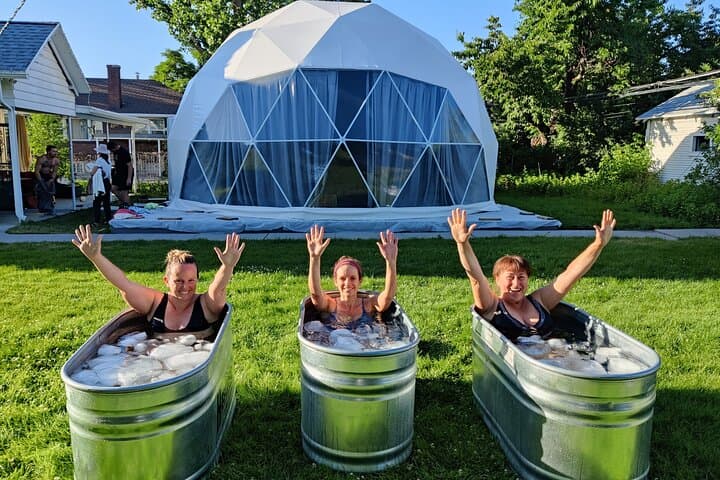


You arrive at a backyard geodesic dome on a cool Salt Lake afternoon, the city’s hum held at bay by a stand of maples and the tentative slope of nearby hills. Inside, mats form a loose semicircle; the facilitator’s voice asks for nothing more than attention to the breath. Air draws in like a tide, then releases, and the group moves together through structured inhales, holds and long exhales until the room feels charged. Later, a tub of ice waits like a dare — cold, honest, immediate.
You arrive at a backyard geodesic dome on a cool Salt Lake afternoon, the city’s hum held at bay by a stand of maples and the tentative slope of nearby hills. Inside, mats form a loose semicircle; the facilitator’s voice asks for nothing more than attention to the breath. Air draws in like a tide, then releases, and the group moves together through structured inhales, holds and long exhales until the room feels charged. Later, a tub of ice waits like a dare — cold, honest, immediate.
The practice threads contemporary breathwork with cold-water exposure techniques that draw on Scandinavian and Wim Hof traditions. Millcreek sits on the eastern bench of the Salt Lake Valley; its foothills are young — uplifted by Basin-and-Range tectonics — and the area has shifted from pioneer farmland into an urban-wild edge where wellness communities gather.
Expect a 2.5–3 hour session that combines guided breath cycles, coaching on mindset and a supervised ice plunge. The work is sensory and confrontational: breath raises heart rate, cold clamps it down, and integration periods let the body and mind settle. Facilitators typically provide instruction, a post-plunge cooldown, and take-home audio to continue practice.
Plan to hydrate well before arrival, wear easily removable layers, and arrive with realistic expectations — cold exposure is progressive and not a performance. People with cardiovascular issues, pregnancy, seizures, or on BP meds should avoid the ice plunge. Bring a towel, warm layers for after the plunge, and an open attitude: the payoff is practical — improved stress tolerance and a recalibrated relationship to discomfort — delivered in a compact, community-focused format.