THE ADVENTURE COLLECTIVE® · Independent discovery and booking for outdoor travel

Learn to capture Tower Bridge, the Shard and the Thames after dark with one-to-one instruction from a professional fine-art photographer. This three-hour private walk covers composition, long exposures and tripod technique at the city’s most photogenic night sites.
Learn to capture Tower Bridge, the Shard and the Thames after dark with one-to-one instruction from a professional fine-art photographer. This three-hour private walk covers composition, long exposures and tripod technique at the city’s most photogenic night sites.
The Thames at night pulls the city into motion: car lights stitch long ribbons across glass, the Shard looms like a shard of ice, and Tower Bridge opens its arms of steel and light for your camera.
Verified experiences and guided adventures in the surrounding area.
Operated by London Photo Tours and Workshops · London, Greater London
The Thames at night pulls the city into motion: car lights stitch long ribbons across glass, the Shard looms like a shard of ice, and Tower Bridge opens its arms of steel and light for your camera.
You start on the Queen's Walk under municipal lamps, guided by a professional fine-art photographer who works with your camera and your eye. The route moves between modern glass—City Hall, the Scoop—and historic masonry: the Tower of London and the Victorian bascules of Tower Bridge. St Katharine Docks provides still-water reflections; walkways along More London reveal low angles and architectural lines.
London’s riverside is layered history: a medieval port turned industrial artery, which by the late 20th century became a focus of urban renewal and contemporary architecture. Geology is incidental here—riverine silt and the engineered Thames embankments—but culture is central: civic buildings, public sculptures and the nightly rhythm of commuters and tourists.
Practical guidance: this private three-hour tour is a walking lesson in night exposure, composition and tripod technique. Expect easy, flat pavement but bring a tripod for long exposures, spare batteries for long shooting sessions, and a small torch for menu changes. Aim for ISO 100–400, apertures f/8–f/16 for sharpness, and shutter speeds from 1/4s to multi-seconds for light trails and glass-like water.
Timing matters—twilight and the first hour after dark give the best balance of ambient light. Use public transport to arrive early, dress in layers against river breezes, and be prepared to move deliberately between setups; the photographer tailors instruction to your camera and skill level.
easy.
3 hours.
Light walking on paved surfaces; suitable for most fitness levels
Yes—tripod use is central to learning long exposures; hire options may be available if you contact the operator after booking.
Yes—the instructor adapts tuition to skill level and camera type, from compact to DSLR and mirrorless systems.
Meeting details are provided at booking; public transport (Tower Hill tube, London Bridge, or nearby buses) places you within a short walk of the Queen's Walk/Tower Bridge area.
Full refund available if you cancel at least 24 hours before the scheduled departure time.
Tower Bridge opened in 1894; the Thames waterfront evolved from medieval port to industrial hub and now a redeveloped riverside of mixed historic and modern architecture.
Keep tripod footprints small on pedestrian walkways, avoid intrusive flash near wildlife, and respect local signage—minimising light pollution and litter helps maintain riverbank scenes for everyone.
London Photo Tours and Workshops operates guided outdoor trips and adventures with an emphasis on safety, stewardship, and memorable experiences.
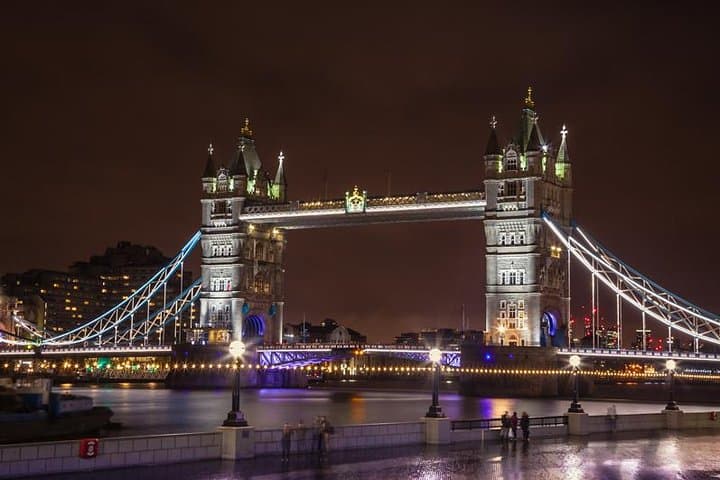
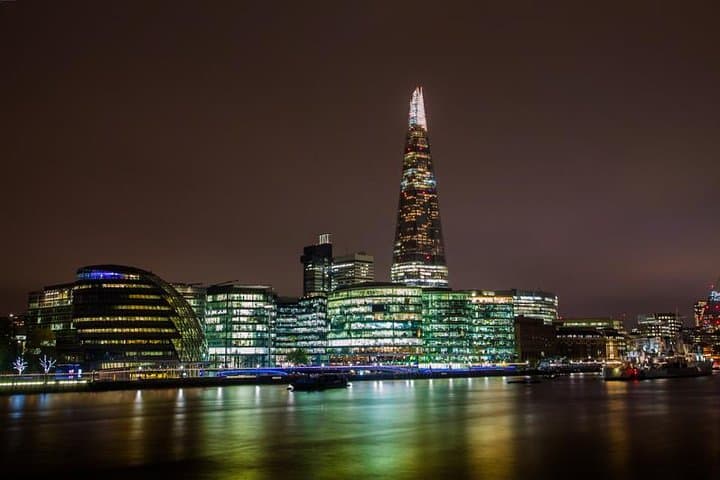
The Thames at night pulls the city into motion: car lights stitch long ribbons across glass, the Shard looms like a shard of ice, and Tower Bridge opens its arms of steel and light for your camera.
The Thames at night pulls the city into motion: car lights stitch long ribbons across glass, the Shard looms like a shard of ice, and Tower Bridge opens its arms of steel and light for your camera.
You start on the Queen's Walk under municipal lamps, guided by a professional fine-art photographer who works with your camera and your eye. The route moves between modern glass—City Hall, the Scoop—and historic masonry: the Tower of London and the Victorian bascules of Tower Bridge. St Katharine Docks provides still-water reflections; walkways along More London reveal low angles and architectural lines.
London’s riverside is layered history: a medieval port turned industrial artery, which by the late 20th century became a focus of urban renewal and contemporary architecture. Geology is incidental here—riverine silt and the engineered Thames embankments—but culture is central: civic buildings, public sculptures and the nightly rhythm of commuters and tourists.
Practical guidance: this private three-hour tour is a walking lesson in night exposure, composition and tripod technique. Expect easy, flat pavement but bring a tripod for long exposures, spare batteries for long shooting sessions, and a small torch for menu changes. Aim for ISO 100–400, apertures f/8–f/16 for sharpness, and shutter speeds from 1/4s to multi-seconds for light trails and glass-like water.
Timing matters—twilight and the first hour after dark give the best balance of ambient light. Use public transport to arrive early, dress in layers against river breezes, and be prepared to move deliberately between setups; the photographer tailors instruction to your camera and skill level.