THE ADVENTURE COLLECTIVE® · Independent discovery and booking for outdoor travel

Todra Gorge offers high, vertical limestone walls and guided climbs for all levels just outside Tinerhir. This guide covers what to expect—routes, geology, local culture, and practical tips to prepare for a day on the rock.
Todra Gorge offers high, vertical limestone walls and guided climbs for all levels just outside Tinerhir. This guide covers what to expect—routes, geology, local culture, and practical tips to prepare for a day on the rock.
You step into a slot of stone where sunlight becomes a knife, slicing the gorge into warm bands of orange and shadow. The riverbed beneath your boots is mostly dry; the cliffs rise straight up—vertical sheets of limestone that dare you to find purchase. Climbers string ropes along bolt lines while local guides move with practiced calm, reading holds the way others read weather.
Verified experiences and guided adventures in the surrounding area.
You step into a slot of stone where sunlight becomes a knife, slicing the gorge into warm bands of orange and shadow. The riverbed beneath your boots is mostly dry; the cliffs rise straight up—vertical sheets of limestone that dare you to find purchase. Climbers string ropes along bolt lines while local guides move with practiced calm, reading holds the way others read weather.
Geology here is blunt: folded Atlas Mountains pushed ancient seabed into towering walls, then water carved the narrow canyon over millennia. The Todra (Toudgha) Gorge sits on the edge of Berber country; villages nearby still run on irrigation from palm-lined oases and an economy shaped by kasbahs, mud-brick architecture, and seasonal tourism. Climbers first explored Todra in the late 20th century; today routes range from single-pitch sport climbs to sustained multi-pitch lines up to a few hundred meters.
Practical guidance: guided trips accommodate beginners and experienced climbers—expect routes from French 4s up to 8a in the bolted sectors, with many bolted sport lines ideal for top-roping and lead instruction. Most approaches are short (5–30 minutes) on firm scree or paved valley tracks. Carry 2–3 liters of water, sun protection, and shoes with sticky rubber; mornings are coolest and most comfortable, late afternoon can be hot and dusty.
Respect local customs and scarce water resources, follow your guide’s briefing on anchors and rappel stations, and leave no chalk or tape behind. Climbers will find sharp limestone, warm canyon air, and an honest vertical challenge—guided, safe, and rooted in a landscape older than the climbs themselves.
moderate.
4–8 hours (half-day to full-day guided options).
Moderate fitness — able to scramble, stand on feet for several hours, and handle sustained effort on vertical terrain
No — guides can introduce beginners to top-rope and lead basics, though some routes require prior belaying experience for advanced climbs.
Yes — Todra has many bolted sport routes and established multi-pitch lines; guides inspect anchors and will brief on safety systems.
Approaches are generally short (5–30 minutes) on dirt or paved valley tracks, though some multi-pitch sectors require longer walks and route-finding.
Shoulder seasons (spring and fall) offer the best temperatures; mornings are preferable year-round to avoid heat on the rock.
The gorge lies at a junction of Berber communities and historic caravan routes; the cliffs are part of the High Atlas uplift formed from ancient seabed limestone.
Climbing has increased foot traffic—stick to established trails, use fixed anchors when present, pack out all waste, and minimize chalk to protect the rock and local water supplies.
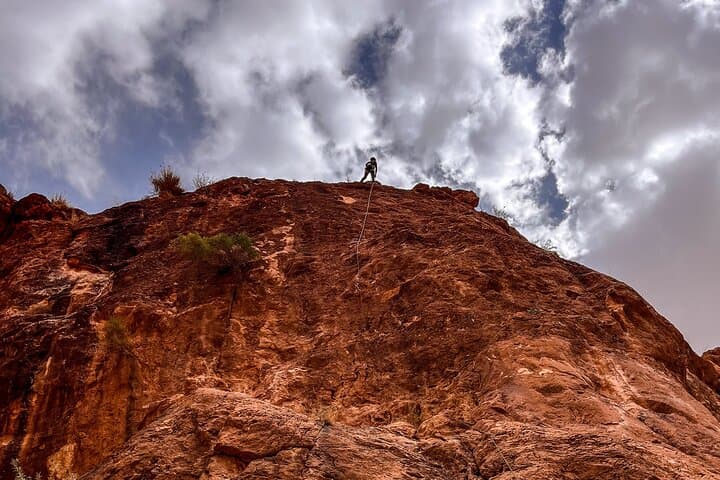
You step into a slot of stone where sunlight becomes a knife, slicing the gorge into warm bands of orange and shadow. The riverbed beneath your boots is mostly dry; the cliffs rise straight up—vertical sheets of limestone that dare you to find purchase. Climbers string ropes along bolt lines while local guides move with practiced calm, reading holds the way others read weather.
You step into a slot of stone where sunlight becomes a knife, slicing the gorge into warm bands of orange and shadow. The riverbed beneath your boots is mostly dry; the cliffs rise straight up—vertical sheets of limestone that dare you to find purchase. Climbers string ropes along bolt lines while local guides move with practiced calm, reading holds the way others read weather.
Geology here is blunt: folded Atlas Mountains pushed ancient seabed into towering walls, then water carved the narrow canyon over millennia. The Todra (Toudgha) Gorge sits on the edge of Berber country; villages nearby still run on irrigation from palm-lined oases and an economy shaped by kasbahs, mud-brick architecture, and seasonal tourism. Climbers first explored Todra in the late 20th century; today routes range from single-pitch sport climbs to sustained multi-pitch lines up to a few hundred meters.
Practical guidance: guided trips accommodate beginners and experienced climbers—expect routes from French 4s up to 8a in the bolted sectors, with many bolted sport lines ideal for top-roping and lead instruction. Most approaches are short (5–30 minutes) on firm scree or paved valley tracks. Carry 2–3 liters of water, sun protection, and shoes with sticky rubber; mornings are coolest and most comfortable, late afternoon can be hot and dusty.
Respect local customs and scarce water resources, follow your guide’s briefing on anchors and rappel stations, and leave no chalk or tape behind. Climbers will find sharp limestone, warm canyon air, and an honest vertical challenge—guided, safe, and rooted in a landscape older than the climbs themselves.