THE ADVENTURE COLLECTIVE® · Independent discovery and booking for outdoor travel

Spend a brisk half-day inside Tijuca National Park — Rio’s vast replanted urban forest — hiking to waterfalls, exploring a bat cave and taking sweeping viewpoints over the city and bay. Practical route, guide-led transport and a chance to cool off in natural pools.
Spend a brisk half-day inside Tijuca National Park — Rio’s vast replanted urban forest — hiking to waterfalls, exploring a bat cave and taking sweeping viewpoints over the city and bay. Practical route, guide-led transport and a chance to cool off in natural pools.
You step off the van into a wall of green — humid air that smells of wet leaf litter and earth, birds arguing from the canopy and a distant rush of water daring you toward it.
Verified experiences and guided adventures in the surrounding area.
Operated by RIOTRIPS · Rio de Janeiro, Rio de Janeiro
You step off the van into a wall of green — humid air that smells of wet leaf litter and earth, birds arguing from the canopy and a distant rush of water daring you toward it.
This half-day tour threads through Tijuca National Park, the world’s largest replanted urban forest, rising above Rio with steep granite outcrops, shaded trails and concealed cascades. Geologically the park sits on ancient coastal granitoid massifs carved by weather and time; culturally it’s layered with 19th-century reforestation history and local lore that rescued the watershed that feeds the city.
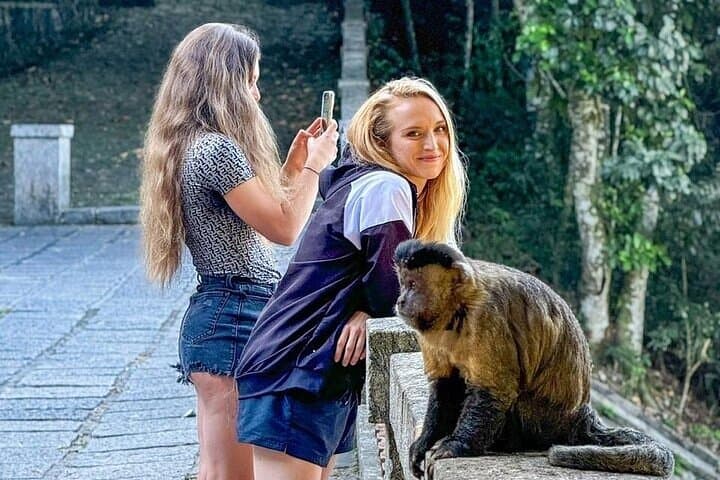
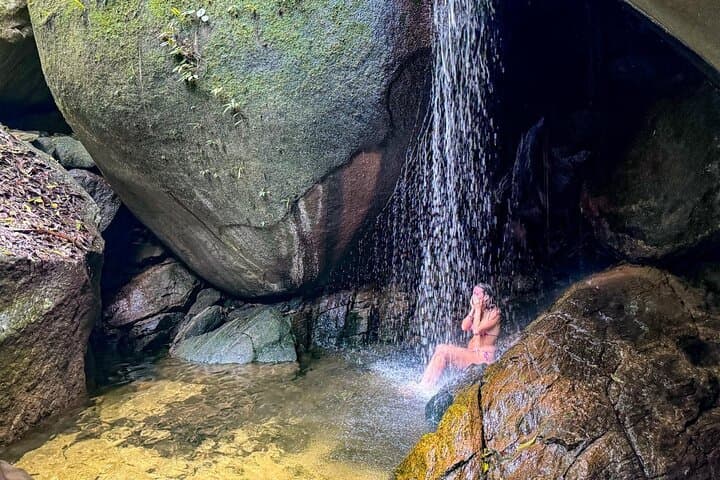
Expect a stop at Mirante das Canoas for a broad, cinematic view of mountains meeting bay, a walk along Atlantic Forest trails where coatis and small primates move like shadows, and a visit to Cascatinha Taunay — a 35-meter fall whose plunge pools invite a quick, cold dip. The Cave of Bats (Gruta dos Morcegos) adds a compact spelunking moment: low light, cool rock and the steady flutter of wings.
Practical edge: trails are mostly well-trod but can be slippery; the route covers mixed stone steps, muddy sections and short climbs over roughly 5 hours total. Bring good trail shoes, a rain layer, insect protection and a swimsuit for the waterfalls. Guides cover transport, park entrance and context, and the Chinese View may be included on weekdays only. Hydrate, move deliberately where rock is wet, and leave no trace — the forest is both spectacle and vital infrastructure for Rio.
moderate.
5 hours.
Light-to-moderate fitness; able to walk uneven trails and handle short climbs.
The tour runs about 5 hours and includes guided transport, park entrance, stops at viewpoints, a forest walk, Cascatinha Taunay waterfall and the Cave of Bats (subject to access rules).
The tour is described as suitable for most fitness levels, but some short uneven sections and stairs may be challenging for very young children or those with mobility limitations; check with the operator for custom arrangements.
Note: Operator-provided answer overwritten due to JSON schema — please use the first 'answer' field.
Pickups are offered in central neighborhoods (Copacabana, Ipanema, Botafogo, Centro, Santa Teresa). The Chinese View is accessible by vehicle only on weekdays; on weekends the itinerary may substitute Mirante das Canoas.
Tijuca was largely replanted in the 19th century to restore Rio’s water supply after deforestation; the park now protects critical watershed and urban biodiversity.
The park is fragile: stick to marked trails, pack out all waste and avoid feeding animals to reduce human-wildlife conflicts and erosion.
RIOTRIPS operates guided outdoor trips and adventures with an emphasis on safety, stewardship, and memorable experiences.


You step off the van into a wall of green — humid air that smells of wet leaf litter and earth, birds arguing from the canopy and a distant rush of water daring you toward it.
You step off the van into a wall of green — humid air that smells of wet leaf litter and earth, birds arguing from the canopy and a distant rush of water daring you toward it.
This half-day tour threads through Tijuca National Park, the world’s largest replanted urban forest, rising above Rio with steep granite outcrops, shaded trails and concealed cascades. Geologically the park sits on ancient coastal granitoid massifs carved by weather and time; culturally it’s layered with 19th-century reforestation history and local lore that rescued the watershed that feeds the city.
Expect a stop at Mirante das Canoas for a broad, cinematic view of mountains meeting bay, a walk along Atlantic Forest trails where coatis and small primates move like shadows, and a visit to Cascatinha Taunay — a 35-meter fall whose plunge pools invite a quick, cold dip. The Cave of Bats (Gruta dos Morcegos) adds a compact spelunking moment: low light, cool rock and the steady flutter of wings.
Practical edge: trails are mostly well-trod but can be slippery; the route covers mixed stone steps, muddy sections and short climbs over roughly 5 hours total. Bring good trail shoes, a rain layer, insect protection and a swimsuit for the waterfalls. Guides cover transport, park entrance and context, and the Chinese View may be included on weekdays only. Hydrate, move deliberately where rock is wet, and leave no trace — the forest is both spectacle and vital infrastructure for Rio.