THE ADVENTURE COLLECTIVE® · Independent discovery and booking for outdoor travel

Hike a loop through Tijuca National Park’s replanted rainforest—6.4 km of 19th-century trails, waterfalls, caves and historic sites. This small-group circuit blends natural drama with local history and ends with a waterfall shower.
Hike a loop through Tijuca National Park’s replanted rainforest—6.4 km of 19th-century trails, waterfalls, caves and historic sites. This small-group circuit blends natural drama with local history and ends with a waterfall shower.
A wet wind pushes down from the ridge as the group threads a narrow trail through high canopy—the Atlantic Forest seems to test every step, leaves flicking and branches urging the pace. Early light slips through moss and fern, and within twenty minutes the distant roar of Cascatinha Taunay promises a cool end to the climb.
Verified experiences and guided adventures in the surrounding area.
Operated by Jungle Me · Rio de Janeiro, Rio de Janeiro
A wet wind pushes down from the ridge as the group threads a narrow trail through high canopy—the Atlantic Forest seems to test every step, leaves flicking and branches urging the pace. Early light slips through moss and fern, and within twenty minutes the distant roar of Cascatinha Taunay promises a cool end to the climb.
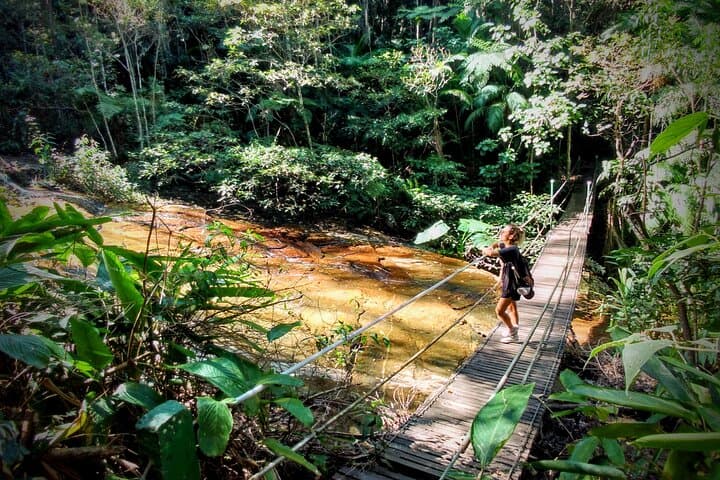
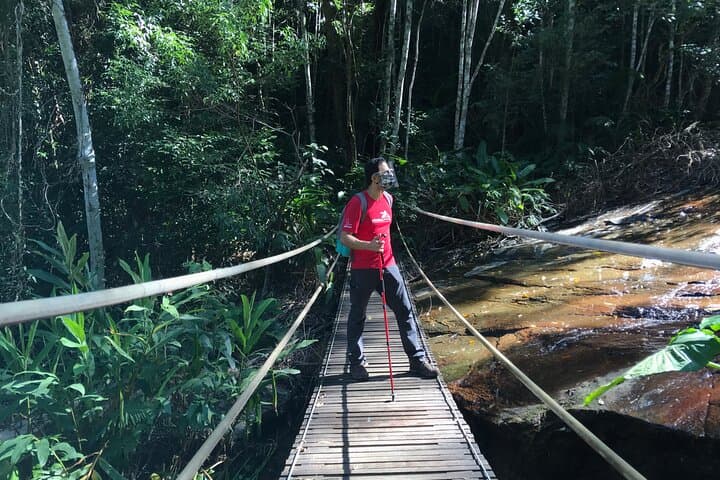
The circuit follows 19th-century firebreaks and former coffee-farm tracks, routes that shaped Rio’s expansion and the park’s replanting. Tijuca National Park is one of the largest replanted urban forests in the world; its geology is dominated by gneiss and granite outcrops that form caves and sharp ridgelines. Along the way, hikers will pass the Mayrink Chapel (mid-1800s), the Cova da Onça Bridge and the Eucalyptus area—once a burial place for enslaved people—each stop layering cultural memory onto the landscape.
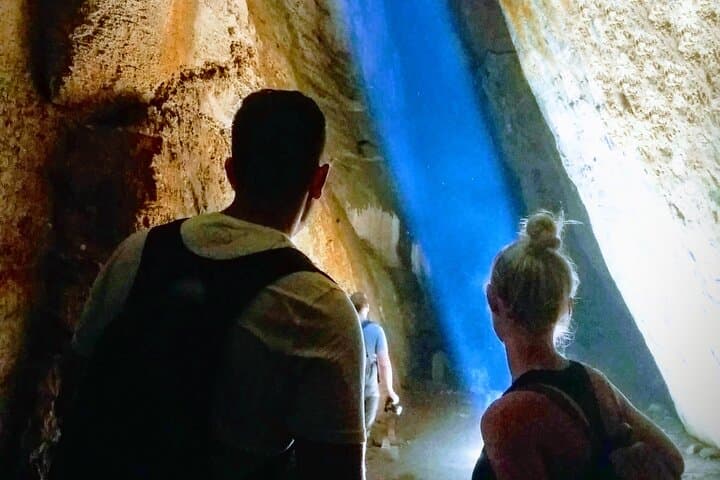
The Bat’s Grotto, carved into gneiss, highlights the park’s deep-time story while Cascatinha Taunay and Baronesa Cascade offer cold-water showers after steep uphill sections. Wildlife is active: toucans and howler monkeys announce themselves; insects and amphibians animate the understory.
Practical notes: the loop is about 6.4 km with roughly 448 m of elevation gain, three hours on the trail and moderate technical demand—sturdy shoes and 1.5–2 L of water are non-negotiable. Pickup from Rio’s South Zone is included; exact times vary by meeting point and are confirmed the evening before. The trail gets slippery in rain; guides will reschedule or cancel for safety. Go early to avoid heat and to catch the clearest views.
moderate.
3–6 hours (3h on trail; up to 6h total with transfers).
Should be comfortable with uphill hiking and uneven terrain for several hours; regular walkers or recreational hikers will manage well.
The loop is roughly 6.4 km with about 448 m elevation gain; expect around 3 hours on the trail with moderate uphill sections—suitable for people with average fitness.
Yes—pickup and drop-off from designated hotels in Rio’s South Zone (Copacabana, Ipanema, Leblon, Leme, Santa Teresa, Flamengo and Botafogo) is included; exact pickup time is confirmed the evening prior.
Children under 12 are not recommended; minors must be accompanied and the hike involves terrain unsuitable for very young participants.
The operator may reschedule or cancel the tour in heavy rain or unsafe conditions; cancellations 24 hours prior qualify for a full refund per policy.
Trails were cut in the 19th century when coffee farms occupied the area; reforestation efforts in the 19th and 20th centuries created the current urban forest.
Tijuca is an active conservation project—stay on trails, carry out waste and avoid disturbing wildlife to support the park’s recovery and visitor safety.
Jungle Me operates guided outdoor trips and adventures with an emphasis on safety, stewardship, and memorable experiences.
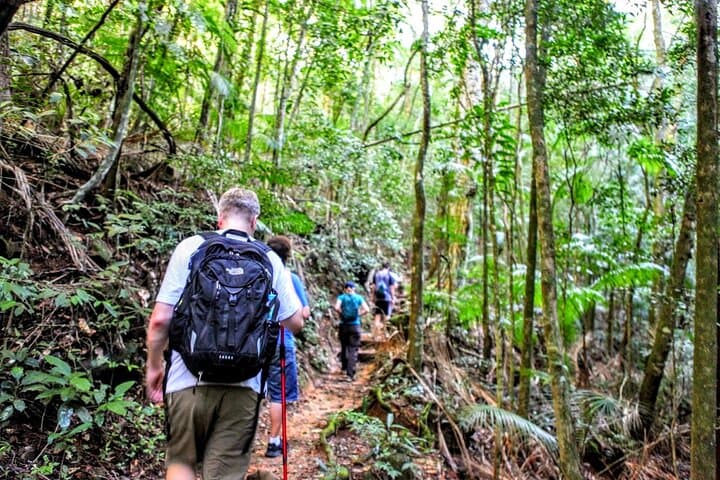
A wet wind pushes down from the ridge as the group threads a narrow trail through high canopy—the Atlantic Forest seems to test every step, leaves flicking and branches urging the pace. Early light slips through moss and fern, and within twenty minutes the distant roar of Cascatinha Taunay promises a cool end to the climb.
A wet wind pushes down from the ridge as the group threads a narrow trail through high canopy—the Atlantic Forest seems to test every step, leaves flicking and branches urging the pace. Early light slips through moss and fern, and within twenty minutes the distant roar of Cascatinha Taunay promises a cool end to the climb.
The circuit follows 19th-century firebreaks and former coffee-farm tracks, routes that shaped Rio’s expansion and the park’s replanting. Tijuca National Park is one of the largest replanted urban forests in the world; its geology is dominated by gneiss and granite outcrops that form caves and sharp ridgelines. Along the way, hikers will pass the Mayrink Chapel (mid-1800s), the Cova da Onça Bridge and the Eucalyptus area—once a burial place for enslaved people—each stop layering cultural memory onto the landscape.
The Bat’s Grotto, carved into gneiss, highlights the park’s deep-time story while Cascatinha Taunay and Baronesa Cascade offer cold-water showers after steep uphill sections. Wildlife is active: toucans and howler monkeys announce themselves; insects and amphibians animate the understory.
Practical notes: the loop is about 6.4 km with roughly 448 m of elevation gain, three hours on the trail and moderate technical demand—sturdy shoes and 1.5–2 L of water are non-negotiable. Pickup from Rio’s South Zone is included; exact times vary by meeting point and are confirmed the evening before. The trail gets slippery in rain; guides will reschedule or cancel for safety. Go early to avoid heat and to catch the clearest views.