THE ADVENTURE COLLECTIVE® · Independent discovery and booking for outdoor travel

Spend three days crossing the Salar de Uyuni and surrounding high desert: train graveyard, Colchani saltworks, Incahuasi’s cacti and the red lagoons. Expect extreme altitude, basic lodgings and otherworldly photo opportunities.
Spend three days crossing the Salar de Uyuni and surrounding high desert: train graveyard, Colchani saltworks, Incahuasi’s cacti and the red lagoons. Expect extreme altitude, basic lodgings and otherworldly photo opportunities.
A thin white horizon stretches until the sky meets it — a blank so bright it redefines distance. On day one the land opens: rusting locomotives crouch at the Train Cemetery, Colchani’s salt artisans shape bricks and handicrafts, and by afternoon the Salar de Uyuni unfolds into an endless, geometric plain.
Verified experiences and guided adventures in the surrounding area.
Operated by Skyline Traveller · Uyuni, Potosí
A thin white horizon stretches until the sky meets it — a blank so bright it redefines distance. On day one the land opens: rusting locomotives crouch at the Train Cemetery, Colchani’s salt artisans shape bricks and handicrafts, and by afternoon the Salar de Uyuni unfolds into an endless, geometric plain.
The salt flat is a remnant of prehistoric lakes that dried millennia ago, leaving a hard crust and vast lithium-rich beds atop the Altiplano at roughly 3,650 m (12,000 ft). History here is tied to trade routes and extraction: salt caravans once crossed the high plains and today cooperative workshops in Colchani show traditional harvesting techniques.
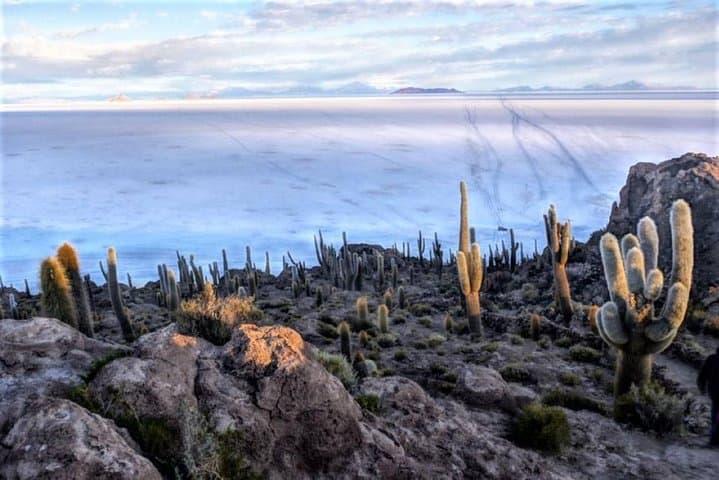
Geology rules the itinerary — polygonal salt tiles, volcanic silhouettes like Ollagüe and Licancabur, sulphur-streaked geysers, and isolated cacti-studded islands such as Incahuasi rising like stony islets. Culturally, the route threads through Aymara and Quechua landscapes; small settlements trade llama textiles and roadside vendors sell cuy or toasted corn.
Practical guidance: altitude is the real challenge. Tours move slowly to aid acclimatization, but expect daytime temperatures that swing from strong sun to sharp cold and nights in very basic lodgings, including a salt-brick hotel. Carry layered insulation, sun protection, a refillable water bottle, and small Bolivianos for park fees and tips.
Photography demands planning — the mirror effect appears after rains and can turn the flat into a glass sky, but wet sections can be impassable. Embrace the pace: the trip is less about distance than about witnessing extreme landscapes where wind, salt and heat shape everything they touch.
moderate.
3 days.
Moderate fitness recommended: able to manage long vehicle days, short hikes up to 30–60 minutes at high altitude, and daily walking over uneven ground.
Yes — the itinerary reaches 4,300–4,600 m; allow time to acclimatize, stay hydrated, avoid alcohol, and consult a doctor about preventive medication.
During the rainy season (roughly Dec–Mar) thin water layers create reflections; mornings after calm weather are best for photos.
Lodgings are basic to rustic, often with shared bathrooms and thin mattresses; one night in a salt hotel is part of many itineraries but expect limited heating.
Climbing Licancabur requires extra time, guides and high-altitude mountaineering experience; standard tours pass the volcano but do not include a summit attempt.
Uyuni grew from 19th–20th century railroad ambitions; abandoned locomotives at the Train Cemetery reflect regional trade history and shifting transport routes.
The region faces pressure from lithium extraction and tourism; stick to marked paths, avoid salt removal and support local cooperatives selling salt crafts.
Skyline Traveller operates guided outdoor trips and adventures with an emphasis on safety, stewardship, and memorable experiences.
A thin white horizon stretches until the sky meets it — a blank so bright it redefines distance. On day one the land opens: rusting locomotives crouch at the Train Cemetery, Colchani’s salt artisans shape bricks and handicrafts, and by afternoon the Salar de Uyuni unfolds into an endless, geometric plain.
A thin white horizon stretches until the sky meets it — a blank so bright it redefines distance. On day one the land opens: rusting locomotives crouch at the Train Cemetery, Colchani’s salt artisans shape bricks and handicrafts, and by afternoon the Salar de Uyuni unfolds into an endless, geometric plain.
The salt flat is a remnant of prehistoric lakes that dried millennia ago, leaving a hard crust and vast lithium-rich beds atop the Altiplano at roughly 3,650 m (12,000 ft). History here is tied to trade routes and extraction: salt caravans once crossed the high plains and today cooperative workshops in Colchani show traditional harvesting techniques.
Geology rules the itinerary — polygonal salt tiles, volcanic silhouettes like Ollagüe and Licancabur, sulphur-streaked geysers, and isolated cacti-studded islands such as Incahuasi rising like stony islets. Culturally, the route threads through Aymara and Quechua landscapes; small settlements trade llama textiles and roadside vendors sell cuy or toasted corn.
Practical guidance: altitude is the real challenge. Tours move slowly to aid acclimatization, but expect daytime temperatures that swing from strong sun to sharp cold and nights in very basic lodgings, including a salt-brick hotel. Carry layered insulation, sun protection, a refillable water bottle, and small Bolivianos for park fees and tips.
Photography demands planning — the mirror effect appears after rains and can turn the flat into a glass sky, but wet sections can be impassable. Embrace the pace: the trip is less about distance than about witnessing extreme landscapes where wind, salt and heat shape everything they touch.