THE ADVENTURE COLLECTIVE® · Independent discovery and booking for outdoor travel

Cross the High Atlas, stand inside Todra Gorge, and ride camels into the Erg Chebbi on a compact three-day loop between Marrakech and Fez. This itinerary balances dramatic desert nights with fortified kasbahs and mountain passes.
Cross the High Atlas, stand inside Todra Gorge, and ride camels into the Erg Chebbi on a compact three-day loop between Marrakech and Fez. This itinerary balances dramatic desert nights with fortified kasbahs and mountain passes.
You step out of a minibus as the High Atlas opens like a book of wind-carved pages, cold air from the passes brushing your face before the sun wins the day. The first morning route puts the kasbahs of Ait Ben Haddou in relief—mud-brick towers rising from an ochre plain—then slides toward the red-rock folds of Dades and the knife-edge walls of Todra Gorge.
Verified experiences and guided adventures in the surrounding area.
Operated by Sundunes Experience · Marrakech, Marrakech-Safi
You step out of a minibus as the High Atlas opens like a book of wind-carved pages, cold air from the passes brushing your face before the sun wins the day. The first morning route puts the kasbahs of Ait Ben Haddou in relief—mud-brick towers rising from an ochre plain—then slides toward the red-rock folds of Dades and the knife-edge walls of Todra Gorge.
This route threads Morocco’s layered history: Berber strongholds, caravan roads, and kasbah architecture that served both family and fortress. Geologically the trip moves from the folded metamorphic rocks of the Atlas into the soft, wind-sculpted dunes of the Erg Chebbi, where wind and sand converse each evening and push the horizon into new shapes.
Culture is tactile here—shared tagine dinners, the slow cadence of camel steps, and the Berber campfire conversations under a sky that seems to press its stars closer. Local insights include bargaining customs in roadside villages and modest dress for conservative towns.
Practical guidance: the tour is long-drive heavy but low technical demand; bring sun protection and layered clothing for cool desert nights. Hydrate on driving days and allow time to stretch at canyon viewpoints. Footwear should handle short rocky walks and loose sand for the camel approach.
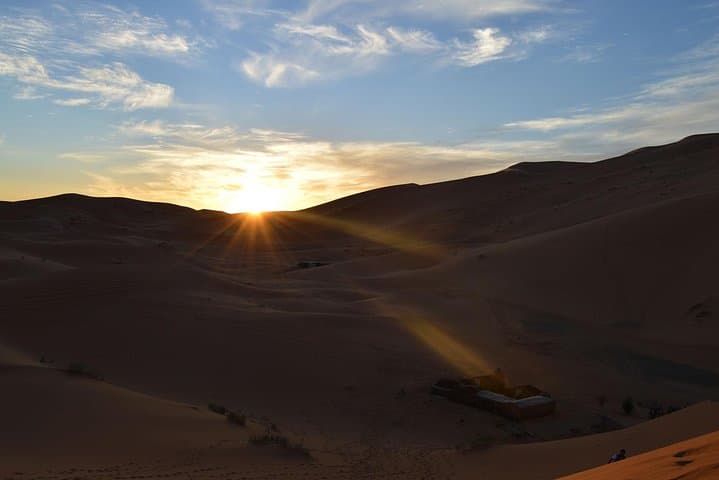
Timing matters—sunset in the dunes is the aim of day two; arriving early gives you light to photograph and time to settle into the camp. Respect local etiquette, pack out trash from camps, and prepare for early starts on mountain passes.
moderate.
3 days.
Suitable for travelers in normal physical condition—able to manage short walks, camel saddle transfers, and multi-hour drives.
Expect several hours on day one across the Atlas to Dades, a medium drive to Merzouga on day two, and a longer transfer toward Fez on day three—plan for multiple stops to stretch and photograph.
No special skills are required; camels kneel for mounting and guides assist—you should be comfortable with short periods seated and able to climb down from the saddle.
Nights alternate between comfortable guesthouses with ensuites and authentic Berber camps in the dunes—camps provide shared or private tents depending on the booking.
The tour includes specified breakfasts and dinners; lunches are usually at local restaurants where you can choose from set menus (budget about €8–€10).
The route follows sections of historic caravan corridors where kasbahs functioned as family fortresses and trade depots; Ait Ben Haddou is a UNESCO site that illustrates traditional mud-brick construction.
Dune camps are sensitive to waste and water use—choose operators who follow leave-no-trace practices and support local conservation initiatives.
Sundunes Experience operates guided outdoor trips and adventures with an emphasis on safety, stewardship, and memorable experiences.


You step out of a minibus as the High Atlas opens like a book of wind-carved pages, cold air from the passes brushing your face before the sun wins the day. The first morning route puts the kasbahs of Ait Ben Haddou in relief—mud-brick towers rising from an ochre plain—then slides toward the red-rock folds of Dades and the knife-edge walls of Todra Gorge.
You step out of a minibus as the High Atlas opens like a book of wind-carved pages, cold air from the passes brushing your face before the sun wins the day. The first morning route puts the kasbahs of Ait Ben Haddou in relief—mud-brick towers rising from an ochre plain—then slides toward the red-rock folds of Dades and the knife-edge walls of Todra Gorge.
This route threads Morocco’s layered history: Berber strongholds, caravan roads, and kasbah architecture that served both family and fortress. Geologically the trip moves from the folded metamorphic rocks of the Atlas into the soft, wind-sculpted dunes of the Erg Chebbi, where wind and sand converse each evening and push the horizon into new shapes.
Culture is tactile here—shared tagine dinners, the slow cadence of camel steps, and the Berber campfire conversations under a sky that seems to press its stars closer. Local insights include bargaining customs in roadside villages and modest dress for conservative towns.
Practical guidance: the tour is long-drive heavy but low technical demand; bring sun protection and layered clothing for cool desert nights. Hydrate on driving days and allow time to stretch at canyon viewpoints. Footwear should handle short rocky walks and loose sand for the camel approach.
Timing matters—sunset in the dunes is the aim of day two; arriving early gives you light to photograph and time to settle into the camp. Respect local etiquette, pack out trash from camps, and prepare for early starts on mountain passes.