THE ADVENTURE COLLECTIVE® · Independent discovery and booking for outdoor travel

A compact 3‑day route from Hanoi that pairs the thunder of Ban Gioc with the calm of Ba Be Lake. Expect long drives, short hikes, motorbike loops and homestays that put you close to karst cliffs and living local culture.
A compact 3‑day route from Hanoi that pairs the thunder of Ban Gioc with the calm of Ba Be Lake. Expect long drives, short hikes, motorbike loops and homestays that put you close to karst cliffs and living local culture.
Dawn finds you on the highway out of Hanoi, the city shrinking behind a rising wall of limestone ridges and rice terraces. By late afternoon you’re skirting Ba Be Lake, where the water pushes cool air into the valleys and bamboo rafts cut slow arcs on still water. The second day is defined by Ban Gioc—cascades that thunder across the China–Vietnam border, spray painting nearby cliffs with moss. Between waterfalls and caves, motorbike tracks climb to Wind Pass and Pac Bo, a plain-rock cave of modern history.
Verified experiences and guided adventures in the surrounding area.
Operated by Red Gecko Travel · Cao Bang, Cao Bang Province
Dawn finds you on the highway out of Hanoi, the city shrinking behind a rising wall of limestone ridges and rice terraces. By late afternoon you’re skirting Ba Be Lake, where the water pushes cool air into the valleys and bamboo rafts cut slow arcs on still water. The second day is defined by Ban Gioc—cascades that thunder across the China–Vietnam border, spray painting nearby cliffs with moss. Between waterfalls and caves, motorbike tracks climb to Wind Pass and Pac Bo, a plain-rock cave of modern history.
Geology here is dramatic: karst towers and underground streams carved in limestone, producing plunge pools and fluted cliffs. Culturally, the region is home to Tay, Nung and Hmong communities—homestays offer river-side dinners and simple rooms. Pac Bo Cave is historically notable as a place Ho Chi Minh used after returning to Vietnam in 1941, giving the landscape an added layer of national memory.
Practical guide: the loop runs about 300–350 km round-trip from Hanoi with long transfers each day—expect 4–7 hours of driving between stops. Trails and viewpoints are short but uneven; bring waterproof layers for sudden storms and shoes with grip for slippery rocks at Ban Gioc. Carry cash—remote villages have limited card acceptance—and a basic first-aid kit. Best months are March–May and September–November when water is high and roads less muddy. Respect local customs at homestays, keep a safe distance from fast river currents, and plan for early starts to avoid the midday heat on motorbike segments. The trip balances big-water scenery with quiet boat time—practical planning rewards the experience.
moderate.
3 days (approx. 72 hours).
Basic fitness for short walks, boarding small boats and a few uneven paths; comfortable with several hours of travel per day.
Expect roughly 4–7 hours each way depending on traffic and stops; roads are mountainous and slower than highways.
Homestays vary from simple to basic guesthouses—most offer clean beds and shared bathrooms with a strong emphasis on local meals and hospitality.
The tour includes boat rides, short walks and some uneven terrain; it’s generally family-friendly but not wheelchair accessible—check with the operator for children’s policies.
No special permits are required to view Ban Gioc from the Vietnamese side, but you must remain on the Vietnam side; carry your passport when traveling between provinces.
Pac Bo Cave is historically significant as a 1941 refuge when Ho Chi Minh returned to Vietnam; the border landscape also shaped trade and cultural exchange with China.
High visitor numbers and litter can impact riverbanks and karst vegetation; stick to marked paths, avoid single-use plastics and support local homestays that practice low-impact tourism.
Red Gecko Travel operates guided outdoor trips and adventures with an emphasis on safety, stewardship, and memorable experiences.



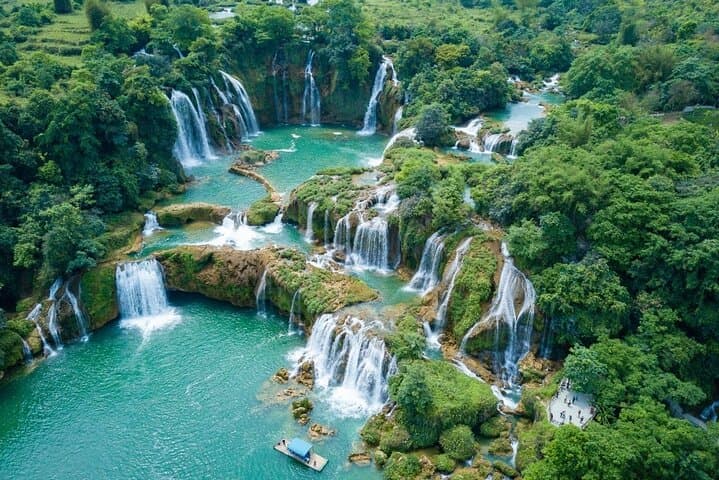
Dawn finds you on the highway out of Hanoi, the city shrinking behind a rising wall of limestone ridges and rice terraces. By late afternoon you’re skirting Ba Be Lake, where the water pushes cool air into the valleys and bamboo rafts cut slow arcs on still water. The second day is defined by Ban Gioc—cascades that thunder across the China–Vietnam border, spray painting nearby cliffs with moss. Between waterfalls and caves, motorbike tracks climb to Wind Pass and Pac Bo, a plain-rock cave of modern history.
Dawn finds you on the highway out of Hanoi, the city shrinking behind a rising wall of limestone ridges and rice terraces. By late afternoon you’re skirting Ba Be Lake, where the water pushes cool air into the valleys and bamboo rafts cut slow arcs on still water. The second day is defined by Ban Gioc—cascades that thunder across the China–Vietnam border, spray painting nearby cliffs with moss. Between waterfalls and caves, motorbike tracks climb to Wind Pass and Pac Bo, a plain-rock cave of modern history.
Geology here is dramatic: karst towers and underground streams carved in limestone, producing plunge pools and fluted cliffs. Culturally, the region is home to Tay, Nung and Hmong communities—homestays offer river-side dinners and simple rooms. Pac Bo Cave is historically notable as a place Ho Chi Minh used after returning to Vietnam in 1941, giving the landscape an added layer of national memory.
Practical guide: the loop runs about 300–350 km round-trip from Hanoi with long transfers each day—expect 4–7 hours of driving between stops. Trails and viewpoints are short but uneven; bring waterproof layers for sudden storms and shoes with grip for slippery rocks at Ban Gioc. Carry cash—remote villages have limited card acceptance—and a basic first-aid kit. Best months are March–May and September–November when water is high and roads less muddy. Respect local customs at homestays, keep a safe distance from fast river currents, and plan for early starts to avoid the midday heat on motorbike segments. The trip balances big-water scenery with quiet boat time—practical planning rewards the experience.