THE ADVENTURE COLLECTIVE® · Independent discovery and booking for outdoor travel

Paddle the dark channels of Cocoa Beach’s Thousand Islands and watch living light trace every stroke. This guided, seasonal night tour highlights bioluminescent dinoflagellates and comb jellies — best during new moons and warm summer months.
Paddle the dark channels of Cocoa Beach’s Thousand Islands and watch living light trace every stroke. This guided, seasonal night tour highlights bioluminescent dinoflagellates and comb jellies — best during new moons and warm summer months.
The air is warm and still as you push off into the black water; the kayak parts the surface and a trailing ribbon of blue light blooms where your paddle cuts through. Out here in the Thousand Islands — a scattering of mangrove islets and shallow channels off Cocoa Beach — the lagoon feels like a living map of motion. Comb jellies and dinoflagellates glow with every ripple, daring you to move deliberately and watch closely.
Verified experiences and guided adventures in the surrounding area.
Operated by Cocoa Kayaking · Cocoa Beach, Florida
The air is warm and still as you push off into the black water; the kayak parts the surface and a trailing ribbon of blue light blooms where your paddle cuts through. Out here in the Thousand Islands — a scattering of mangrove islets and shallow channels off Cocoa Beach — the lagoon feels like a living map of motion. Comb jellies and dinoflagellates glow with every ripple, daring you to move deliberately and watch closely.
The Thousand Islands sit along the Indian River Lagoon, a biologically rich estuary shaped by sea-level shifts and tidal flow. Indigenous peoples and later coastal settlers used these protected waters for food and transport; today the Space Coast’s launch pads rise on the horizon, reminding paddlers of the region’s layered history. Geologically, the islands are sandbars and mangrove roots holding sediments in place, forming tight channels ideal for quiet, guided paddles.
Practically: tours run seasonally (best July–mid-October) and perform strongest around new moons when artificial and lunar light are low. Guides provide single kayaks or tandems, PFDs, and paddles; expect two hours from check-in to return. The water is shallow and protected, but night paddling rewards steady balance and calm breathing. Bring a headlamp with a red filter, hydrate beforehand, and wear quick-drying layers. Keep lights low and movements smooth — the glow is fragile and reacts to disturbance.
This trip is equal parts science and sensory thrill: you learn about nocturnal marine life while watching the water respond to your presence. For photographers, a tripod-mounted long-exposure from shore can capture the effect; on the water, the show is best experienced with eyes open and hands quiet.
easy.
2 hours.
Light aerobic fitness; comfortable sitting and basic paddling stamina for up to two hours.
Seasonal peak in this area is July through mid-October; warm water and low moonlight amplify the display.
Yes — tours are rated easy and guides provide instruction; infants must sit on laps per operator policy.
Bioluminescence is a natural phenomenon that fluctuates; operators typically note this in policies and may cancel for weather but not for variable organism activity.
You can bring a camera, but long-exposure shots are easier from shore; on-water photos require steady hands and minimal light to capture the effect.
The Thousand Islands fringe the Indian River Lagoon, one of North America’s most biodiverse estuaries; the area also sits within Florida’s Space Coast, where 20th-century rocket launches reshaped the skyline.
Bioluminescent organisms are sensitive to light and nutrient pollution; keep noise and light low, avoid using soaps in the water, and follow guide instructions to minimize disturbance.
Cocoa Kayaking operates guided outdoor trips and adventures with an emphasis on safety, stewardship, and memorable experiences.

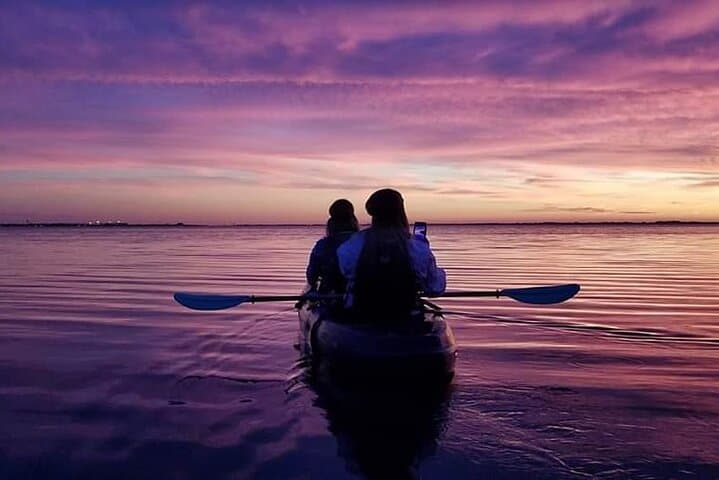


The air is warm and still as you push off into the black water; the kayak parts the surface and a trailing ribbon of blue light blooms where your paddle cuts through. Out here in the Thousand Islands — a scattering of mangrove islets and shallow channels off Cocoa Beach — the lagoon feels like a living map of motion. Comb jellies and dinoflagellates glow with every ripple, daring you to move deliberately and watch closely.
The air is warm and still as you push off into the black water; the kayak parts the surface and a trailing ribbon of blue light blooms where your paddle cuts through. Out here in the Thousand Islands — a scattering of mangrove islets and shallow channels off Cocoa Beach — the lagoon feels like a living map of motion. Comb jellies and dinoflagellates glow with every ripple, daring you to move deliberately and watch closely.
The Thousand Islands sit along the Indian River Lagoon, a biologically rich estuary shaped by sea-level shifts and tidal flow. Indigenous peoples and later coastal settlers used these protected waters for food and transport; today the Space Coast’s launch pads rise on the horizon, reminding paddlers of the region’s layered history. Geologically, the islands are sandbars and mangrove roots holding sediments in place, forming tight channels ideal for quiet, guided paddles.
Practically: tours run seasonally (best July–mid-October) and perform strongest around new moons when artificial and lunar light are low. Guides provide single kayaks or tandems, PFDs, and paddles; expect two hours from check-in to return. The water is shallow and protected, but night paddling rewards steady balance and calm breathing. Bring a headlamp with a red filter, hydrate beforehand, and wear quick-drying layers. Keep lights low and movements smooth — the glow is fragile and reacts to disturbance.
This trip is equal parts science and sensory thrill: you learn about nocturnal marine life while watching the water respond to your presence. For photographers, a tripod-mounted long-exposure from shore can capture the effect; on the water, the show is best experienced with eyes open and hands quiet.