THE ADVENTURE COLLECTIVE® · Independent discovery and booking for outdoor travel

Climb from Antalya’s coast into pine-scented hills to walk the ancient city of Termessos and descend into Karain Cave’s Paleolithic chambers. This half-day tour pairs mountain ruins with prehistoric archaeology for a concise, compelling glimpse of Anatolia’s past.
Climb from Antalya’s coast into pine-scented hills to walk the ancient city of Termessos and descend into Karain Cave’s Paleolithic chambers. This half-day tour pairs mountain ruins with prehistoric archaeology for a concise, compelling glimpse of Anatolia’s past.
You arrive before the heat peaks, the air sharp with pine resin and the salt of the distant Mediterranean. A narrow mountain road climbs from Antalya and, within half an hour, the city’s skyline is replaced by jagged limestone ridges. High above the plain, the stone ruins of Termessos sit as they have for two millennia, carved into the flank of Güllük Dağı with amphitheater rows looking over a valley of scrub and cedar.
Verified experiences and guided adventures in the surrounding area.
Operated by Laledi Tur · Antalya, Antalya Province
You arrive before the heat peaks, the air sharp with pine resin and the salt of the distant Mediterranean. A narrow mountain road climbs from Antalya and, within half an hour, the city’s skyline is replaced by jagged limestone ridges. High above the plain, the stone ruins of Termessos sit as they have for two millennia, carved into the flank of Güllük Dağı with amphitheater rows looking over a valley of scrub and cedar.
Termessos was a Pisidian stronghold that resisted Alexander the Great; its rock-cut tombs, necropolis terraces and the amphitheater still speak to a Hellenistic and Roman past. Karain Cave, lower on the coastal side, flips the script: a deep limestone cavern where Paleolithic tools and bone fragments show continuous human presence dating back tens of thousands of years. Geology here is blunt — karstified limestone, caves, and steep gullies — shaped by ancient seas and modern winter torrents.
Culturally, the route ties Antalya’s classical ruins to its prehistory; guides often point out Ottoman shepherd trails that now serve as walking routes. Practical note: expect rocky, uneven ground at Termessos and damp, slippery floors in Karain; both sites require short hikes and steady footing. Carry water, closed-toe shoes with grip, sun protection, and a light layer for cooler cave air. Photography is rewarding but respect signs and barriers — both sites prioritize preservation.
This half-day loop blends archaeology and spelunking into a compact window on Anatolia’s long human story, best enjoyed early in the day or late afternoon when light renders the stone warm and the crowds thin.
moderate.
4–5 hours.
Moderate fitness: comfortable walking on uneven ground, short uphill sections and stairs are required
The tour runs about 4.5 hours (270 minutes), typically covering Termessos first then Karain Cave with guide-led stops.
The tour is broadly suitable for people of average mobility, but uneven terrain and cave steps may be challenging for young children or those with limited mobility.
Admission to Termessos and Karain Cave is usually not included—confirm with your operator before booking as policies vary.
Photography is allowed in many areas, but flash or touching displays may be restricted—follow onsite signage and guide instructions.
Termessos was a Pisidian city that resisted conquest by Alexander the Great; Karain Cave has yielded Paleolithic human artifacts showing early Anatolian habitation.
Both sites are protected; stay on marked paths, avoid touching artifacts, and carry out any trash—local preservation efforts rely on visitor responsibility.
Laledi Tur operates guided outdoor trips and adventures with an emphasis on safety, stewardship, and memorable experiences.

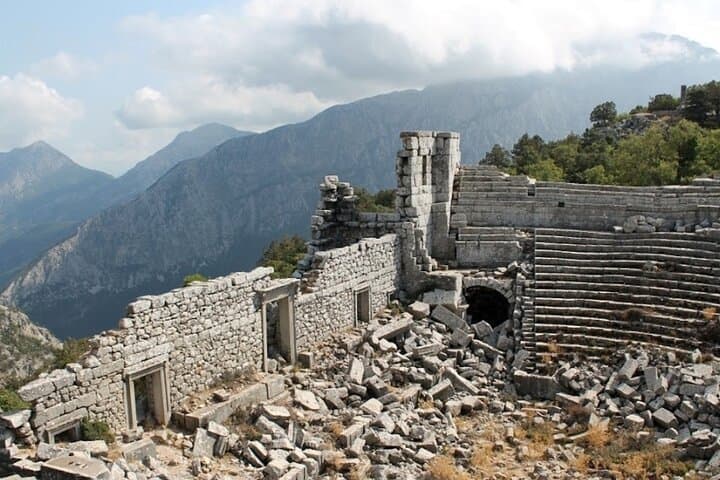


You arrive before the heat peaks, the air sharp with pine resin and the salt of the distant Mediterranean. A narrow mountain road climbs from Antalya and, within half an hour, the city’s skyline is replaced by jagged limestone ridges. High above the plain, the stone ruins of Termessos sit as they have for two millennia, carved into the flank of Güllük Dağı with amphitheater rows looking over a valley of scrub and cedar.
You arrive before the heat peaks, the air sharp with pine resin and the salt of the distant Mediterranean. A narrow mountain road climbs from Antalya and, within half an hour, the city’s skyline is replaced by jagged limestone ridges. High above the plain, the stone ruins of Termessos sit as they have for two millennia, carved into the flank of Güllük Dağı with amphitheater rows looking over a valley of scrub and cedar.
Termessos was a Pisidian stronghold that resisted Alexander the Great; its rock-cut tombs, necropolis terraces and the amphitheater still speak to a Hellenistic and Roman past. Karain Cave, lower on the coastal side, flips the script: a deep limestone cavern where Paleolithic tools and bone fragments show continuous human presence dating back tens of thousands of years. Geology here is blunt — karstified limestone, caves, and steep gullies — shaped by ancient seas and modern winter torrents.
Culturally, the route ties Antalya’s classical ruins to its prehistory; guides often point out Ottoman shepherd trails that now serve as walking routes. Practical note: expect rocky, uneven ground at Termessos and damp, slippery floors in Karain; both sites require short hikes and steady footing. Carry water, closed-toe shoes with grip, sun protection, and a light layer for cooler cave air. Photography is rewarding but respect signs and barriers — both sites prioritize preservation.
This half-day loop blends archaeology and spelunking into a compact window on Anatolia’s long human story, best enjoyed early in the day or late afternoon when light renders the stone warm and the crowds thin.