THE ADVENTURE COLLECTIVE® · Independent discovery and booking for outdoor travel

Take a thoughtful half-day trip from Prague to the Small Fortress in Terezín. This guided tour with transfer and mobile audio walks you through the town’s garrison origins and its tragic role as Theresienstadt during WWII.
Take a thoughtful half-day trip from Prague to the Small Fortress in Terezín. This guided tour with transfer and mobile audio walks you through the town’s garrison origins and its tragic role as Theresienstadt during WWII.
You step off the minibus into a pale-brick town where ramparts cut the light into hard lines and the river beyond seems to watch. Cold air can feel like a presence here; the stone keeps stories. The walk through the Small Fortress follows corridors once used for garrison duty and later pressed into the machinery of a Nazi camp — plaques, cells and rooms that hold testimony more than explanation.
Verified experiences and guided adventures in the surrounding area.
Operated by Get Prague Guide · Terezín, Ústí nad Labem Region
You step off the minibus into a pale-brick town where ramparts cut the light into hard lines and the river beyond seems to watch. Cold air can feel like a presence here; the stone keeps stories. The walk through the Small Fortress follows corridors once used for garrison duty and later pressed into the machinery of a Nazi camp — plaques, cells and rooms that hold testimony more than explanation.
Built in the late 18th century under Emperor Joseph II, Terezín was originally designed as a fortified garrison town. In World War II the Nazis renamed it Theresienstadt and transformed parts of the town into a concentration camp and transit ghetto beginning in 1941, using existing barracks, prisons and the town’s infrastructure to house, deport and exploit thousands of Jewish people. The site now balances museum rooms and preserved prison spaces with quiet exterior ramparts and views over the Labe (Elbe) valley.
On this half-day outing you’ll leave central Prague, spend roughly an hour each way on the road, and get a one-hour guided walk inside the Small Fortress plus audio-guided context for the wider history. Expect cobbles, narrow passages, and moments that require quiet and respect. Practical notes: bring headphones for the mobile audio guide, wear sturdy shoes and layered clothing, and allow extra time for reflection between exhibits. The experience is historically heavy but essential for understanding the region’s wartime history and how memory occupies place.
easy.
4–5 hours.
Suitable for most fitness levels; expect up to 2 hours of walking on uneven ground and stairs.
The full experience runs about 4–5 hours, including roughly one hour each way on the minibus and a 1–2 hour visit in Terezín.
Yes — the online audio guide is offered in English, German, French, Italian, Spanish, Czech, Polish and Simplified Chinese.
Yes, but children must be accompanied by an adult; content is historically heavy and may not be suitable for very young visitors.
Parts of the site have stairs and uneven ground; contact the operator in advance for specifics and potential accommodations.
Terezín was constructed in the 1780s by Emperor Joseph II as a fortified garrison; in WWII the Nazis converted parts into the Theresienstadt ghetto and camp beginning in 1941.
The site is both museum and memorial — visitors are asked not to touch artifacts, to follow signage, and to support preservation through respectful behavior and donations to local heritage programs.
Get Prague Guide operates guided outdoor trips and adventures with an emphasis on safety, stewardship, and memorable experiences.
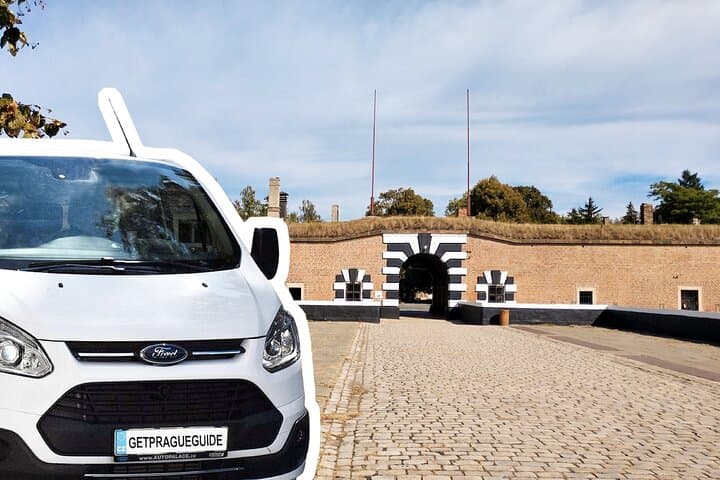


You step off the minibus into a pale-brick town where ramparts cut the light into hard lines and the river beyond seems to watch. Cold air can feel like a presence here; the stone keeps stories. The walk through the Small Fortress follows corridors once used for garrison duty and later pressed into the machinery of a Nazi camp — plaques, cells and rooms that hold testimony more than explanation.
You step off the minibus into a pale-brick town where ramparts cut the light into hard lines and the river beyond seems to watch. Cold air can feel like a presence here; the stone keeps stories. The walk through the Small Fortress follows corridors once used for garrison duty and later pressed into the machinery of a Nazi camp — plaques, cells and rooms that hold testimony more than explanation.
Built in the late 18th century under Emperor Joseph II, Terezín was originally designed as a fortified garrison town. In World War II the Nazis renamed it Theresienstadt and transformed parts of the town into a concentration camp and transit ghetto beginning in 1941, using existing barracks, prisons and the town’s infrastructure to house, deport and exploit thousands of Jewish people. The site now balances museum rooms and preserved prison spaces with quiet exterior ramparts and views over the Labe (Elbe) valley.
On this half-day outing you’ll leave central Prague, spend roughly an hour each way on the road, and get a one-hour guided walk inside the Small Fortress plus audio-guided context for the wider history. Expect cobbles, narrow passages, and moments that require quiet and respect. Practical notes: bring headphones for the mobile audio guide, wear sturdy shoes and layered clothing, and allow extra time for reflection between exhibits. The experience is historically heavy but essential for understanding the region’s wartime history and how memory occupies place.