THE ADVENTURE COLLECTIVE® · Independent discovery and booking for outdoor travel

Explore the Temple Mount with a licensed private guide who unpacks centuries of religion, archaeology, and contemporary politics in 2–3 hours. Expect security checks, modest dress, and tightly controlled visiting windows—your guide handles timing and context.
Explore the Temple Mount with a licensed private guide who unpacks centuries of religion, archaeology, and contemporary politics in 2–3 hours. Expect security checks, modest dress, and tightly controlled visiting windows—your guide handles timing and context.
Stone streets give way to an elevated plaza where history insists on being felt: the air hums with calls to prayer and the sun presses on ancient limestone, while a licensed guide parses layers of faith and politics across two intense hours. Visitors move through a living archaeological book—walls that once contained Solomon's Temple, later Islamic shrines, and modern tensions—each stone carrying a different story.
Verified experiences and guided adventures in the surrounding area.
Operated by Nissim Slama - Guide et Conférencier - Tour Guide & Lecturer · Jerusalem, Jerusalem
Stone streets give way to an elevated plaza where history insists on being felt: the air hums with calls to prayer and the sun presses on ancient limestone, while a licensed guide parses layers of faith and politics across two intense hours. Visitors move through a living archaeological book—walls that once contained Solomon's Temple, later Islamic shrines, and modern tensions—each stone carrying a different story.
The Temple Mount (Haram al-Sharif) is the holiest site in Judaism and one of Islam’s most revered places; the Dome of the Rock marks a sacred bedrock that has been a focal point for pilgrimage and contention for millennia. Geology matters here too: Jerusalem’s soft limestone has preserved archaeological strata and forced builders to terrace the summit, producing the high plaza and its retaining walls. The result is a site where religion, archaeology, and contemporary geopolitics meet in tight, charged spaces.
A private guided visit peels back those layers: expect contextual talks on history, archaeology, current events, and the site's role in Palestinian and Israeli identity. Practicalities matter—entry is regulated, security screenings are routine, and non-Muslim visiting hours can be restricted; your guide navigates permissions and timing.
For an efficient visit bring modest, breathable clothing, sturdy walking shoes for uneven flagstones, water, and photo etiquette that respects worshippers. The tour’s 2–3 hour rhythm lets you absorb the plaza’s architecture and adjacent sites—the Western Wall and Davidson Center—without rushing. This is a compact, intense encounter with one of the world’s most consequential urban landscapes.
easy.
2–3 hours.
Suitable for most fitness levels; requires standing and walking on paved and uneven surfaces for extended periods
Yes, but visiting hours for non-Muslims are limited and access can be closed with little notice; guides will check current rules and plan timing accordingly.
Expect multiple security screenings and metal detectors; certain items and behavior may be restricted—follow guide instructions for a smooth entry.
The tour lists wheelchair-accessible options, but some areas have steps and uneven surfaces; contact the operator in advance to confirm specific access needs.
Mobile tickets are accepted, but you should bring a passport or government ID for security; the tour is private and booked per reservation.
The plateau has been a religious and civic focal point for millennia—associated with the biblical Mount Moriah, the Umayyad Dome of the Rock (7th century), and complex custodial arrangements that reflect centuries of competing claims.
Heavy visitor traffic and political pressures strain fragile archaeological surfaces; stay on designated paths, avoid leaning on ancient masonry, and follow guide directions to minimize impact.
Nissim Slama - Guide et Conférencier - Tour Guide & Lecturer operates guided outdoor trips and adventures with an emphasis on safety, stewardship, and memorable experiences.
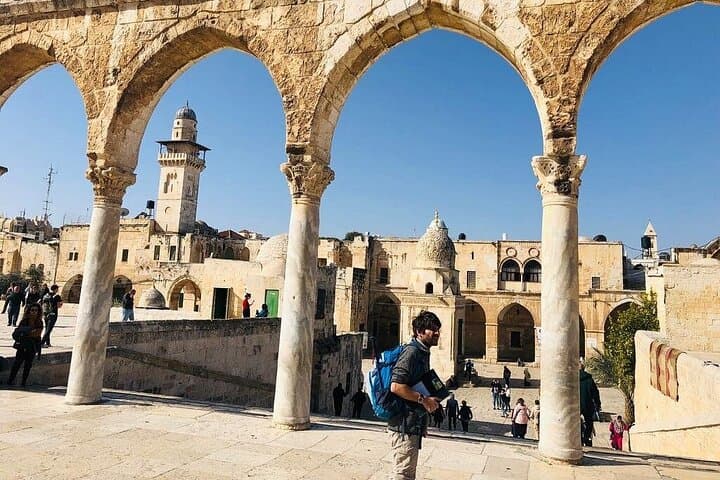
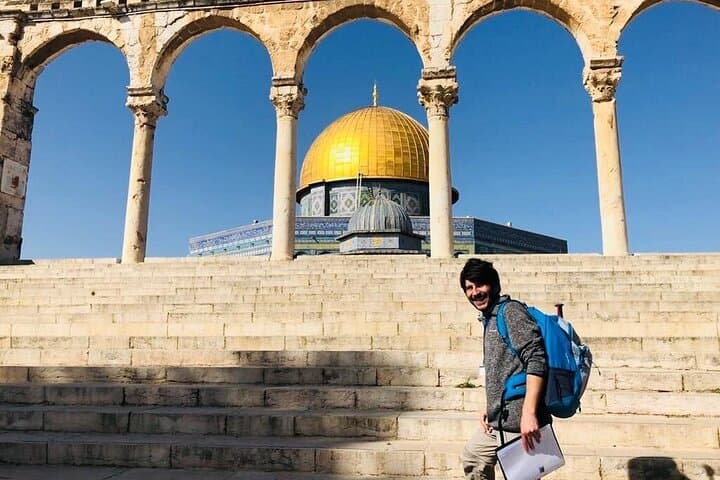
Stone streets give way to an elevated plaza where history insists on being felt: the air hums with calls to prayer and the sun presses on ancient limestone, while a licensed guide parses layers of faith and politics across two intense hours. Visitors move through a living archaeological book—walls that once contained Solomon's Temple, later Islamic shrines, and modern tensions—each stone carrying a different story.
Stone streets give way to an elevated plaza where history insists on being felt: the air hums with calls to prayer and the sun presses on ancient limestone, while a licensed guide parses layers of faith and politics across two intense hours. Visitors move through a living archaeological book—walls that once contained Solomon's Temple, later Islamic shrines, and modern tensions—each stone carrying a different story.
The Temple Mount (Haram al-Sharif) is the holiest site in Judaism and one of Islam’s most revered places; the Dome of the Rock marks a sacred bedrock that has been a focal point for pilgrimage and contention for millennia. Geology matters here too: Jerusalem’s soft limestone has preserved archaeological strata and forced builders to terrace the summit, producing the high plaza and its retaining walls. The result is a site where religion, archaeology, and contemporary geopolitics meet in tight, charged spaces.
A private guided visit peels back those layers: expect contextual talks on history, archaeology, current events, and the site's role in Palestinian and Israeli identity. Practicalities matter—entry is regulated, security screenings are routine, and non-Muslim visiting hours can be restricted; your guide navigates permissions and timing.
For an efficient visit bring modest, breathable clothing, sturdy walking shoes for uneven flagstones, water, and photo etiquette that respects worshippers. The tour’s 2–3 hour rhythm lets you absorb the plaza’s architecture and adjacent sites—the Western Wall and Davidson Center—without rushing. This is a compact, intense encounter with one of the world’s most consequential urban landscapes.