THE ADVENTURE COLLECTIVE® · Independent discovery and booking for outdoor travel

Spend a long day from Tbilisi exploring mineral springs, a multi-faith fortress and the cliff-cut cave city of Vardzia. This guided route combines geology, medieval history and forested walks into a single full-day itinerary.
Spend a long day from Tbilisi exploring mineral springs, a multi-faith fortress and the cliff-cut cave city of Vardzia. This guided route combines geology, medieval history and forested walks into a single full-day itinerary.
Morning light lifts off the roadside pines as a small coach threads south from Tbilisi toward Georgia’s limestone spine. By midday the air smells of mineral springs and wood smoke; you stand under the watchful tiers of Rabati’s towers, then later trace the carved galleries of Vardzia where cliffs seem to hold their breath.
Verified experiences and guided adventures in the surrounding area.
Operated by Vitis Travel · Borjomi, Samtskhe–Javakheti
Morning light lifts off the roadside pines as a small coach threads south from Tbilisi toward Georgia’s limestone spine. By midday the air smells of mineral springs and wood smoke; you stand under the watchful tiers of Rabati’s towers, then later trace the carved galleries of Vardzia where cliffs seem to hold their breath.
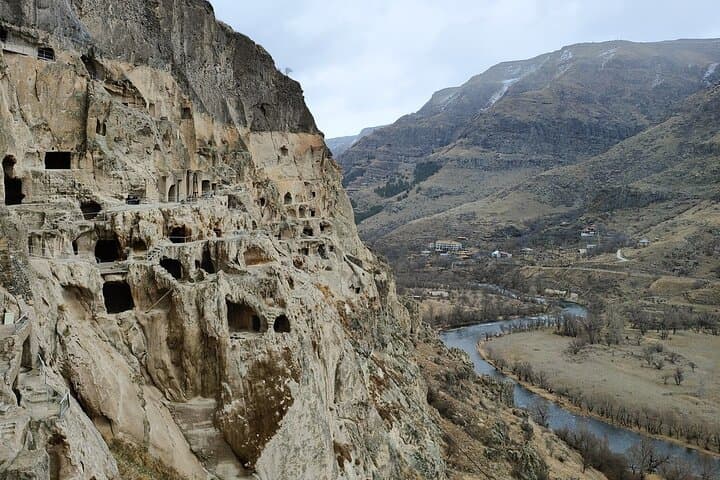
Vardzia’s cave city dates to the 12th century and was both monastery and refuge, carved into volcanic tuff along the Kura River’s tributaries. Rabati Fortress in Akhaltsikhe layers Ottoman, Armenian and Georgian architecture—mosque domes and orthodox churches sharing a single courtyard. Borjomi, fed by tectonic springs, has drawn visitors since the Russian imperial era for its naturally carbonated water and forested walking trails. Geology here is active: river-cut gorges, welded tuff cliffs and thermal outflows shape both landscape and culture.
Expect a mix of paved paths, stone steps and uneven cave galleries; guides explain frescoes, defensive passages and local winemaking cellars. The day is long—transport between sites takes most of the morning and late afternoon—but each stop rewards slow exploration: tasting mineral water, climbing Rabati’s ramparts, squeezing into Vardzia’s chapels.
Practicalities: entrance fees are modest and paid on site; wear grippy walking shoes and layers for cool caves and warmer valley sun. Bring water, a light rain layer, and a camera with spare battery. If you have limited mobility, some cave sections and fortress towers require steady footing. Time your tour for clear weather to get the best views and avoid wet, slippery steps.
moderate.
14 hours.
Moderate fitness required: able to walk on uneven ground, climb stairs and stand for extended periods.
The drive from central Tbilisi to Borjomi or Akhaltsikhe takes roughly 2.5–3.5 hours depending on traffic and route; expect the full day to be about 12–14 hours including stops.
Entrance fees for Rabati and Vardzia are typically paid on site (around 17 GEL / ~6 EUR each); transport and guiding are included in the tour price.
Infants and small children can join, but Vardzia’s caves and some fortress areas are not stroller-friendly—carriers are recommended for cave sections.
The tour requires climbing stairs and walking on uneven surfaces; it’s not recommended for travelers with serious mobility limitations or spinal/heart conditions.
This corridor of southern Georgia was a medieval crossroads—Vardzia served as a monastic stronghold during Queen Tamar’s era, while Rabati reflects Ottoman and Russian-period layers.
Borjomi National Park is protected; stick to marked trails, avoid collecting mineral spring water in single-use plastics and follow local guidelines to minimize erosion and waste.
Vitis Travel operates guided outdoor trips and adventures with an emphasis on safety, stewardship, and memorable experiences.


Morning light lifts off the roadside pines as a small coach threads south from Tbilisi toward Georgia’s limestone spine. By midday the air smells of mineral springs and wood smoke; you stand under the watchful tiers of Rabati’s towers, then later trace the carved galleries of Vardzia where cliffs seem to hold their breath.
Morning light lifts off the roadside pines as a small coach threads south from Tbilisi toward Georgia’s limestone spine. By midday the air smells of mineral springs and wood smoke; you stand under the watchful tiers of Rabati’s towers, then later trace the carved galleries of Vardzia where cliffs seem to hold their breath.
Vardzia’s cave city dates to the 12th century and was both monastery and refuge, carved into volcanic tuff along the Kura River’s tributaries. Rabati Fortress in Akhaltsikhe layers Ottoman, Armenian and Georgian architecture—mosque domes and orthodox churches sharing a single courtyard. Borjomi, fed by tectonic springs, has drawn visitors since the Russian imperial era for its naturally carbonated water and forested walking trails. Geology here is active: river-cut gorges, welded tuff cliffs and thermal outflows shape both landscape and culture.
Expect a mix of paved paths, stone steps and uneven cave galleries; guides explain frescoes, defensive passages and local winemaking cellars. The day is long—transport between sites takes most of the morning and late afternoon—but each stop rewards slow exploration: tasting mineral water, climbing Rabati’s ramparts, squeezing into Vardzia’s chapels.
Practicalities: entrance fees are modest and paid on site; wear grippy walking shoes and layers for cool caves and warmer valley sun. Bring water, a light rain layer, and a camera with spare battery. If you have limited mobility, some cave sections and fortress towers require steady footing. Time your tour for clear weather to get the best views and avoid wet, slippery steps.