THE ADVENTURE COLLECTIVE® · Independent discovery and booking for outdoor travel

Spend a full day from Arusha exploring Tarangire National Park by private 4x4. Expect large elephant herds, baobab-lined plains and steady river views, guided by a local naturalist.
Spend a full day from Arusha exploring Tarangire National Park by private 4x4. Expect large elephant herds, baobab-lined plains and steady river views, guided by a local naturalist.
The morning light cuts across flat savannah as the 4x4 crunches toward the Tarangire River; baobabs silhouette the horizon and the first elephants of the day appear like slow-moving islands. From the pop-up roof, the river seems to breathe — a steady source that draws wildlife and shapes the park’s rhythm.
Verified experiences and guided adventures in the surrounding area.
Operated by MERU SLOPES TOURS AND SAFARIS · Arusha, Arusha Region
The morning light cuts across flat savannah as the 4x4 crunches toward the Tarangire River; baobabs silhouette the horizon and the first elephants of the day appear like slow-moving islands. From the pop-up roof, the river seems to breathe — a steady source that draws wildlife and shapes the park’s rhythm.
Tarangire sits on the northern Tanzania circuit, protected since the 1970s to conserve the riverine corridor and seasonal wetlands. Geologically the park is a low-lying plain fed by underground springs and seasonal runoff; the soil and water create the dense vegetation belts that sustain large herbivore aggregations. The Maasai people have shared this landscape for generations and continue to read the land’s cues, guiding visitors with local knowledge of animal behavior.
On a private day run from Arusha, expect long game-drive windows: elephant herds numbering in the hundreds in dry months, scattered giraffes feeding from acacia crowns, and a rich bird list that includes the Masai ostrich. The guide’s role is practical and educational — tracking movement, finding shade stops, and briefing on safe viewing distances.
Practical guidance: depart early to beat heat and maximize sightings, pack layered sun protection, full water, and binoculars. Wear sturdy closed shoes for short walks and keep cameras ready with extra batteries. Timed right, the day delivers dramatic wildlife encounters without demanding technical skill — mostly long, comfortable stints in the vehicle punctuated by crisp river vistas and the patient authority of elephants moving toward water.
easy.
8–12 hours.
Suitable for most fitness levels; long periods in vehicle with short, easy walks possible
The transfer is typically 2–3 hours each way depending on traffic and your exact pickup location in Arusha.
Tarangire has one of the highest elephant densities in northern Tanzania; elephants are seen year-round though herd sizes grow during the dry season.
Yes—vehicles are accessible and the tour is rated easy, but check vehicle access specifics for wheelchair needs and bring appropriate child restraints if required.
A zoom lens (200–400mm), extra batteries, and a dust cover are recommended since animals can be both distant and surprisingly close.
Tarangire was designated as a national park in the early 1970s to protect the Tarangire River corridor and its seasonal wetlands that support large migrations.
Park management focuses on protecting migration routes and water sources; visitors should stay on tracks and support local guides to minimize disturbance.
MERU SLOPES TOURS AND SAFARIS operates guided outdoor trips and adventures with an emphasis on safety, stewardship, and memorable experiences.


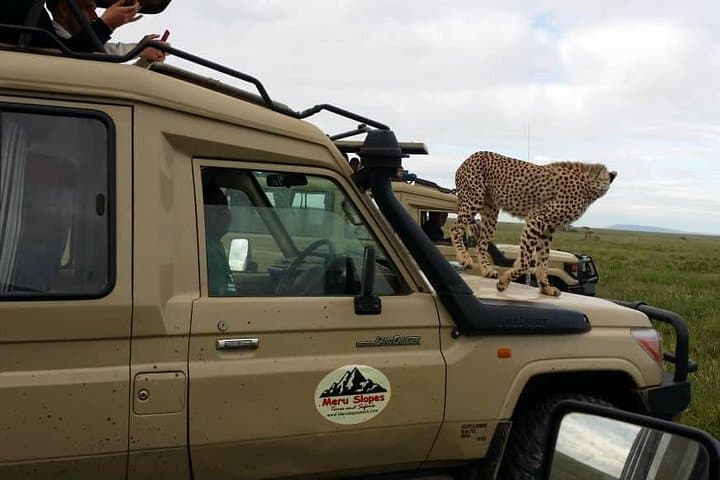

The morning light cuts across flat savannah as the 4x4 crunches toward the Tarangire River; baobabs silhouette the horizon and the first elephants of the day appear like slow-moving islands. From the pop-up roof, the river seems to breathe — a steady source that draws wildlife and shapes the park’s rhythm.
The morning light cuts across flat savannah as the 4x4 crunches toward the Tarangire River; baobabs silhouette the horizon and the first elephants of the day appear like slow-moving islands. From the pop-up roof, the river seems to breathe — a steady source that draws wildlife and shapes the park’s rhythm.
Tarangire sits on the northern Tanzania circuit, protected since the 1970s to conserve the riverine corridor and seasonal wetlands. Geologically the park is a low-lying plain fed by underground springs and seasonal runoff; the soil and water create the dense vegetation belts that sustain large herbivore aggregations. The Maasai people have shared this landscape for generations and continue to read the land’s cues, guiding visitors with local knowledge of animal behavior.
On a private day run from Arusha, expect long game-drive windows: elephant herds numbering in the hundreds in dry months, scattered giraffes feeding from acacia crowns, and a rich bird list that includes the Masai ostrich. The guide’s role is practical and educational — tracking movement, finding shade stops, and briefing on safe viewing distances.
Practical guidance: depart early to beat heat and maximize sightings, pack layered sun protection, full water, and binoculars. Wear sturdy closed shoes for short walks and keep cameras ready with extra batteries. Timed right, the day delivers dramatic wildlife encounters without demanding technical skill — mostly long, comfortable stints in the vehicle punctuated by crisp river vistas and the patient authority of elephants moving toward water.