THE ADVENTURE COLLECTIVE® · Independent discovery and booking for outdoor travel

Ride the five‑minute cable car to Table Mountain’s flattened summit and trade the city grid for wind and panorama. Choose short guided loops—Dassie, Agama or Klipspringer—for geology, wildlife and sweeping views of Cape Town and Table Bay.
Ride the five‑minute cable car to Table Mountain’s flattened summit and trade the city grid for wind and panorama. Choose short guided loops—Dassie, Agama or Klipspringer—for geology, wildlife and sweeping views of Cape Town and Table Bay.
The cable car hums and tilts as it climbs, the city sliding away beneath a sudden strip of blue: Table Bay, the harbor, and the serrated roofs of Cape Town shrink into a mosaic. In five minutes the car docks at the top and you step onto a wind-sculpted plateau more than a billion heartbeats old — Table Mountain’s flat crown, rising roughly 1,084.6 meters above sea level, opens in every direction.
Verified experiences and guided adventures in the surrounding area.
Operated by SadiCapeTours · Cape Town, Western Cape
The cable car hums and tilts as it climbs, the city sliding away beneath a sudden strip of blue: Table Bay, the harbor, and the serrated roofs of Cape Town shrink into a mosaic. In five minutes the car docks at the top and you step onto a wind-sculpted plateau more than a billion heartbeats old — Table Mountain’s flat crown, rising roughly 1,084.6 meters above sea level, opens in every direction.
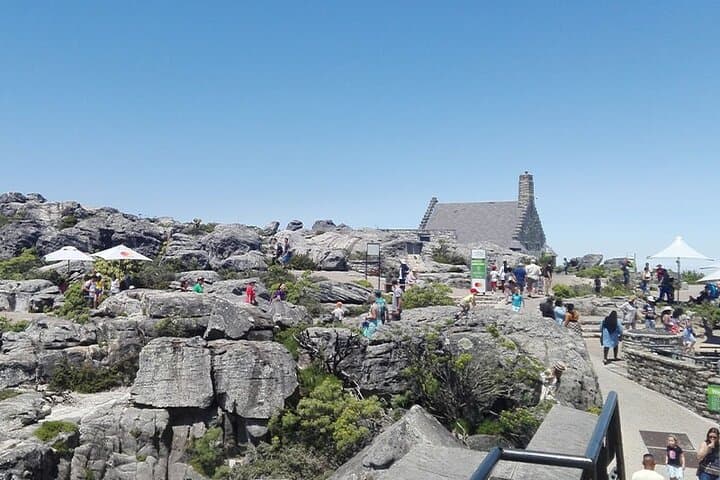
This is a place of hard stone and sharp weather, a sandstone cap laid down in the Paleozoic and worn by time into the broad table that gives Cape Town its silhouette. Indigenous Khoisan peoples named and navigated these slopes long before colonial charts arrived; later the mountain became a landmark for sailors and a strategic lookout over Table Bay. Today, the cableway that ferries visitors to the summit is as practical as it is dramatic: a five‑minute ascent to 1,067 meters, with access to short guided walks that reveal the mountain’s plants, birds and human stories.
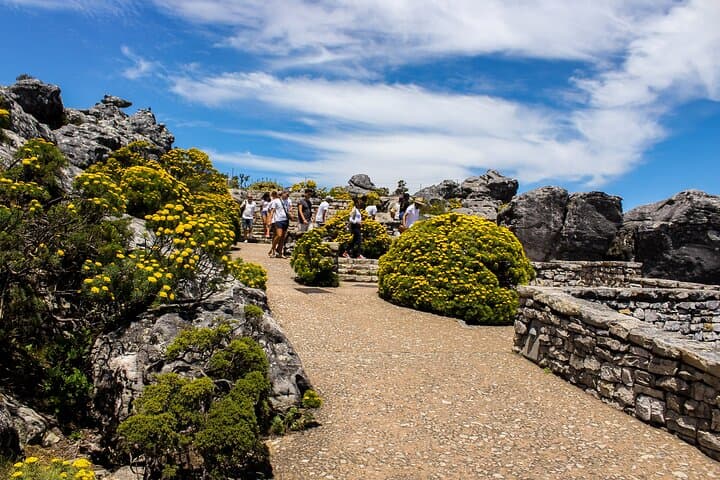
Geology here is visible at arm’s length — exfoliated sandstone, fissures that funnel wind, and the hard edge of the plateau that drops to the city below. Vegetation is unusually compact and adapted: fynbos teasels and proteas crowd the crevices. Wildlife is modest but present; rock hyraxes (dassies) and agile klipspringer genes mark the walks named for them. On clear days you can pick out Robben Island, the Twelve Apostles ridge to the west and the long sweep of the Cape Peninsula.
The tour is practical in its scope: cable car admission included, bottled water provided, and a choice of three guided loops — Dassie Walk (15 minutes), Agama Walk (30 minutes) and Klipspringer Walk (45 minutes). If you want views without sweat, the Platteklip or cable-to-top option is ideal; if you want context, take the guide-led Klipspringer route for geological and cultural notes along stone steps and small ledges.
Plan for weather that changes faster than a schedule: layers, windproof outerwear and sun protection are essential. The summit has a self-service café for a quick meal, but bring a snack if you plan to linger on a viewpoint. Allow 1–4 hours for the full visit — shorter if you ride up and back immediately, longer if you explore the trails and photo vantage points. Morning visits often yield calmer winds and clearer air; late afternoons can be dramatic but chillier.
Accessibility is a plus: the tour lists options for all fitness levels and provides private transport on request. Treat the plateau with respect — stick to paths, carry out litter, and be ready for wind that pushes you toward the stone. The reward is elemental: a broad, airborne perspective of Cape Town that presses the city into a map and the ocean into a dare.
easy.
1–4 hours.
Basic mobility—able to stand, walk short uneven trails and climb a few steps; suitable for most fitness levels.
The cable car journey takes about five minutes from the lower station to the summit station.
Yes — this tour includes cableway admission as part of the package.
Yes — the Dassie (15 min), Agama (30 min) and Klipspringer (45 min) walks are suitable for most fitness levels; guides adapt routes to the group.
Tours can be cancelled if the cableway is closed for safety; you’ll be notified and eligible for a refund if cancelled at least 24 hours prior according to the policy.
There is a self-service Table Mountain Café on the plateau; bottled water is included with the tour but bring snacks if you prefer.
Allow 1–4 hours depending on whether you ride up and down immediately or explore the guided trails and viewpoints.
Table Mountain served as a navigational landmark for centuries and holds cultural significance for the Khoisan peoples; later it became a colonial waypoint and a modern national park feature.
Table Mountain National Park protects unique fynbos ecosystems; visitors are asked to stay on trails, avoid picking plants and dispose of waste responsibly.
SadiCapeTours operates guided outdoor trips and adventures with an emphasis on safety, stewardship, and memorable experiences.
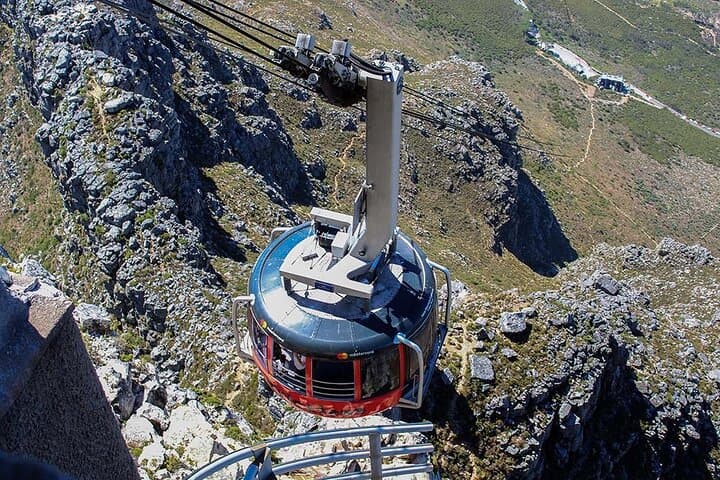
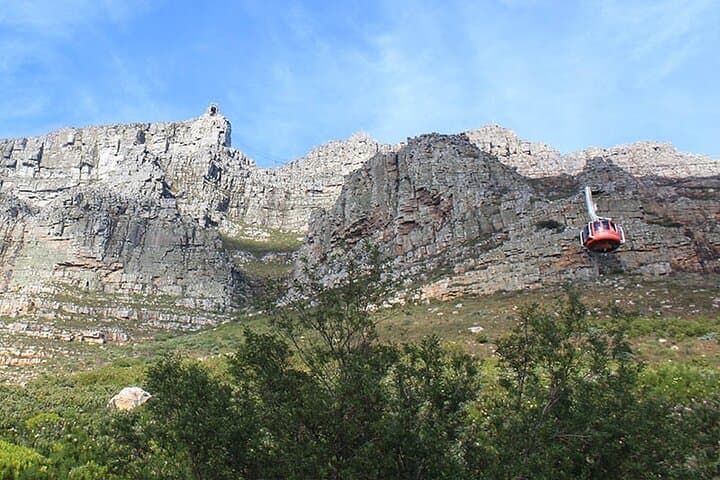
The cable car hums and tilts as it climbs, the city sliding away beneath a sudden strip of blue: Table Bay, the harbor, and the serrated roofs of Cape Town shrink into a mosaic. In five minutes the car docks at the top and you step onto a wind-sculpted plateau more than a billion heartbeats old — Table Mountain’s flat crown, rising roughly 1,084.6 meters above sea level, opens in every direction.
The cable car hums and tilts as it climbs, the city sliding away beneath a sudden strip of blue: Table Bay, the harbor, and the serrated roofs of Cape Town shrink into a mosaic. In five minutes the car docks at the top and you step onto a wind-sculpted plateau more than a billion heartbeats old — Table Mountain’s flat crown, rising roughly 1,084.6 meters above sea level, opens in every direction.
This is a place of hard stone and sharp weather, a sandstone cap laid down in the Paleozoic and worn by time into the broad table that gives Cape Town its silhouette. Indigenous Khoisan peoples named and navigated these slopes long before colonial charts arrived; later the mountain became a landmark for sailors and a strategic lookout over Table Bay. Today, the cableway that ferries visitors to the summit is as practical as it is dramatic: a five‑minute ascent to 1,067 meters, with access to short guided walks that reveal the mountain’s plants, birds and human stories.
Geology here is visible at arm’s length — exfoliated sandstone, fissures that funnel wind, and the hard edge of the plateau that drops to the city below. Vegetation is unusually compact and adapted: fynbos teasels and proteas crowd the crevices. Wildlife is modest but present; rock hyraxes (dassies) and agile klipspringer genes mark the walks named for them. On clear days you can pick out Robben Island, the Twelve Apostles ridge to the west and the long sweep of the Cape Peninsula.
The tour is practical in its scope: cable car admission included, bottled water provided, and a choice of three guided loops — Dassie Walk (15 minutes), Agama Walk (30 minutes) and Klipspringer Walk (45 minutes). If you want views without sweat, the Platteklip or cable-to-top option is ideal; if you want context, take the guide-led Klipspringer route for geological and cultural notes along stone steps and small ledges.
Plan for weather that changes faster than a schedule: layers, windproof outerwear and sun protection are essential. The summit has a self-service café for a quick meal, but bring a snack if you plan to linger on a viewpoint. Allow 1–4 hours for the full visit — shorter if you ride up and back immediately, longer if you explore the trails and photo vantage points. Morning visits often yield calmer winds and clearer air; late afternoons can be dramatic but chillier.
Accessibility is a plus: the tour lists options for all fitness levels and provides private transport on request. Treat the plateau with respect — stick to paths, carry out litter, and be ready for wind that pushes you toward the stone. The reward is elemental: a broad, airborne perspective of Cape Town that presses the city into a map and the ocean into a dare.