THE ADVENTURE COLLECTIVE® · Independent discovery and booking for outdoor travel

Practice kundalini yoga as the sun slides over Trapani’s salt pans—gentle breathwork and guided meditation on the reserve’s flat, reflective pools. This accessible, hour-long session pairs simple movement with dramatic coastal light.
Practice kundalini yoga as the sun slides over Trapani’s salt pans—gentle breathwork and guided meditation on the reserve’s flat, reflective pools. This accessible, hour-long session pairs simple movement with dramatic coastal light.
The session begins with the sun tipping toward the western horizon and the shallow basins of the Trapani salt pans turning to sheets of molten gold. You lay a mat on the packed salt flats or a dune grass verge and feel the breeze push across the water, as if the landscape itself invites you to breathe slower.
Verified experiences and guided adventures in the surrounding area.
The session begins with the sun tipping toward the western horizon and the shallow basins of the Trapani salt pans turning to sheets of molten gold. You lay a mat on the packed salt flats or a dune grass verge and feel the breeze push across the water, as if the landscape itself invites you to breathe slower.
These salt pans—worked for millennia by Phoenician, Greek and later Arab and Norman salt harvesters—are both industrial landscape and wildlife refuge. The geometric evaporation pools are carved into limestone and alluvial terraces, making a flat platform with long sightlines toward the Egadi Islands. Local culture still orients around salt: simple sheds, old windmills and the Ecomuseum nearby document that living history.
The class is gentle and accessible: guided breathing, spinal movements, and a closing meditation timed to the changing light. Expect the click of wading birds, the metallic tang of salt on the air and a horizon that seems to elongate as the sun descends—nature taking an active role in the practice.
Practicalities: sessions last about 60 minutes; arrive 15–20 minutes early to claim a flat, dry spot. Wear layers for cooling breezes after sunset, use a non-slip mat on coarse salt surfaces, and carry water—the area is exposed. Respect bird nesting zones and marked paths; the reserve is protected and sensitive to foot traffic. For beginners this is low-impact, restorative, and rooted in a striking coastal landscape that amplifies simple breath work into something elemental.
easy.
1 hour.
Suitable for beginners and most fitness levels; minimal exertion required
Yes—exercises and breathing are adapted for all levels; instructors offer modifications for limited mobility.
The salt pans are a short drive or taxi ride from central Trapani; some visitors cycle or join local shuttle services during high season.
Yes—bringing your own mat and a small towel is recommended because surfaces can be abrasive.
Organizers typically cancel or relocate in heavy rain or hazardous winds; check your booking confirmation for the host’s policy.
Trapani’s salt pans have been exploited since antiquity; salt was a strategic commodity for Phoenician and later Mediterranean trade networks.
The Saline di Trapani e Paceco is a protected reserve—visit with low-impact practices, follow signage, and avoid trampling vegetation or disturbing birds.
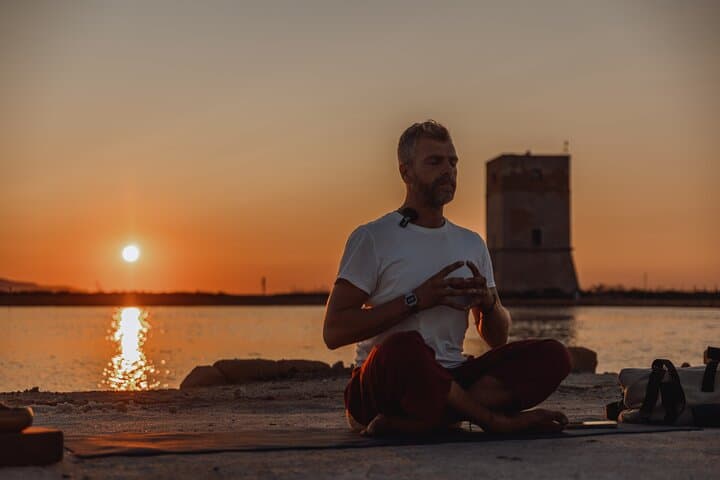
The session begins with the sun tipping toward the western horizon and the shallow basins of the Trapani salt pans turning to sheets of molten gold. You lay a mat on the packed salt flats or a dune grass verge and feel the breeze push across the water, as if the landscape itself invites you to breathe slower.
The session begins with the sun tipping toward the western horizon and the shallow basins of the Trapani salt pans turning to sheets of molten gold. You lay a mat on the packed salt flats or a dune grass verge and feel the breeze push across the water, as if the landscape itself invites you to breathe slower.
These salt pans—worked for millennia by Phoenician, Greek and later Arab and Norman salt harvesters—are both industrial landscape and wildlife refuge. The geometric evaporation pools are carved into limestone and alluvial terraces, making a flat platform with long sightlines toward the Egadi Islands. Local culture still orients around salt: simple sheds, old windmills and the Ecomuseum nearby document that living history.
The class is gentle and accessible: guided breathing, spinal movements, and a closing meditation timed to the changing light. Expect the click of wading birds, the metallic tang of salt on the air and a horizon that seems to elongate as the sun descends—nature taking an active role in the practice.
Practicalities: sessions last about 60 minutes; arrive 15–20 minutes early to claim a flat, dry spot. Wear layers for cooling breezes after sunset, use a non-slip mat on coarse salt surfaces, and carry water—the area is exposed. Respect bird nesting zones and marked paths; the reserve is protected and sensitive to foot traffic. For beginners this is low-impact, restorative, and rooted in a striking coastal landscape that amplifies simple breath work into something elemental.