THE ADVENTURE COLLECTIVE® · Independent discovery and booking for outdoor travel

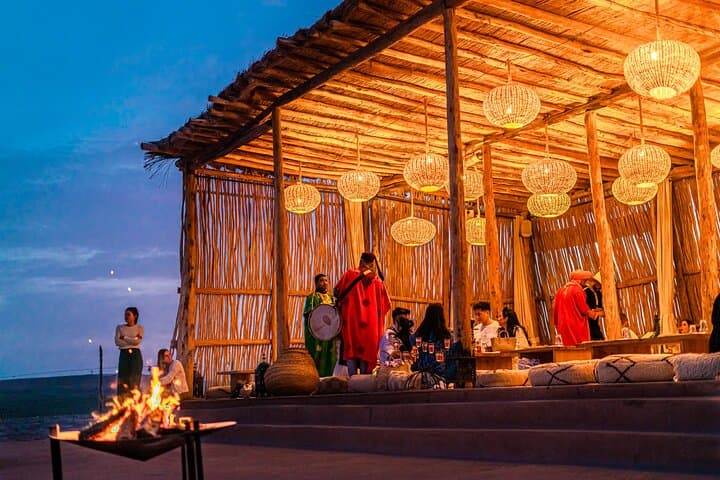
Ride a camel across the rocky plains of the Agafay Desert, return to Alkamar Camp for a three-course Moroccan dinner, live Gnawa and Tuareg music, and a fire-eater performance. This seven-hour evening excursion combines accessible adventure with cultural immersion just outside Marrakech.
Ride a camel across the rocky plains of the Agafay Desert, return to Alkamar Camp for a three-course Moroccan dinner, live Gnawa and Tuareg music, and a fire-eater performance. This seven-hour evening excursion combines accessible adventure with cultural immersion just outside Marrakech.
You step out of the air-conditioned vehicle and the Agafay spreads before you — a hard, rocky plain where dust and stone trade places with shadow as the sun drops. Camels sway like slow ships on a stony sea, and the horizon pushes color into the sky while a cool desert breeze tests your jacket. The one-hour camel ride crosses low dunes and compact reg, delivering you back to Alkamar Camp as evening settles and lanterns come alive.
Verified experiences and guided adventures in the surrounding area.
Operated by Alkamar Collection · Marrakech, Marrakech-Safi
You step out of the air-conditioned vehicle and the Agafay spreads before you — a hard, rocky plain where dust and stone trade places with shadow as the sun drops. Camels sway like slow ships on a stony sea, and the horizon pushes color into the sky while a cool desert breeze tests your jacket. The one-hour camel ride crosses low dunes and compact reg, delivering you back to Alkamar Camp as evening settles and lanterns come alive.
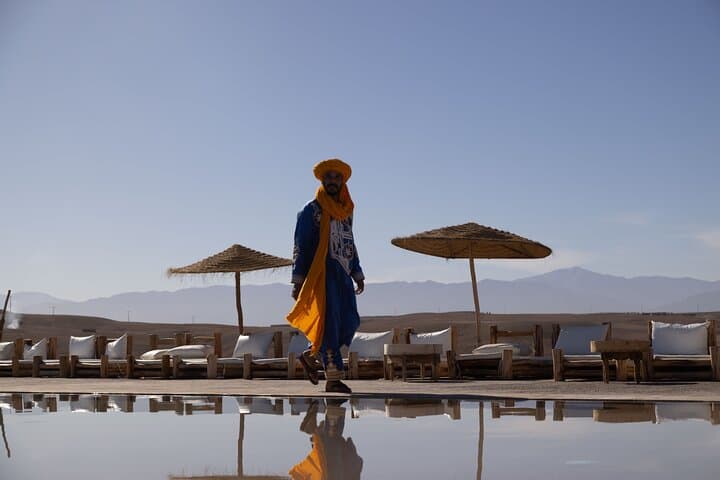
Agafay is not Sahara sand; it’s a gravelly desert formed by weathering of the High Atlas foothills and ancient lake beds. That geology makes for broad, open views and dramatic sunsets that local Berber communities have used as crossroads for centuries. At camp, expect a three-course Moroccan dinner of shared plates and mint tea, followed by Gnawa and Tuareg music that trace histories of trade, migration, and spiritual practice. A fire-eater and musicians make the night kinetic; the pool and lounge offer a quieter counterpoint.
Practical guidance: the whole experience runs about seven hours including transport, and groups are shared up to roughly 17 people. Wear closed-toe shoes for the camel saddle and bring layered clothing—the temperature drops quickly after sunset. Hydrate before you arrive and carry a refillable bottle; sunscreen and a wide-brim hat are useful even in late afternoon. Cameras do well in the low light but be respectful during performances and around performers. If you have mobility or spine issues, note camel saddles can be jarring. Confirm dietary needs ahead of time; many camps accommodate vegetarian and gluten-free requests. Leave no trace, follow guides’ direction, and tip performers and guides to support local livelihoods.
moderate.
7 hours.
Good for those with moderate fitness and basic balance—camel saddles are stable but can be jostling for people with back issues.
The camel ride is approximately one hour across the Agafay terrain; the full tour, including transport and dinner, is about seven hours.
Yes—children may ride, but infants must sit on an adult’s lap and operators may apply age or weight limits for safety; check with the provider when booking.
Yes—Alkamar Camp typically accommodates vegetarian, vegan, and gluten-free requests if notified in advance.
Pool access and towels are listed as included amenities, but usage may be seasonal and subject to camp rules and timing of the evening program.
The Agafay area functions as a transitional zone below the High Atlas, historically crossed by local Berber routes and more recently developed for tourism-facing camp experiences.
The Agafay’s fragile reg surface and limited water mean visitors should stick to established tracks, avoid off-road driving, and minimize water use to reduce local impact.
Alkamar Collection operates guided outdoor trips and adventures with an emphasis on safety, stewardship, and memorable experiences.
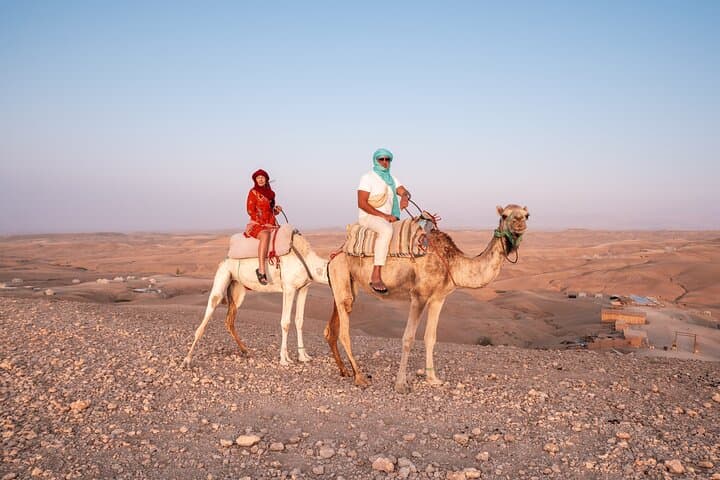
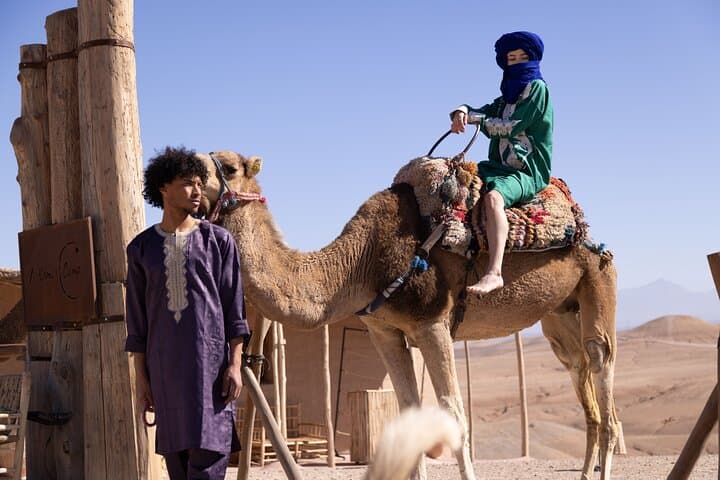
You step out of the air-conditioned vehicle and the Agafay spreads before you — a hard, rocky plain where dust and stone trade places with shadow as the sun drops. Camels sway like slow ships on a stony sea, and the horizon pushes color into the sky while a cool desert breeze tests your jacket. The one-hour camel ride crosses low dunes and compact reg, delivering you back to Alkamar Camp as evening settles and lanterns come alive.
You step out of the air-conditioned vehicle and the Agafay spreads before you — a hard, rocky plain where dust and stone trade places with shadow as the sun drops. Camels sway like slow ships on a stony sea, and the horizon pushes color into the sky while a cool desert breeze tests your jacket. The one-hour camel ride crosses low dunes and compact reg, delivering you back to Alkamar Camp as evening settles and lanterns come alive.
Agafay is not Sahara sand; it’s a gravelly desert formed by weathering of the High Atlas foothills and ancient lake beds. That geology makes for broad, open views and dramatic sunsets that local Berber communities have used as crossroads for centuries. At camp, expect a three-course Moroccan dinner of shared plates and mint tea, followed by Gnawa and Tuareg music that trace histories of trade, migration, and spiritual practice. A fire-eater and musicians make the night kinetic; the pool and lounge offer a quieter counterpoint.
Practical guidance: the whole experience runs about seven hours including transport, and groups are shared up to roughly 17 people. Wear closed-toe shoes for the camel saddle and bring layered clothing—the temperature drops quickly after sunset. Hydrate before you arrive and carry a refillable bottle; sunscreen and a wide-brim hat are useful even in late afternoon. Cameras do well in the low light but be respectful during performances and around performers. If you have mobility or spine issues, note camel saddles can be jarring. Confirm dietary needs ahead of time; many camps accommodate vegetarian and gluten-free requests. Leave no trace, follow guides’ direction, and tip performers and guides to support local livelihoods.