THE ADVENTURE COLLECTIVE® · Independent discovery and booking for outdoor travel

Climb Baegundae, Bukhansan’s highest summit, on a private guided hike that balances efficient routing with local knowledge. Expect steep granite steps, 530 m of gain and panoramic Seoul views — ideal for hikers with moderate fitness.
Climb Baegundae, Bukhansan’s highest summit, on a private guided hike that balances efficient routing with local knowledge. Expect steep granite steps, 530 m of gain and panoramic Seoul views — ideal for hikers with moderate fitness.
You step out before dawn and the city lights of Seoul dim beneath the granite ribs of Bukhansan. The trail pushes up through pine-scented gullies, rock steps and exposed slabs; the mountain seems to test your pace and then reward it — the skyline opens, the Han River narrowing into a ribbon. Baegundae, the park’s highest point at about 836.5 m, crowns the range and pulls your gaze between close-up lichened rock and distant urban grid.
Verified experiences and guided adventures in the surrounding area.
You step out before dawn and the city lights of Seoul dim beneath the granite ribs of Bukhansan. The trail pushes up through pine-scented gullies, rock steps and exposed slabs; the mountain seems to test your pace and then reward it — the skyline opens, the Han River narrowing into a ribbon. Baegundae, the park’s highest point at about 836.5 m, crowns the range and pulls your gaze between close-up lichened rock and distant urban grid.
Bukhansan’s granite is sculpted by millennia of frost and runoff; the slopes once framed defensive walls and watch posts of Bukhansanseong in the Joseon era, giving the park both geological grit and historical weight. Local culture treats the mountain as an everyday refuge — commuters, temple visitors and climbers share routes with wary squirrels and magpies.
Practically, the common Baegundae approach covered on private tours runs roughly 3.5 km one-way with ~530 m of elevation gain, and the round-trip program usually takes 4–5 hours including stops. Expect steep sections, ladder-like rock steps and short exposed pitches where footing matters. Guides note that visitors unfamiliar with Korean trail signage sometimes become disoriented; this tour pairs local route knowledge with a steady pace.
Bring supportive footwear, layered clothing and at least 1.5–2 liters of water. Start early to avoid mid-day heat and crowds, and leave no trace — the park’s popularity makes trail preservation essential. On clear days, the summit rewards you with a brisk panorama of Seoul framed by granite ribs that seem to push the city outward.
moderate.
4–5 hours.
Moderate fitness; comfortable with sustained uphill hiking and short exposed rock sections.
The route is rated moderate: about 3.5 km one-way with ~530 m gain and some exposed rocky sections; basic hiking experience and good footwear are recommended.
No special permit is needed for day hikes to Baegundae within Bukhansan National Park, but park entry regulations and fees may apply for vehicles and certain access points.
Trails intersect frequently and Korean signage can be unfamiliar; a guided tour helps navigation and reduces the chance of getting off-route.
Early morning in spring or fall offers the best combination of light, temperature and views; avoid midday in summer due to heat and afternoon storms.
Bukhansan’s slopes include sections of Bukhansanseong, a Joseon-era mountain fortress built to protect Seoul; the area has long been both strategic and sacred.
High visitor numbers stress trails and vegetation — stay on marked paths, pack out all waste and avoid chalking or altering rock.
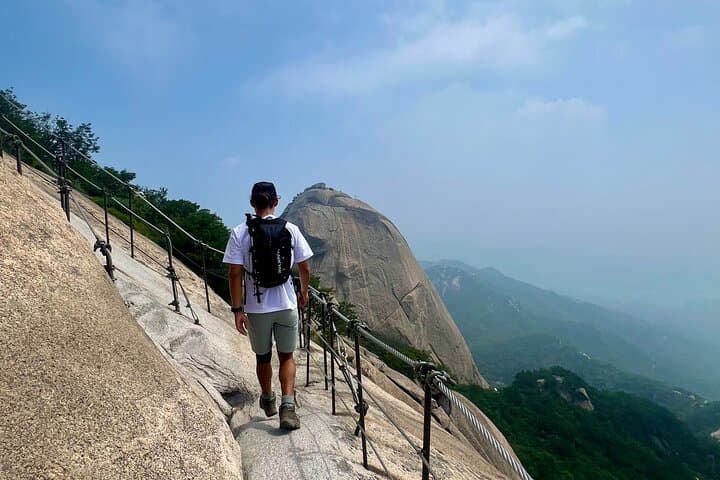
You step out before dawn and the city lights of Seoul dim beneath the granite ribs of Bukhansan. The trail pushes up through pine-scented gullies, rock steps and exposed slabs; the mountain seems to test your pace and then reward it — the skyline opens, the Han River narrowing into a ribbon. Baegundae, the park’s highest point at about 836.5 m, crowns the range and pulls your gaze between close-up lichened rock and distant urban grid.
You step out before dawn and the city lights of Seoul dim beneath the granite ribs of Bukhansan. The trail pushes up through pine-scented gullies, rock steps and exposed slabs; the mountain seems to test your pace and then reward it — the skyline opens, the Han River narrowing into a ribbon. Baegundae, the park’s highest point at about 836.5 m, crowns the range and pulls your gaze between close-up lichened rock and distant urban grid.
Bukhansan’s granite is sculpted by millennia of frost and runoff; the slopes once framed defensive walls and watch posts of Bukhansanseong in the Joseon era, giving the park both geological grit and historical weight. Local culture treats the mountain as an everyday refuge — commuters, temple visitors and climbers share routes with wary squirrels and magpies.
Practically, the common Baegundae approach covered on private tours runs roughly 3.5 km one-way with ~530 m of elevation gain, and the round-trip program usually takes 4–5 hours including stops. Expect steep sections, ladder-like rock steps and short exposed pitches where footing matters. Guides note that visitors unfamiliar with Korean trail signage sometimes become disoriented; this tour pairs local route knowledge with a steady pace.
Bring supportive footwear, layered clothing and at least 1.5–2 liters of water. Start early to avoid mid-day heat and crowds, and leave no trace — the park’s popularity makes trail preservation essential. On clear days, the summit rewards you with a brisk panorama of Seoul framed by granite ribs that seem to push the city outward.