THE ADVENTURE COLLECTIVE® · Independent discovery and booking for outdoor travel

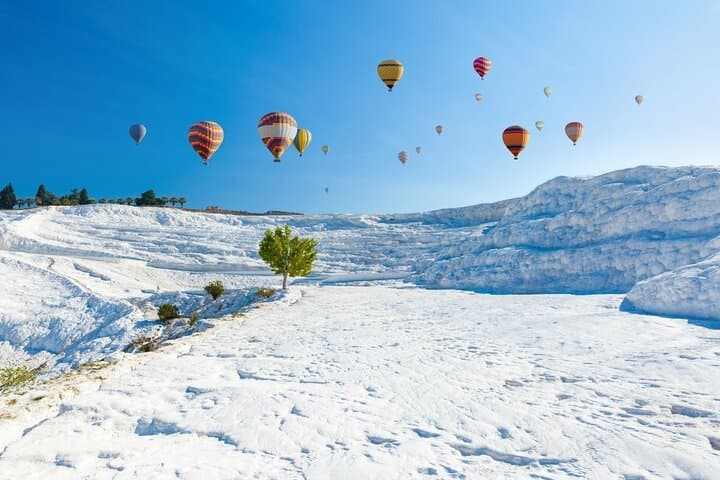
Float at dawn above Pamukkale’s otherworldly white travertines and ancient Hierapolis. This one-hour hot-air balloon flight pairs geological wonder with a gentle aerial perspective and ends with a celebratory champagne toast and certificate.
Float at dawn above Pamukkale’s otherworldly white travertines and ancient Hierapolis. This one-hour hot-air balloon flight pairs geological wonder with a gentle aerial perspective and ends with a celebratory champagne toast and certificate.
Before dawn the field smells of cool earth and propane; envelopes lie flat as sleeping whales while crews stitch heat into color. As the first burners flare you feel the balloon lift and the world loosens — white travertine shelves, the ruins of Hierapolis and a string of thermal springs slide beneath you in the slow, silent rhythm of the breeze.
Verified experiences and guided adventures in the surrounding area.
Operated by Hot Air Balloon In Pamukkale · Pamukkale, Denizli Province
Before dawn the field smells of cool earth and propane; envelopes lie flat as sleeping whales while crews stitch heat into color. As the first burners flare you feel the balloon lift and the world loosens — white travertine shelves, the ruins of Hierapolis and a string of thermal springs slide beneath you in the slow, silent rhythm of the breeze.
Pamukkale’s terraces were built by millennia of mineral-rich waters leaving calcium deposits that harden into the pale, scalloped steps visitors see today. Above them, Hierapolis — a Greco-Roman spa town founded in the Hellenistic era and later rebuilt by Romans — spreads out in ruins: a theater, temples and necropolis that hint at centuries of bathing culture and pilgrimage. The flight offers both geological close-up and cultural overview; pilots commonly point out the Pool of Cleopatra and the Roman theater as the sun cuts across the limestone.
Practicalities are simple: scheduled hotel pickup, roughly 60 minutes airborne within a 2–3 hour experience, celebration and a printed certificate afterwards. Flights are weather-dependent and cancel in high winds. Expect to stand for the hour, keep cameras ready, and dress in layers — mornings are cool even in summer. Photography rewards early-risers: soft light, steam rising from pools and vultures or kestrels circling overhead. After landing, crews typically offer a small toast to mark the flight before returning you to your hotel to catch breakfast and the rest of Pamukkale’s UNESCO-listed landscape.
easy.
2–3 hours.
Suitable for most fitness levels; requires standing and stepping in/out of the basket and brief walking on uneven ground at launch/landing sites.
The airborne portion is roughly one hour; the full experience including pickup, inflation, and post-flight celebration is about 2–3 hours.
Flights operate in suitable weather only; operators will cancel for strong winds or low visibility and offer refunds per policy.
Children are typically allowed but policies vary by operator — check age/height rules at booking and note that infants may be restricted.
Pilots aim to fly close to the travertines and ruins for views, but you will not land on the terraces; approach distances depend on wind and safety considerations.
Hierapolis grew as a Hellenistic and Roman spa town built atop Pamukkale’s thermal water; the site is a UNESCO World Heritage Site for its combined natural and archaeological value.
The calcite terraces are fragile — visitors should stay on designated paths and follow park rules; operators and the national park limit access to reduce erosion and preserve the formations.
Hot Air Balloon In Pamukkale operates guided outdoor trips and adventures with an emphasis on safety, stewardship, and memorable experiences.



Before dawn the field smells of cool earth and propane; envelopes lie flat as sleeping whales while crews stitch heat into color. As the first burners flare you feel the balloon lift and the world loosens — white travertine shelves, the ruins of Hierapolis and a string of thermal springs slide beneath you in the slow, silent rhythm of the breeze.
Before dawn the field smells of cool earth and propane; envelopes lie flat as sleeping whales while crews stitch heat into color. As the first burners flare you feel the balloon lift and the world loosens — white travertine shelves, the ruins of Hierapolis and a string of thermal springs slide beneath you in the slow, silent rhythm of the breeze.
Pamukkale’s terraces were built by millennia of mineral-rich waters leaving calcium deposits that harden into the pale, scalloped steps visitors see today. Above them, Hierapolis — a Greco-Roman spa town founded in the Hellenistic era and later rebuilt by Romans — spreads out in ruins: a theater, temples and necropolis that hint at centuries of bathing culture and pilgrimage. The flight offers both geological close-up and cultural overview; pilots commonly point out the Pool of Cleopatra and the Roman theater as the sun cuts across the limestone.
Practicalities are simple: scheduled hotel pickup, roughly 60 minutes airborne within a 2–3 hour experience, celebration and a printed certificate afterwards. Flights are weather-dependent and cancel in high winds. Expect to stand for the hour, keep cameras ready, and dress in layers — mornings are cool even in summer. Photography rewards early-risers: soft light, steam rising from pools and vultures or kestrels circling overhead. After landing, crews typically offer a small toast to mark the flight before returning you to your hotel to catch breakfast and the rest of Pamukkale’s UNESCO-listed landscape.