THE ADVENTURE COLLECTIVE® · Independent discovery and booking for outdoor travel

Beat the city to light on a 90-minute guided climb of Lycabettus Hill. Reach the Chapel of St. George in time to watch Athens shift from night to day, with panoramic views of the Acropolis and the Saronic Gulf.
Beat the city to light on a 90-minute guided climb of Lycabettus Hill. Reach the Chapel of St. George in time to watch Athens shift from night to day, with panoramic views of the Acropolis and the Saronic Gulf.
Before the city stirs, you climb through quiet streets and the last pocket of night. The trail up Lycabettus Hill tightens into steps and switchbacks, and as your headlamp skims olive trees the first gold edge of the sun pries open the horizon. Athens breathes in layers below you—red-tiled roofs, the Acropolis silhouette, and the silver thread of the Saronic Gulf—until the whole city unfolds in a single, waking sweep.
Verified experiences and guided adventures in the surrounding area.
Operated by Ultimate Athens · Athens, Attica
Before the city stirs, you climb through quiet streets and the last pocket of night. The trail up Lycabettus Hill tightens into steps and switchbacks, and as your headlamp skims olive trees the first gold edge of the sun pries open the horizon. Athens breathes in layers below you—red-tiled roofs, the Acropolis silhouette, and the silver thread of the Saronic Gulf—until the whole city unfolds in a single, waking sweep.
Lycabettus (Lykavittos) rises about 277 meters above sea level and is one of Athens’ most visible natural features. The hill is an isolated limestone outcrop long used as a lookout; a small whitewashed Chapel of St. George crowns its summit and whispers of 19th-century rebuilding. Geologically it’s an urban karst knob, its slopes carved into paths and alleys that have been part of the city’s cultural life for centuries.
The guided walk takes roughly 90 minutes and is timed to reach the top for sunrise. Expect steep sections and stone steps; the route favors fit walkers and moves briskly with groups capped at about 10. Practical prep pays off: wear grippy shoes, bring water and a headlamp for the approach, and plan to arrive 45–60 minutes before sunrise to account for pace and photo stops. Public transport reaches nearby Kolonaki and the funicular runs for those who prefer a shorter ascent, but this tour is on foot. Note restrictions: not recommended for travelers with spinal, cardiac issues, or pregnancy. Leave-no-trace practices help keep the hill clean for the next dawn—pack out any trash and respect quiet while the city wakes.
moderate.
1–1.5 hours.
Suitable for hikers with good cardiovascular fitness and experience on steep, stepped trails; expect sustained uphill effort.
The guided tour lasts about 90 minutes round-trip, timed so you reach Lycabettus Hill’s summit for sunrise.
Yes — a funicular operates to the summit from Kolonaki, but this specific activity is conducted on foot to experience the dawn approach.
Participants should have a high level of physical fitness able to handle sustained uphill walking and stairs; it’s not suitable for those with spinal, pregnancy, or serious heart conditions.
Absolutely — the summit offers 360-degree views ideal for photos of the Acropolis, cityscape, and the Saronic Gulf; arrive early to secure a good vantage point.
Lycabettus has been a lookout and landmark for millennia; its name likely refers to wolves historically roaming nearby, and the summit chapel dates to 19th-century rebuilding traditions.
Heavy foot traffic can erode paths; stick to marked trails, carry out trash, and avoid disturbing vegetation to protect the hill’s fragile urban ecology.
Ultimate Athens operates guided outdoor trips and adventures with an emphasis on safety, stewardship, and memorable experiences.
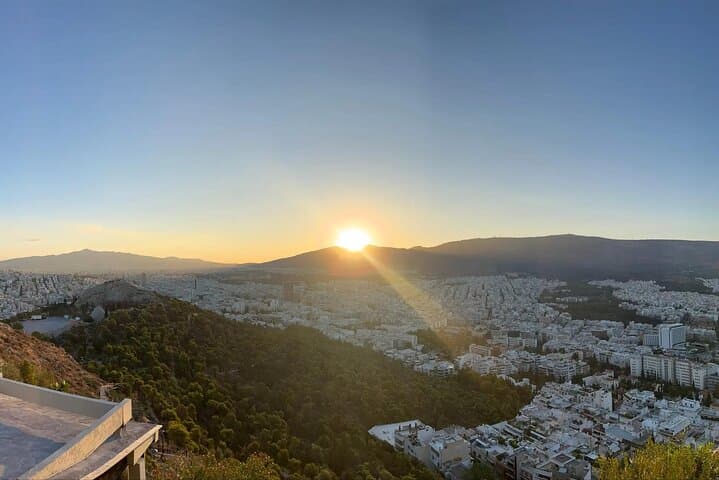



Before the city stirs, you climb through quiet streets and the last pocket of night. The trail up Lycabettus Hill tightens into steps and switchbacks, and as your headlamp skims olive trees the first gold edge of the sun pries open the horizon. Athens breathes in layers below you—red-tiled roofs, the Acropolis silhouette, and the silver thread of the Saronic Gulf—until the whole city unfolds in a single, waking sweep.
Before the city stirs, you climb through quiet streets and the last pocket of night. The trail up Lycabettus Hill tightens into steps and switchbacks, and as your headlamp skims olive trees the first gold edge of the sun pries open the horizon. Athens breathes in layers below you—red-tiled roofs, the Acropolis silhouette, and the silver thread of the Saronic Gulf—until the whole city unfolds in a single, waking sweep.
Lycabettus (Lykavittos) rises about 277 meters above sea level and is one of Athens’ most visible natural features. The hill is an isolated limestone outcrop long used as a lookout; a small whitewashed Chapel of St. George crowns its summit and whispers of 19th-century rebuilding. Geologically it’s an urban karst knob, its slopes carved into paths and alleys that have been part of the city’s cultural life for centuries.
The guided walk takes roughly 90 minutes and is timed to reach the top for sunrise. Expect steep sections and stone steps; the route favors fit walkers and moves briskly with groups capped at about 10. Practical prep pays off: wear grippy shoes, bring water and a headlamp for the approach, and plan to arrive 45–60 minutes before sunrise to account for pace and photo stops. Public transport reaches nearby Kolonaki and the funicular runs for those who prefer a shorter ascent, but this tour is on foot. Note restrictions: not recommended for travelers with spinal, cardiac issues, or pregnancy. Leave-no-trace practices help keep the hill clean for the next dawn—pack out any trash and respect quiet while the city wakes.