THE ADVENTURE COLLECTIVE® · Independent discovery and booking for outdoor travel

Paddle into the Madu River’s maze at dawn, where mangrove channels, cinnamon islets and waking waterbirds define a fragile Ramsar wetland. This three-hour sunrise kayak trip from Colombo pairs gentle paddling with guided natural history and local insight.
Paddle into the Madu River’s maze at dawn, where mangrove channels, cinnamon islets and waking waterbirds define a fragile Ramsar wetland. This three-hour sunrise kayak trip from Colombo pairs gentle paddling with guided natural history and local insight.
Before the sun clears the horizon, the Madu River moves like a slow, breathing thing — channels dark with tide, mangrove roots reaching like hands to the water. A small flotilla of sit-on-top kayaks slips out from a narrow jetty; oars tap quietly, birds argue from the canopy, and the river seems to nudge you farther into its maze.
Verified experiences and guided adventures in the surrounding area.
Operated by Serendib Adventures · Balapitiya, Southern Province
Before the sun clears the horizon, the Madu River moves like a slow, breathing thing — channels dark with tide, mangrove roots reaching like hands to the water. A small flotilla of sit-on-top kayaks slips out from a narrow jetty; oars tap quietly, birds argue from the canopy, and the river seems to nudge you farther into its maze.
Madu Ganga is a Ramsar-declared wetland on Sri Lanka’s southwest coast, formed by a complex estuary of mangrove islets, sandbars and tidal creeks. The area supports a high diversity of plants and animals and a handful of cinnamon-collection islets and small fishing communities whose livelihoods are tied to the tide.
This sunrise trip is straightforward: an early meeting, a safety briefing, and roughly three hours of paddling through shallow channels and sheltered lagoons. Expect flat water, narrow tunnels threaded by prop roots, and tidal shifts that speed or slow your progress — the river will guide you if you respect its currents.
Practicalities: wear quick-dry clothing, reef-safe sunscreen and a wide-brimmed hat; bring a dry bag for your phone and a reusable water bottle. Guides supply life jackets, a safety chase boat and light snacks. Paddling is low-impact aerobic work — steady pace, occasional short bursts to pass a current or reach a viewpoint.
Timing matters: dawn light opens the mangroves and bird activity peaks. Keep noise low, follow the guide’s route to protect fragile islets, and leave no trace — the ecosystem is resilient but vulnerable to careless traffic. When the tour ends, you’ll have a clearer pulse and a quieter head, with the river having reclaimed some of your city haste.
easy.
3 hours.
Suitable for beginners in average fitness; requires basic upper-body stamina for sustained paddling.
No—this trip is designed for beginners; guides provide training and a safety chase boat follows the group.
Many operators offer shuttle options from Colombo or nearby towns; check the tour page for pickup points and times.
Expect kingfishers, herons and possibly smooth-coated otters or sea eagles; sightings vary by season and noise level.
Children can join but must sit in adult laps if infants; confirm age limits and safety provisions when booking.
Madu Ganga developed as an estuarine network supporting local fishing and cinnamon collection; it was designated a Ramsar wetland for its ecological importance.
The wetland is sensitive to pollution and unregulated boat traffic—stick to guided routes, avoid plastics, and support operators who follow responsible practices.
Serendib Adventures operates guided outdoor trips and adventures with an emphasis on safety, stewardship, and memorable experiences.

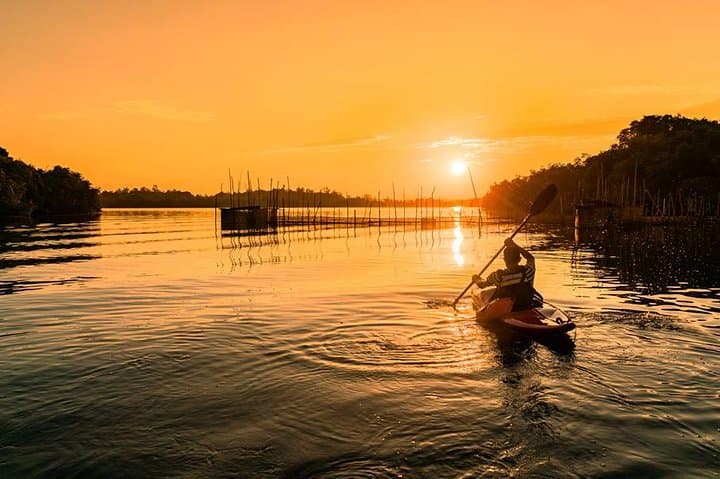


Before the sun clears the horizon, the Madu River moves like a slow, breathing thing — channels dark with tide, mangrove roots reaching like hands to the water. A small flotilla of sit-on-top kayaks slips out from a narrow jetty; oars tap quietly, birds argue from the canopy, and the river seems to nudge you farther into its maze.
Before the sun clears the horizon, the Madu River moves like a slow, breathing thing — channels dark with tide, mangrove roots reaching like hands to the water. A small flotilla of sit-on-top kayaks slips out from a narrow jetty; oars tap quietly, birds argue from the canopy, and the river seems to nudge you farther into its maze.
Madu Ganga is a Ramsar-declared wetland on Sri Lanka’s southwest coast, formed by a complex estuary of mangrove islets, sandbars and tidal creeks. The area supports a high diversity of plants and animals and a handful of cinnamon-collection islets and small fishing communities whose livelihoods are tied to the tide.
This sunrise trip is straightforward: an early meeting, a safety briefing, and roughly three hours of paddling through shallow channels and sheltered lagoons. Expect flat water, narrow tunnels threaded by prop roots, and tidal shifts that speed or slow your progress — the river will guide you if you respect its currents.
Practicalities: wear quick-dry clothing, reef-safe sunscreen and a wide-brimmed hat; bring a dry bag for your phone and a reusable water bottle. Guides supply life jackets, a safety chase boat and light snacks. Paddling is low-impact aerobic work — steady pace, occasional short bursts to pass a current or reach a viewpoint.
Timing matters: dawn light opens the mangroves and bird activity peaks. Keep noise low, follow the guide’s route to protect fragile islets, and leave no trace — the ecosystem is resilient but vulnerable to careless traffic. When the tour ends, you’ll have a clearer pulse and a quieter head, with the river having reclaimed some of your city haste.