THE ADVENTURE COLLECTIVE® · Independent discovery and booking for outdoor travel

Rise at dawn over Teotihuacan in a 40–60 minute hot-air balloon flight, follow it with a cave breakfast and a guided tasting of pulque and tequila, then spend an hour among the pyramids. Morning weather and early pickup windows shape the day—plan layers, water and an allowance for delays.
Rise at dawn over Teotihuacan in a 40–60 minute hot-air balloon flight, follow it with a cave breakfast and a guided tasting of pulque and tequila, then spend an hour among the pyramids. Morning weather and early pickup windows shape the day—plan layers, water and an allowance for delays.
Before sunrise a ragged horizon brightens over the Valley of Mexico, and a cluster of inflated envelopes lifts from the field beside the pyramids.
The flight over Teotihuacan lasts 40–60 minutes; you rise with thermals, drift with high-altitude wind and get a slow, panoramic read of the Avenue of the Dead, the Sun and Moon pyramids and the patchwork agave fields below.
After landing you watch drone footage, then descend into a cave restaurant for a breakfast of local staples and strong coffee. A local artisan leads tastings of pulque and tequila while explaining maguey and obsidian's roles in regional craft and ritual.
Teotihuacan began growing into a major urban center around the first centuries CE. The site sits on volcanic plains where obsidian deposits shaped trade and toolmaking; the pyramids rest on compacted fill and volcanic bedrock that gives the site its striking profiles.
Practical guidance: transfers from central Mexico City run very early (pickup between ~4:30–5:00 a.m.) to reach the launch area by dawn. Total time is roughly six hours including about an hour to explore the archaeological zone; admission is separate. Expect uneven ground, stone stairs and short uphill sections if you climb the Pyramid of the Moon.
Dress in layers for cold mornings and fast-rising sun, hydrate for ~2,300 m elevation and wear sturdy shoes. The pilot controls ascent and descent only—direction depends on wind—so plan for weather-dependent delays or cancellations. Keep valuables secured during landing and respect restricted areas within the archaeological zone.
Verified experiences and guided adventures in the surrounding area.
Operated by Explora México Teotihuacan · San Juan Teotihuacán, State of Mexico
Before sunrise a ragged horizon brightens over the Valley of Mexico, and a cluster of inflated envelopes lifts from the field beside the pyramids.
The flight over Teotihuacan lasts 40–60 minutes; you rise with thermals, drift with high-altitude wind and get a slow, panoramic read of the Avenue of the Dead, the Sun and Moon pyramids and the patchwork agave fields below.
After landing you watch drone footage, then descend into a cave restaurant for a breakfast of local staples and strong coffee. A local artisan leads tastings of pulque and tequila while explaining maguey and obsidian's roles in regional craft and ritual.
Teotihuacan began growing into a major urban center around the first centuries CE. The site sits on volcanic plains where obsidian deposits shaped trade and toolmaking; the pyramids rest on compacted fill and volcanic bedrock that gives the site its striking profiles.
Practical guidance: transfers from central Mexico City run very early (pickup between ~4:30–5:00 a.m.) to reach the launch area by dawn. Total time is roughly six hours including about an hour to explore the archaeological zone; admission is separate. Expect uneven ground, stone stairs and short uphill sections if you climb the Pyramid of the Moon.
Dress in layers for cold mornings and fast-rising sun, hydrate for ~2,300 m elevation and wear sturdy shoes. The pilot controls ascent and descent only—direction depends on wind—so plan for weather-dependent delays or cancellations. Keep valuables secured during landing and respect restricted areas within the archaeological zone.
easy.
6 hours.
Suitable for travelers with basic mobility—short walks and stair climbs at moderate altitude; be prepared for an early morning and uneven surfaces.
Flights typically last 40–60 minutes depending on weather and wind conditions; pilots control ascent and descent but not horizontal direction.
No—archaeological zone admission is separate (roughly the equivalent of USD 5); the itinerary usually allows about an hour to explore the site.
Yes—options include pickup from a limited radius around the historic center (around 10 km) early in the morning; confirm your pickup point when booking.
Flights are weather-dependent; operators will cancel for safety and typically offer a refund or reschedule—confirm the provider's cancellation window when booking.
Teotihuacan emerged as a major Mesoamerican city between the first and seventh centuries CE; obsidian trade and ceremonial centers shaped its urban plan.
The archaeological zone is protected; visitors should stay on marked paths, avoid touching fragile structures and follow site rules. Balloon operations are regulated—operators should adhere to local airspace and landing protocols to minimize impact.
Explora México Teotihuacan operates guided outdoor trips and adventures with an emphasis on safety, stewardship, and memorable experiences.
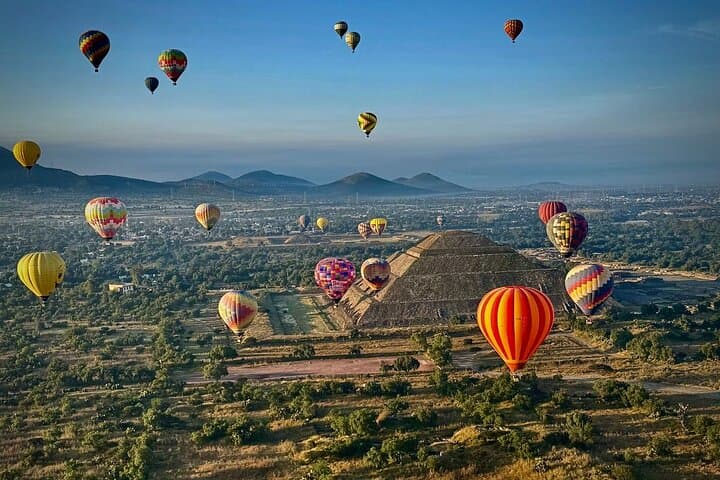


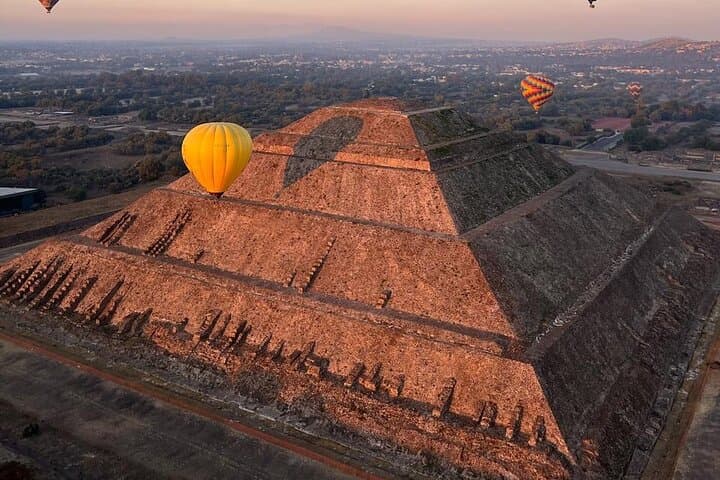
Before sunrise a ragged horizon brightens over the Valley of Mexico, and a cluster of inflated envelopes lifts from the field beside the pyramids.
The flight over Teotihuacan lasts 40–60 minutes; you rise with thermals, drift with high-altitude wind and get a slow, panoramic read of the Avenue of the Dead, the Sun and Moon pyramids and the patchwork agave fields below.
After landing you watch drone footage, then descend into a cave restaurant for a breakfast of local staples and strong coffee. A local artisan leads tastings of pulque and tequila while explaining maguey and obsidian's roles in regional craft and ritual.
Teotihuacan began growing into a major urban center around the first centuries CE. The site sits on volcanic plains where obsidian deposits shaped trade and toolmaking; the pyramids rest on compacted fill and volcanic bedrock that gives the site its striking profiles.
Practical guidance: transfers from central Mexico City run very early (pickup between ~4:30–5:00 a.m.) to reach the launch area by dawn. Total time is roughly six hours including about an hour to explore the archaeological zone; admission is separate. Expect uneven ground, stone stairs and short uphill sections if you climb the Pyramid of the Moon.
Dress in layers for cold mornings and fast-rising sun, hydrate for ~2,300 m elevation and wear sturdy shoes. The pilot controls ascent and descent only—direction depends on wind—so plan for weather-dependent delays or cancellations. Keep valuables secured during landing and respect restricted areas within the archaeological zone.