THE ADVENTURE COLLECTIVE® · Independent discovery and booking for outdoor travel

Float over palm groves and stony desert plains at sunrise, then land for a traditional Berber breakfast in a tent. This small-group flight offers Atlas Mountain views, an early-morning safety briefing, and a gentle aerial perspective of Marrakech’s outskirts.
Float over palm groves and stony desert plains at sunrise, then land for a traditional Berber breakfast in a tent. This small-group flight offers Atlas Mountain views, an early-morning safety briefing, and a gentle aerial perspective of Marrakech’s outskirts.
You lift off before dawn, the basket humming as it rises over palm groves and the pale sweep of desert beyond. Below, the Palmeraie and stony plains of Agafay flatten into patterns that the morning light eagerly paints; the Atlas Mountains stand to the east, their ridgelines watching the balloon like a patient audience.
Verified experiences and guided adventures in the surrounding area.
You lift off before dawn, the basket humming as it rises over palm groves and the pale sweep of desert beyond. Below, the Palmeraie and stony plains of Agafay flatten into patterns that the morning light eagerly paints; the Atlas Mountains stand to the east, their ridgelines watching the balloon like a patient audience.
The region around Marrakech has long been a crossroads—Berber communities have grazed these plains for centuries and the Atlas range records tectonic uplift that still shapes the skyline. The desert you float above is less a sea of sand here and more a stitched landscape of rocky plateaus, palm oases, and irrigated plots that sustain local farms. Pilots point out kasbahs, irrigation channels and distant villages while a Berber tent breakfast on landing connects the flight to local culture and cuisine.
Practically, expect a 3–4 hour excursion with early hotel pickup, a safety briefing, and roughly 45–60 minutes aloft. Temperatures drop at sunrise; winds move you slowly over varied terrain until the pilot chooses a safe, often uneven, field for touchdown. Operators emphasize small groups and experienced crews to limit crowding and improve safety.
Book a morning slot for the best light and calmer air. Wear layers and closed-toe shoes for the landing, bring a camera with a secure strap, and plan logistics for a morning return to Marrakech. The flight is low on physical demand but rich in photographic opportunity and cultural context, a straightforward way to see the desert and Atlas foothills from a quiet, aerial vantage point.
easy.
4 hours.
Minimal fitness required—able to stand for ~1 hour and step in/out of a low basket.
Typical airborne time is about 45–60 minutes within a 3–4 hour overall itinerary including pickup, briefing, inflation and breakfast.
Many operators allow children and older guests, but participants must be able to stand for the flight and enter/exit the basket; check age and weight limits with the operator.
Flights depend on calm winds and safe conditions; operators will reschedule or refund if flights are cancelled for safety reasons.
Most packages include round-trip hotel pickup in Marrakech—confirm exact pickup timing and meeting point at booking.
The Marrakech plain and Atlas foothills have supported Berber and agricultural communities for centuries; kasbahs and irrigation channels still mark historic settlement patterns.
Operators increasingly coordinate with local landowners to limit landing impacts; avoid leaving waste and follow crew instructions to minimize disturbance to fields and wildlife.
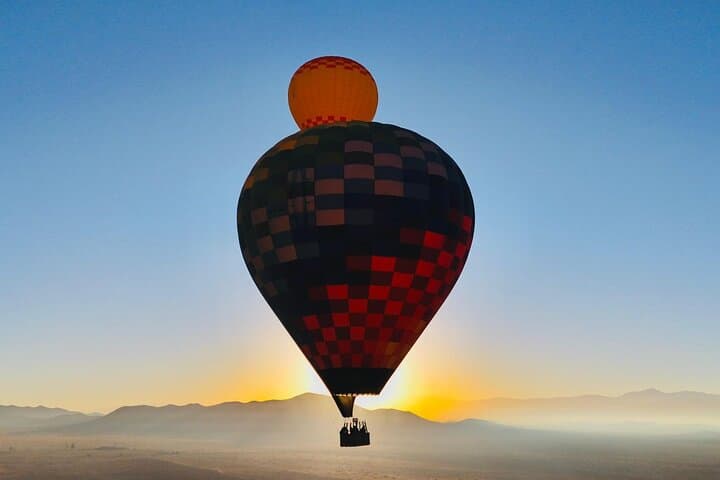
You lift off before dawn, the basket humming as it rises over palm groves and the pale sweep of desert beyond. Below, the Palmeraie and stony plains of Agafay flatten into patterns that the morning light eagerly paints; the Atlas Mountains stand to the east, their ridgelines watching the balloon like a patient audience.
You lift off before dawn, the basket humming as it rises over palm groves and the pale sweep of desert beyond. Below, the Palmeraie and stony plains of Agafay flatten into patterns that the morning light eagerly paints; the Atlas Mountains stand to the east, their ridgelines watching the balloon like a patient audience.
The region around Marrakech has long been a crossroads—Berber communities have grazed these plains for centuries and the Atlas range records tectonic uplift that still shapes the skyline. The desert you float above is less a sea of sand here and more a stitched landscape of rocky plateaus, palm oases, and irrigated plots that sustain local farms. Pilots point out kasbahs, irrigation channels and distant villages while a Berber tent breakfast on landing connects the flight to local culture and cuisine.
Practically, expect a 3–4 hour excursion with early hotel pickup, a safety briefing, and roughly 45–60 minutes aloft. Temperatures drop at sunrise; winds move you slowly over varied terrain until the pilot chooses a safe, often uneven, field for touchdown. Operators emphasize small groups and experienced crews to limit crowding and improve safety.
Book a morning slot for the best light and calmer air. Wear layers and closed-toe shoes for the landing, bring a camera with a secure strap, and plan logistics for a morning return to Marrakech. The flight is low on physical demand but rich in photographic opportunity and cultural context, a straightforward way to see the desert and Atlas foothills from a quiet, aerial vantage point.