THE ADVENTURE COLLECTIVE® · Independent discovery and booking for outdoor travel

Float over the Nile Valley at sunrise, then follow an Egyptologist through the West Bank’s royal tombs. This private half-day pairs aerial views with intimate archaeology—ideal for photographers and history lovers.
Float over the Nile Valley at sunrise, then follow an Egyptologist through the West Bank’s royal tombs. This private half-day pairs aerial views with intimate archaeology—ideal for photographers and history lovers.
Before dawn the desert exhales cool air and the basket bumps gently as the balloon fills; you lift, and Luxor unfurls beneath you—Nile ribbons its way through green fields while mudbrick villages shrink into geometry. The sun edges over the desert rim, throwing long shadows from temples and the stepped silhouette of Hatshepsut’s mortuary into sharp relief.
Verified experiences and guided adventures in the surrounding area.
Operated by Saray El-Nile · Luxor, Luxor Governorate
Before dawn the desert exhales cool air and the basket bumps gently as the balloon fills; you lift, and Luxor unfurls beneath you—Nile ribbons its way through green fields while mudbrick villages shrink into geometry. The sun edges over the desert rim, throwing long shadows from temples and the stepped silhouette of Hatshepsut’s mortuary into sharp relief.
This is the landscape of ancient Thebes: a pharaonic necropolis carved into the West Bank’s limestone cliffs, where tombs of New Kingdom rulers protect painted chambers and funerary corridors. Geologically the valley is a seam between the Nile’s fertile floodplain and the arid plateau; centuries of alluvial silt built the farmland you cross, while wind and flash floods sculpted the cliffs that hide royal tombs.
Culturally, the day balances spectacle and scholarship. A licensed Egyptologist guides you through the Valley of the Kings, Hatshepsut’s temple and the Colossi of Memnon, translating hieroglyphs and explaining ritual life while local farmers tend fields below. Small customs persist—modest dress at sites and subdued behavior in tombs—and your private vehicle keeps logistics tidy.
Practical guidance: pickups are pre-dawn; expect early starts and cool air that warms quickly—dress in layers. Camera gear and extra batteries are essential but avoid flash photography inside tombs. Most walking is on compacted paths and stairs; basic mobility suffices. Bottled water and transfers to/from the balloon launch are typically included, but bring sun protection and a small daypack. Weather can cancel flights—allow flexibility—and tip guides and crew for good service. The combination of airborne perspective and intimate archaeology makes this a compact, unforgettable way to read Luxor’s landscape.
moderate.
5–6 hours.
Suitable for travelers with basic mobility—short walks, stairs in tombs, and standing during the balloon experience.
Operators follow safety protocols and licensed pilots; flights can be canceled for high winds—always follow crew instructions.
Pickup is before sunrise (often 60–90 minutes prior) to reach the launch site; exact time varies seasonally and by hotel location.
Most combined tours include standard entrance into the Valley of the Kings and Hatshepsut, but confirm with your operator if specific tombs or special access are covered.
Infants typically must sit on laps in the basket and some companies have minimum age or weight limits—check provider policies when booking.
Luxor stands on ancient Thebes, the power center of Egypt’s New Kingdom; the West Bank served as the royal funerary landscape for pharaohs and nobles.
Tourism pressure affects fragile tomb paintings and desert soils—use marked paths, avoid touching reliefs, and follow guide rules to minimize impact.
Saray El-Nile operates guided outdoor trips and adventures with an emphasis on safety, stewardship, and memorable experiences.
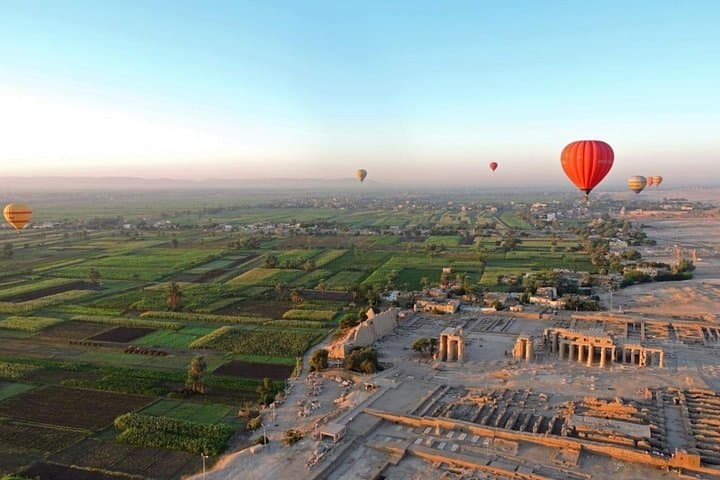


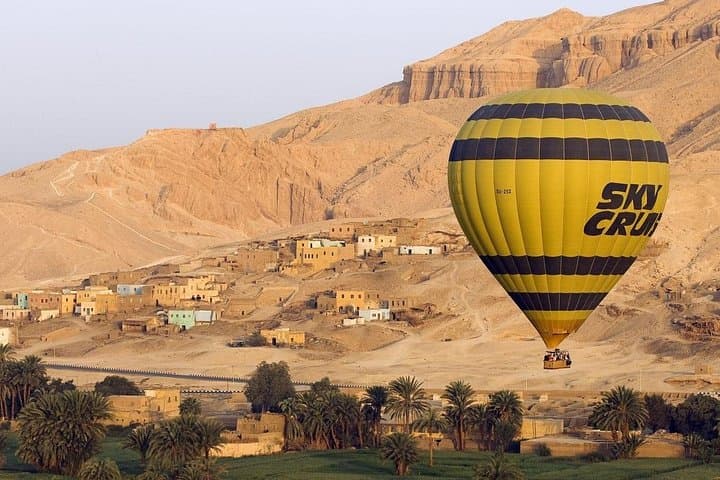
Before dawn the desert exhales cool air and the basket bumps gently as the balloon fills; you lift, and Luxor unfurls beneath you—Nile ribbons its way through green fields while mudbrick villages shrink into geometry. The sun edges over the desert rim, throwing long shadows from temples and the stepped silhouette of Hatshepsut’s mortuary into sharp relief.
Before dawn the desert exhales cool air and the basket bumps gently as the balloon fills; you lift, and Luxor unfurls beneath you—Nile ribbons its way through green fields while mudbrick villages shrink into geometry. The sun edges over the desert rim, throwing long shadows from temples and the stepped silhouette of Hatshepsut’s mortuary into sharp relief.
This is the landscape of ancient Thebes: a pharaonic necropolis carved into the West Bank’s limestone cliffs, where tombs of New Kingdom rulers protect painted chambers and funerary corridors. Geologically the valley is a seam between the Nile’s fertile floodplain and the arid plateau; centuries of alluvial silt built the farmland you cross, while wind and flash floods sculpted the cliffs that hide royal tombs.
Culturally, the day balances spectacle and scholarship. A licensed Egyptologist guides you through the Valley of the Kings, Hatshepsut’s temple and the Colossi of Memnon, translating hieroglyphs and explaining ritual life while local farmers tend fields below. Small customs persist—modest dress at sites and subdued behavior in tombs—and your private vehicle keeps logistics tidy.
Practical guidance: pickups are pre-dawn; expect early starts and cool air that warms quickly—dress in layers. Camera gear and extra batteries are essential but avoid flash photography inside tombs. Most walking is on compacted paths and stairs; basic mobility suffices. Bottled water and transfers to/from the balloon launch are typically included, but bring sun protection and a small daypack. Weather can cancel flights—allow flexibility—and tip guides and crew for good service. The combination of airborne perspective and intimate archaeology makes this a compact, unforgettable way to read Luxor’s landscape.