THE ADVENTURE COLLECTIVE® · Independent discovery and booking for outdoor travel

Catch the temple’s silhouette as sunrise floods the moat and walk through centuries of Khmer history with a private guide. This one‑day tour covers Angkor Wat, Angkor Thom and Ta Prohm with hotel pickup and private transport.
Catch the temple’s silhouette as sunrise floods the moat and walk through centuries of Khmer history with a private guide. This one‑day tour covers Angkor Wat, Angkor Thom and Ta Prohm with hotel pickup and private transport.
The pre-dawn hush around the lotus pond is part ritual, part suspense: black water holds the temple’s silhouette until the horizon bleeds gold and Angkor Wat steps into view.
Verified experiences and guided adventures in the surrounding area.
Operated by Tour Guide-Siem Reap · Siem Reap, Siem Reap Province
The pre-dawn hush around the lotus pond is part ritual, part suspense: black water holds the temple’s silhouette until the horizon bleeds gold and Angkor Wat steps into view.
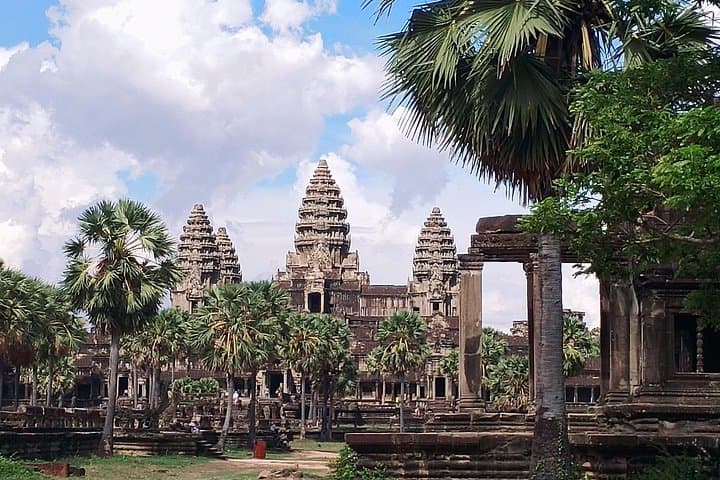
A private guide steers you through that first hour—pointing out the mirror-like reflections, then ferrying you across the galleries where bas‑reliefs narrate wars, cosmology and royal life. The tour moves on to Angkor Thom’s Bayon, whose 216 stone faces watch time pass, then to Ta Prohm where strangler figs have slowly embraced the stones, leaving roots that push and pry like patient hands.
Built in the early 12th century by King Suryavarman II, Angkor Wat began as a state temple and mausoleum; later monuments trace the Khmer Empire’s changing faiths and fortunes. The complex sits on Permian–Triassic sandstone laid down millions of years earlier, carved into massive blocks and transported by an ingenious ancient logistics system.
Practically: expect a 6–8 hour private day with hotel pickup around 4:30 a.m., air‑conditioned transport and an English‑speaking guide. Wear sun‑covering, breathable clothing that respects local customs; bring a refillable water bottle, sturdy shoes for uneven steps, and a lightweight rain layer in the wet season. Confirm whether your tour includes the Angkor Archaeological Park pass—if not, buy it at the ticket center before entry.
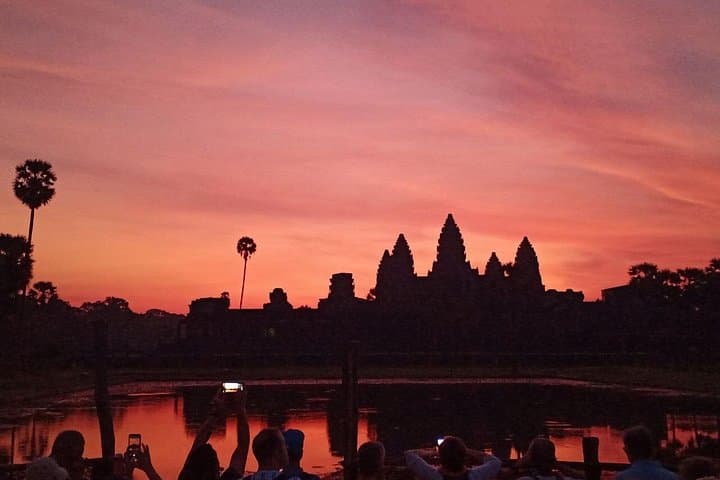
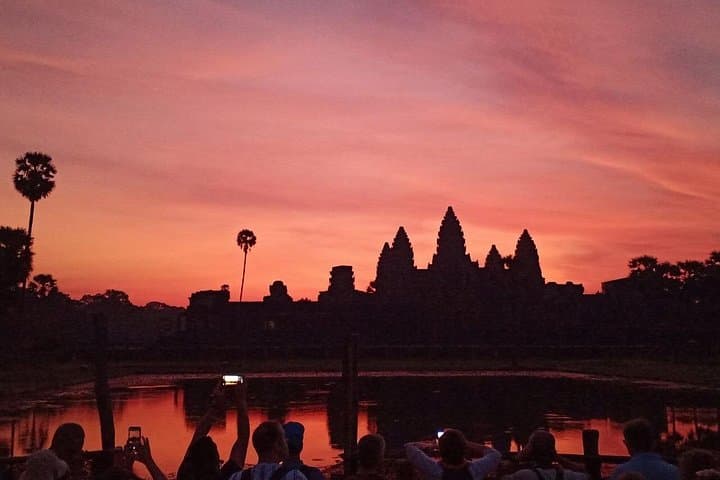
Crowds concentrate at the classic reflection shot; your guide can suggest quieter angles and timing. Move deliberately, give yourself time at each gallery, and remember: these stones are fragile. Leave only photographs, and let the place keep its patient presence for the next dawn.
easy.
6–8 hours.
Light walking on uneven ground and stone steps; suitable for most fitness levels with basic mobility.
Most private sunrise tours pick you up between 4:00–4:45 a.m. to reach the reflection pools before dawn; check your confirmation for the exact time.
Inclusions vary by operator—confirm with your booking whether the Angkor Archaeological Park pass is supplied or if you need to buy it at the ticket center.
Some areas have ramps or level access, but many temple platforms have steep or uneven steps; advise your operator in advance to arrange suitable transport and routing.
Photograph respectfully and always ask permission for close shots of monks or worshippers; avoid flash during ceremonies and maintain a polite distance.
Angkor Wat was constructed early in the 12th century under King Suryavarman II as a state temple and mausoleum; later additions across the park reflect shifts from Hinduism to Buddhism and the Khmer Empire’s evolution.
Ticket revenue supports restoration and management, but heavy foot traffic stresses ancient masonry—follow paths, avoid climbing on fragile carvings, and use established viewing areas.
Tour Guide-Siem Reap operates guided outdoor trips and adventures with an emphasis on safety, stewardship, and memorable experiences.
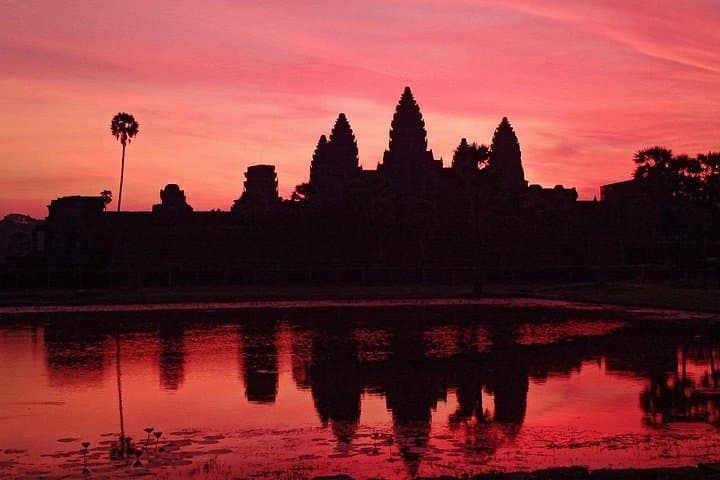
The pre-dawn hush around the lotus pond is part ritual, part suspense: black water holds the temple’s silhouette until the horizon bleeds gold and Angkor Wat steps into view.
The pre-dawn hush around the lotus pond is part ritual, part suspense: black water holds the temple’s silhouette until the horizon bleeds gold and Angkor Wat steps into view.
A private guide steers you through that first hour—pointing out the mirror-like reflections, then ferrying you across the galleries where bas‑reliefs narrate wars, cosmology and royal life. The tour moves on to Angkor Thom’s Bayon, whose 216 stone faces watch time pass, then to Ta Prohm where strangler figs have slowly embraced the stones, leaving roots that push and pry like patient hands.
Built in the early 12th century by King Suryavarman II, Angkor Wat began as a state temple and mausoleum; later monuments trace the Khmer Empire’s changing faiths and fortunes. The complex sits on Permian–Triassic sandstone laid down millions of years earlier, carved into massive blocks and transported by an ingenious ancient logistics system.
Practically: expect a 6–8 hour private day with hotel pickup around 4:30 a.m., air‑conditioned transport and an English‑speaking guide. Wear sun‑covering, breathable clothing that respects local customs; bring a refillable water bottle, sturdy shoes for uneven steps, and a lightweight rain layer in the wet season. Confirm whether your tour includes the Angkor Archaeological Park pass—if not, buy it at the ticket center before entry.
Crowds concentrate at the classic reflection shot; your guide can suggest quieter angles and timing. Move deliberately, give yourself time at each gallery, and remember: these stones are fragile. Leave only photographs, and let the place keep its patient presence for the next dawn.