THE ADVENTURE COLLECTIVE® · Independent discovery and booking for outdoor travel

Climb Etna’s quieter north slope by authorized 4x4 then trek 5 km up to the Central Crater at 3,380 m. Expect loose scoria, volcanic gases and sweeping island-to-sea views on a guided, moderate-to-challenging half-day.
Climb Etna’s quieter north slope by authorized 4x4 then trek 5 km up to the Central Crater at 3,380 m. Expect loose scoria, volcanic gases and sweeping island-to-sea views on a guided, moderate-to-challenging half-day.
The morning air on Etna’s north flank is thin and sharp; 4x4s kick up powdery scoria as they climb through recent lava flows while the pine forest below thins into a stony high-desert. From Piano Provenzana the route threads across lateral craters and fissures, then opens to a panoramic ramp that runs high above the island—sea on two sides, Aeolian silhouettes on the horizon.
Verified experiences and guided adventures in the surrounding area.
Operated by Guide Vulcanologiche Etna Nord · Linguaglossa, Sicily
The morning air on Etna’s north flank is thin and sharp; 4x4s kick up powdery scoria as they climb through recent lava flows while the pine forest below thins into a stony high-desert. From Piano Provenzana the route threads across lateral craters and fissures, then opens to a panoramic ramp that runs high above the island—sea on two sides, Aeolian silhouettes on the horizon.
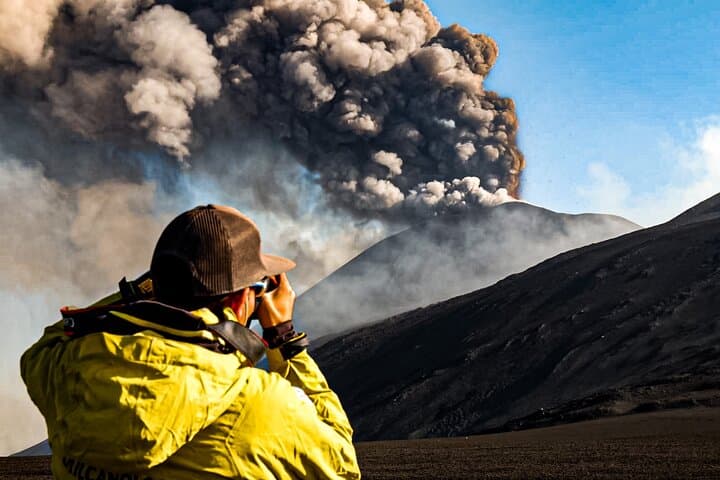
More than a hike, this is a volcanic field study in motion. Etna’s surface reads like a history of eruptions: black hummocks of aa, smoother pahoehoe-like sheets, and the scar of the 2002 flow that reshaped Piano Provenzana. Guides here are authorized volcanological professionals who navigate shifting gas, hot vents and unstable ground; daily activity dictates the exact path toward the summit zone.
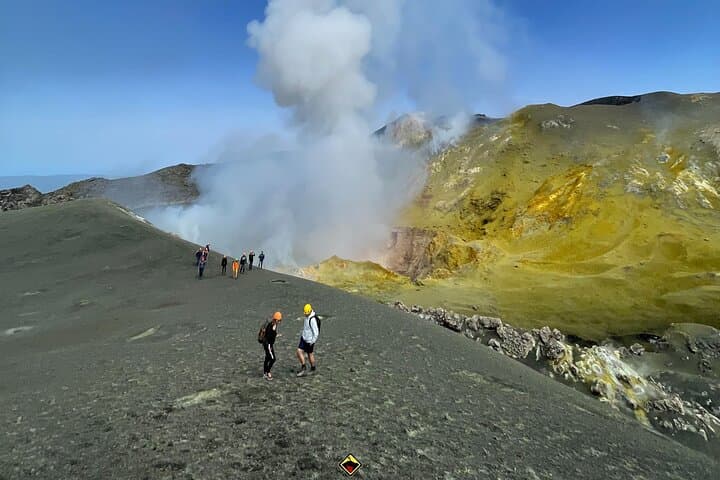
The trekking segment is 5 km with about 550 m of ascent, moving from 2,960 m to the Central Crater at roughly 3,380 m. Expect loose scoria, volcanic bombs, fumarolic smells and sweeping crater rims where steam and mineral-streaked rock give the landscape a raw character.
Practicalities matter: sturdy boots, windproof layers and sun protection are essential; the descent on soft scoria can be quick but abrasive on knees. Groups stay small on the north slope, and the whole excursion runs about five hours including the 25–30 minute 4x4 transfer back to Piano Provenzana. Weather, visibility and volcanic behavior can alter or cancel the route—safety comes first, but the view from the roof of Sicily rewards the effort.
challenging.
5 hours.
Good cardiovascular fitness and regular hiking experience recommended due to sustained ascent and high altitude.
The trek covers about 5 km with 550 m of ascent at high altitude; it’s physically demanding but non-technical—moderately experienced hikers should be fine.
This excursion is not recommended for children under 12 or for pregnant travelers due to altitude, unstable ground and potential gas exposure.
Guides will alter or cancel the route for safety; refunds or rebooking follow the operator’s cancellation policy if conditions prevent the excursion.
Authorized guides typically supply helmets and may provide trekking shoes/poles on request, but personal, well-fitting boots and layered clothing are recommended.
Piano Provenzana was heavily altered by the October 27, 2002 eruption; the visitor area sits within that flow and illustrates Etna’s recent history.
Volcanic soils are fragile and unstable—stick to guided routes, avoid collecting samples, and follow local conservation ordinances to protect sensitive landscapes.
Guide Vulcanologiche Etna Nord operates guided outdoor trips and adventures with an emphasis on safety, stewardship, and memorable experiences.


The morning air on Etna’s north flank is thin and sharp; 4x4s kick up powdery scoria as they climb through recent lava flows while the pine forest below thins into a stony high-desert. From Piano Provenzana the route threads across lateral craters and fissures, then opens to a panoramic ramp that runs high above the island—sea on two sides, Aeolian silhouettes on the horizon.
The morning air on Etna’s north flank is thin and sharp; 4x4s kick up powdery scoria as they climb through recent lava flows while the pine forest below thins into a stony high-desert. From Piano Provenzana the route threads across lateral craters and fissures, then opens to a panoramic ramp that runs high above the island—sea on two sides, Aeolian silhouettes on the horizon.
More than a hike, this is a volcanic field study in motion. Etna’s surface reads like a history of eruptions: black hummocks of aa, smoother pahoehoe-like sheets, and the scar of the 2002 flow that reshaped Piano Provenzana. Guides here are authorized volcanological professionals who navigate shifting gas, hot vents and unstable ground; daily activity dictates the exact path toward the summit zone.
The trekking segment is 5 km with about 550 m of ascent, moving from 2,960 m to the Central Crater at roughly 3,380 m. Expect loose scoria, volcanic bombs, fumarolic smells and sweeping crater rims where steam and mineral-streaked rock give the landscape a raw character.
Practicalities matter: sturdy boots, windproof layers and sun protection are essential; the descent on soft scoria can be quick but abrasive on knees. Groups stay small on the north slope, and the whole excursion runs about five hours including the 25–30 minute 4x4 transfer back to Piano Provenzana. Weather, visibility and volcanic behavior can alter or cancel the route—safety comes first, but the view from the roof of Sicily rewards the effort.