THE ADVENTURE COLLECTIVE® · Independent discovery and booking for outdoor travel

A demanding full-day guided climb from Pucón into Conguillío National Park that gains roughly 1,700 m to reach Llaima’s 3,125 m summit. Expect volcanic scree, possible snow and ice, and broad views over neighboring volcanoes and lakes.
A demanding full-day guided climb from Pucón into Conguillío National Park that gains roughly 1,700 m to reach Llaima’s 3,125 m summit. Expect volcanic scree, possible snow and ice, and broad views over neighboring volcanoes and lakes.
Wind strips clean along the final ridge as you push toward Llaima’s crater — black scoria underfoot, a ring of steam in the distance, and the Araucanía plateau opening to distant lake mirrors. The day begins before dawn in Pucón; the van climbs through pine plantations and the Araucaria woodlands of Conguillío National Park before depositing the group at the volcano’s base near 1,400 m.
Verified experiences and guided adventures in the surrounding area.
Operated by Ermitaño Expediciones · Pucón, Araucanía Region
Wind strips clean along the final ridge as you push toward Llaima’s crater — black scoria underfoot, a ring of steam in the distance, and the Araucanía plateau opening to distant lake mirrors. The day begins before dawn in Pucón; the van climbs through pine plantations and the Araucaria woodlands of Conguillío National Park before depositing the group at the volcano’s base near 1,400 m.
Llaima is one of Chile’s most active volcanos, its cone built from layers of lava and tephra that record cycles of eruption and glacial erosion. The landscape mixes recent volcanic rock with ancient araucaria groves and glacially carved basins — a place where Mapuche culture and geologic violence share the same horizon. Guides here combine mountaineering technique with local knowledge: route choice depends on snow and wind, and the ascent reveals views of neighboring volcanoes and highland lakes.
Practical guide: expect ~1,700 m of elevation gain to 3,125 m, a long summit day that can take most of daylight hours. Trail surfaces alternate between volcanic scree, packed snow, and occasional steep steps; crampon and ice-ax use are typical in shoulder seasons and winter. Bring a layered system for alpine winds, sufficient water and calories, and assume cold temps near the summit even in summer. Prior high-aerobic fitness and some experience with high-elevation climbs are strongly recommended.
If you go, leave no trace: the park’s fragile soils and ancient araucarias recover slowly from trampling. Summit photos are memorable, but the real reward is the hard-earned panorama and the quiet resilience of this volcanic landscape.
difficult.
10–16 hours.
Strong aerobic base and experience on sustained uphill hikes; comfortable with 6+ hours of continuous effort at altitude.
You should have a strong aerobic base and experience with long uphill hikes; the day includes ~1,700 m of elevation gain and alpine conditions.
Yes — guides typically provide crampons, ice axe, helmet and poles, but you should bring appropriate boots and layers that work with crampons.
Previous crampon/ice-axe experience is recommended; guided instruction is provided but participants must be comfortable on steep, loose, or icy slopes.
Summer offers the most stable weather and less snow, but shoulder seasons can be climbed with proper technical gear and favorable conditions; winter climbs require full alpine experience.
Llaima’s eruptions have shaped local landscapes for millennia and the area sits within traditional Mapuche territory; many place names and routes reflect this cultural history.
Conguillío’s araucaria forests are fragile — stick to established trails, pack out waste, and follow guide instructions to minimize impact.
Ermitaño Expediciones operates guided outdoor trips and adventures with an emphasis on safety, stewardship, and memorable experiences.
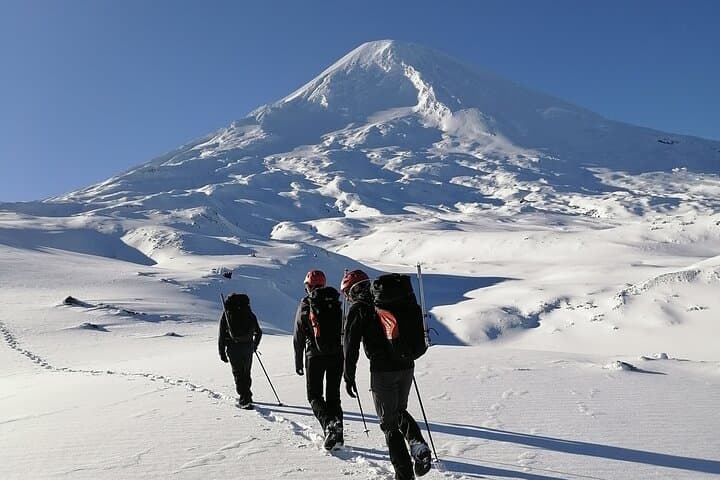
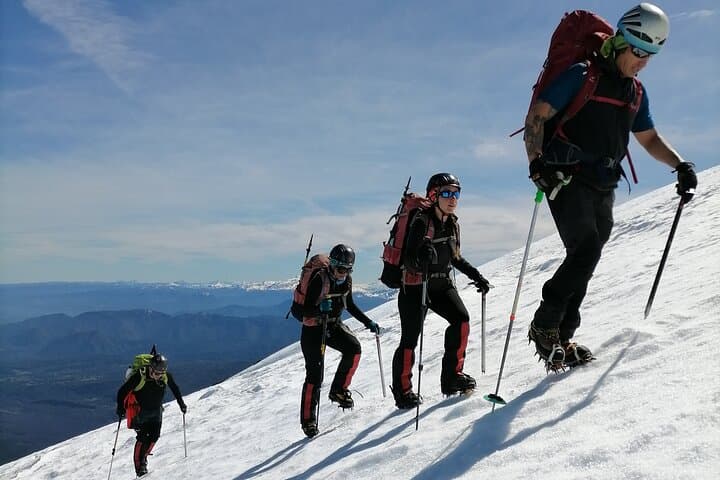
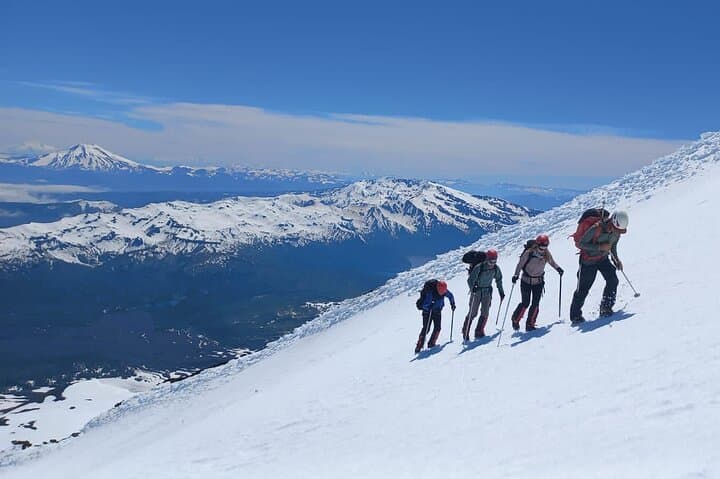
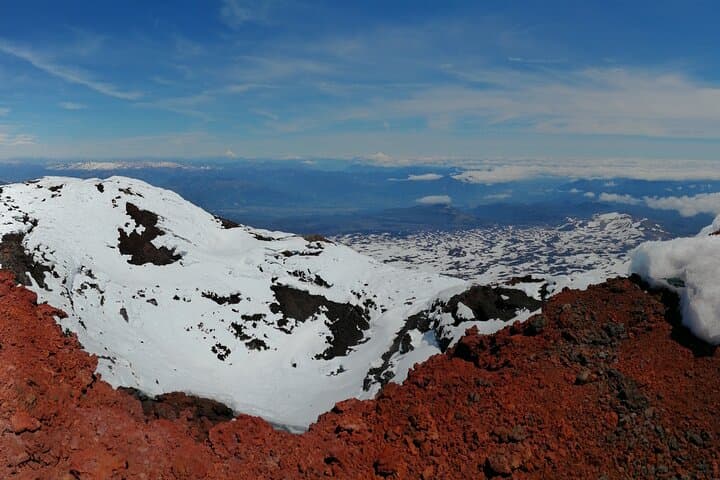
Wind strips clean along the final ridge as you push toward Llaima’s crater — black scoria underfoot, a ring of steam in the distance, and the Araucanía plateau opening to distant lake mirrors. The day begins before dawn in Pucón; the van climbs through pine plantations and the Araucaria woodlands of Conguillío National Park before depositing the group at the volcano’s base near 1,400 m.
Wind strips clean along the final ridge as you push toward Llaima’s crater — black scoria underfoot, a ring of steam in the distance, and the Araucanía plateau opening to distant lake mirrors. The day begins before dawn in Pucón; the van climbs through pine plantations and the Araucaria woodlands of Conguillío National Park before depositing the group at the volcano’s base near 1,400 m.
Llaima is one of Chile’s most active volcanos, its cone built from layers of lava and tephra that record cycles of eruption and glacial erosion. The landscape mixes recent volcanic rock with ancient araucaria groves and glacially carved basins — a place where Mapuche culture and geologic violence share the same horizon. Guides here combine mountaineering technique with local knowledge: route choice depends on snow and wind, and the ascent reveals views of neighboring volcanoes and highland lakes.
Practical guide: expect ~1,700 m of elevation gain to 3,125 m, a long summit day that can take most of daylight hours. Trail surfaces alternate between volcanic scree, packed snow, and occasional steep steps; crampon and ice-ax use are typical in shoulder seasons and winter. Bring a layered system for alpine winds, sufficient water and calories, and assume cold temps near the summit even in summer. Prior high-aerobic fitness and some experience with high-elevation climbs are strongly recommended.
If you go, leave no trace: the park’s fragile soils and ancient araucarias recover slowly from trampling. Summit photos are memorable, but the real reward is the hard-earned panorama and the quiet resilience of this volcanic landscape.