THE ADVENTURE COLLECTIVE® · Independent discovery and booking for outdoor travel

Ha Ling Peak rises sharply above Canmore, offering a steep, rooted scramble and sweeping Bow Valley views. This guide covers history, terrain, and the practical gear and timing to summit safely in a single morning or afternoon.
Ha Ling Peak rises sharply above Canmore, offering a steep, rooted scramble and sweeping Bow Valley views. This guide covers history, terrain, and the practical gear and timing to summit safely in a single morning or afternoon.
A narrow ridge rises above Canmore, the town shrinking beneath your boots and the Bow Valley stretching east toward Banff. On a clear morning the scramble up Ha Ling Peak cuts through larch benches and scree; wind shapes the views and the valley answers back with distant glacier-polished ridges.
Verified experiences and guided adventures in the surrounding area.
Operated by Freeheelin' Adventures · Canmore, Alberta
A narrow ridge rises above Canmore, the town shrinking beneath your boots and the Bow Valley stretching east toward Banff. On a clear morning the scramble up Ha Ling Peak cuts through larch benches and scree; wind shapes the views and the valley answers back with distant glacier-polished ridges.
The peak carries local history—named for Ha Ling, a Chinese cook who reportedly topped the mountain after a late-19th-century bet—and its rock records the same tectonic forces that raised the Canadian Rockies: tilted sedimentary layers, steep faces, and talus fields that remind you the earth is still settling. The route is heavily used by residents and visitors alike, a cultural ritual in Canmore where weekend hikers, trail runners, and guide-led groups converge before and after the climb.
Expect a steep, direct ascent of roughly 3–4 hours round-trip: about 6–8 km depending on the approach, and roughly 600–700 m of elevation gain. Much of the trail alternates compact dirt switchbacks with exposed scree and short sections of hand-assisted scrambling; the summit offers 360-degree views of the Bow Valley and neighboring peaks.
Practical guide: start early for parking and calmer winds, wear ankle-supporting footwear, carry at least 1.5 L of water, and pack layers—weather shifts quickly at alpine elevations. If unfamiliar with scrambling, go with a guide or a group; keep to the trail to protect fragile alpine plants and respect wildlife distances. With preparation, Ha Ling is a reachable, rewarding summit for motivated hikers looking to earn a true Rockies view.
moderate.
3–4 hours.
Good aerobic fitness and leg strength recommended; comfortable with continuous uphill hiking and short scrambles.
Plan on 3–4 hours round-trip with roughly 600–700 m (2,000–2,300 ft) of elevation gain; much of the route is a steady, steep climb with short scrambling sections.
Fit beginners with hiking experience can complete it, but children should be comfortable with continuous uphill hiking and some exposed sections—consider a guide for less experienced parties.
No permit is required for the trail, but guided groups add safety and interpretation; guides can help with route choice and scrambling technique.
Late spring through early fall offers the safest conditions; winter requires mountaineering gear and avalanche awareness.
Ha Ling Peak is named after Ha Ling, a Chinese cook who famously summited in the late 19th century after a local bet, a story woven into Canmore’s pioneer history.
High use has caused trail erosion and fragile alpine plant damage; practice Leave No Trace, stick to the tread, and keep dogs leashed where required.
Freeheelin' Adventures operates guided outdoor trips and adventures with an emphasis on safety, stewardship, and memorable experiences.
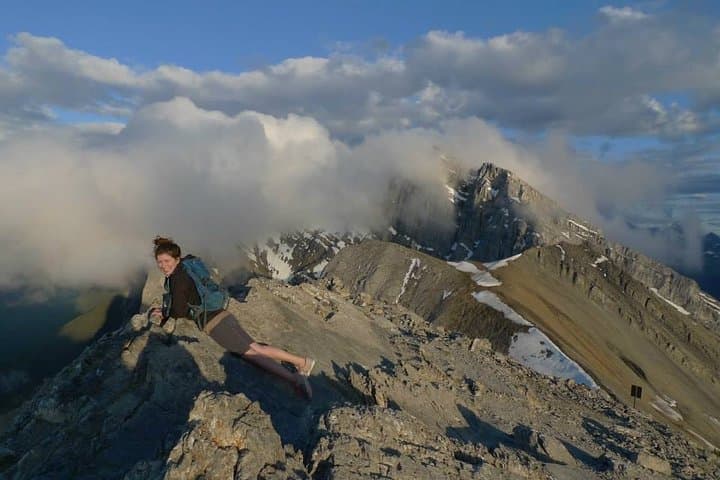


A narrow ridge rises above Canmore, the town shrinking beneath your boots and the Bow Valley stretching east toward Banff. On a clear morning the scramble up Ha Ling Peak cuts through larch benches and scree; wind shapes the views and the valley answers back with distant glacier-polished ridges.
A narrow ridge rises above Canmore, the town shrinking beneath your boots and the Bow Valley stretching east toward Banff. On a clear morning the scramble up Ha Ling Peak cuts through larch benches and scree; wind shapes the views and the valley answers back with distant glacier-polished ridges.
The peak carries local history—named for Ha Ling, a Chinese cook who reportedly topped the mountain after a late-19th-century bet—and its rock records the same tectonic forces that raised the Canadian Rockies: tilted sedimentary layers, steep faces, and talus fields that remind you the earth is still settling. The route is heavily used by residents and visitors alike, a cultural ritual in Canmore where weekend hikers, trail runners, and guide-led groups converge before and after the climb.
Expect a steep, direct ascent of roughly 3–4 hours round-trip: about 6–8 km depending on the approach, and roughly 600–700 m of elevation gain. Much of the trail alternates compact dirt switchbacks with exposed scree and short sections of hand-assisted scrambling; the summit offers 360-degree views of the Bow Valley and neighboring peaks.
Practical guide: start early for parking and calmer winds, wear ankle-supporting footwear, carry at least 1.5 L of water, and pack layers—weather shifts quickly at alpine elevations. If unfamiliar with scrambling, go with a guide or a group; keep to the trail to protect fragile alpine plants and respect wildlife distances. With preparation, Ha Ling is a reachable, rewarding summit for motivated hikers looking to earn a true Rockies view.