THE ADVENTURE COLLECTIVE® · Independent discovery and booking for outdoor travel

Step beyond the Pitti Palace into the Boboli Gardens, a working Renaissance landscape of terraces, sculptures and hidden grottos. This concise guide outlines what to see, why the gardens matter historically, and how to plan a one-hour visit.
Step beyond the Pitti Palace into the Boboli Gardens, a working Renaissance landscape of terraces, sculptures and hidden grottos. This concise guide outlines what to see, why the gardens matter historically, and how to plan a one-hour visit.
A warm breeze threads through plane trees as you step through the Pitti Palace arch and into the Boboli Gardens — a lived-in outdoor museum where stone statues glance over sunlit terraces and clipped hedges give way to long views of Florence.
Verified experiences and guided adventures in the surrounding area.
A warm breeze threads through plane trees as you step through the Pitti Palace arch and into the Boboli Gardens — a lived-in outdoor museum where stone statues glance over sunlit terraces and clipped hedges give way to long views of Florence.
The garden began as the Medici’s 16th-century park and quickly became a model for European landscape design: grottos by Buontalenti, axial promenades, and sculptural grottoes that marry art and engineered water. The site sits on the Oltrarno slope above the Arno, its terraces carved into the hill with classical viewpoints that frame the Duomo and the Tuscan hills beyond.
Walks here alternate paved promenades, gravel paths and stair flights; the lower amphitheatre and the Isolotto fountain reward detours with quiet corners and Renaissance ornament. Cultural layers are visible — from Medici patronage to later Bourbon restorations — and the park’s layout influenced baroque gardens across Europe.
Expect roughly an hour to see the highlights on a guided route: grotto, amphitheatre, the avenue of statues and panoramic terraces. Terrain is uneven in places and includes stone steps; comfortable shoes and a moderate pace will make the visit easier. Morning and late afternoon offer softer light and fewer crowds; bring water and a light layer for shade-to-sun transitions. Photography is excellent but be mindful of conservation rules and restricted areas.
This is an urban green space that rewards slow walking: read the plaques, follow sightlines toward San Miniato al Monte, and leave time to sit and watch Florence unfold.
easy.
1 hour.
Light urban walking ability; able to manage short flights of stairs and uneven paving
A focused visit to main highlights takes about an hour, though exploring more thoroughly can stretch to two hours or more.
Yes, the gardens have an entry fee; booking ahead is recommended during high season to avoid lines and ensure availability.
Some main areas are accessible, but many paths include steps and uneven surfaces; check specific access routes and speak with staff about assistance.
Small snacks are usually allowed, but picnicking in many historic or planted areas is restricted — use designated seating and avoid trampling planted beds.
Laid out for the Medici in the 16th century, Boboli became a prototype for formal European gardens and houses significant Renaissance sculpture and architectural features.
Management balances public access with restoration; visitors should stay on paths and avoid touching sculptures to minimize wear and support preservation efforts.
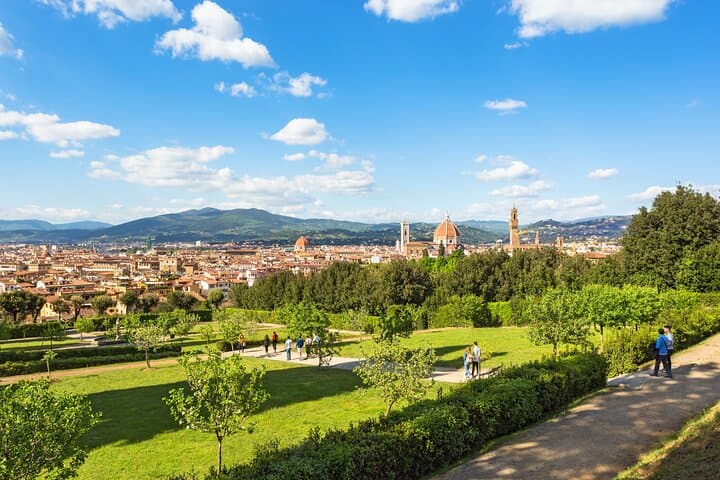
A warm breeze threads through plane trees as you step through the Pitti Palace arch and into the Boboli Gardens — a lived-in outdoor museum where stone statues glance over sunlit terraces and clipped hedges give way to long views of Florence.
A warm breeze threads through plane trees as you step through the Pitti Palace arch and into the Boboli Gardens — a lived-in outdoor museum where stone statues glance over sunlit terraces and clipped hedges give way to long views of Florence.
The garden began as the Medici’s 16th-century park and quickly became a model for European landscape design: grottos by Buontalenti, axial promenades, and sculptural grottoes that marry art and engineered water. The site sits on the Oltrarno slope above the Arno, its terraces carved into the hill with classical viewpoints that frame the Duomo and the Tuscan hills beyond.
Walks here alternate paved promenades, gravel paths and stair flights; the lower amphitheatre and the Isolotto fountain reward detours with quiet corners and Renaissance ornament. Cultural layers are visible — from Medici patronage to later Bourbon restorations — and the park’s layout influenced baroque gardens across Europe.
Expect roughly an hour to see the highlights on a guided route: grotto, amphitheatre, the avenue of statues and panoramic terraces. Terrain is uneven in places and includes stone steps; comfortable shoes and a moderate pace will make the visit easier. Morning and late afternoon offer softer light and fewer crowds; bring water and a light layer for shade-to-sun transitions. Photography is excellent but be mindful of conservation rules and restricted areas.
This is an urban green space that rewards slow walking: read the plaques, follow sightlines toward San Miniato al Monte, and leave time to sit and watch Florence unfold.