THE ADVENTURE COLLECTIVE® · Independent discovery and booking for outdoor travel

Explore Stonehenge Aotearoa on a 90‑minute guided tour that pairs Southern Hemisphere astronomy with Polynesian and Māori sky lore. Perfect for travelers seeking an accessible, educational night under the stars in the Wairarapa countryside.
Explore Stonehenge Aotearoa on a 90‑minute guided tour that pairs Southern Hemisphere astronomy with Polynesian and Māori sky lore. Perfect for travelers seeking an accessible, educational night under the stars in the Wairarapa countryside.
Stand inside a ring of timber and stone and look up: the southern sky slides across a dome tuned to these latitudes, constellations shifting like slow dancers. Stonehenge Aotearoa sits on a gentle rise in the Wairarapa countryside; on a clear evening the Milky Way pours over paddocks and the henge frames the arc of the Southern Cross.
Verified experiences and guided adventures in the surrounding area.
Operated by Stonehenge Aotearo · Carterton, Wellington
Stand inside a ring of timber and stone and look up: the southern sky slides across a dome tuned to these latitudes, constellations shifting like slow dancers. Stonehenge Aotearoa sits on a gentle rise in the Wairarapa countryside; on a clear evening the Milky Way pours over paddocks and the henge frames the arc of the Southern Cross.
The site is a modern working observatory inspired by ancient sky-knowledge. Conceived in the early 2000s and opened as an educational monument, it reinterprets archaeoastronomy for the Southern Hemisphere, integrating Polynesian and Māori ways of mapping the heavens alongside Western celestial mechanics.
Geologically the Wairarapa is a low, rolling landscape shaped by tectonic uplift and river terraces; the flat foreground makes for unobstructed horizons—ideal for horizon-based markers and solar alignments. Locally, guides weave practical astronomy with cultural narratives, explaining how navigators read stars for voyaging and seasonal cues for planting.
Practical guidance: shared tours run about 90 minutes with an audiovisual introduction and guided walk-through. Tours are wheelchair accessible but sensible footwear is advised—paths are grass and can be uneven when wet. Arrive 10–15 minutes early to catch pre-show displays and secure a central spot in the ring. Sunset and clear-night slots offer the best sky viewing; cloudy nights shift the focus to the interpretive exhibit.
Bring layered clothing (wind and chill arrive fast after dark), a compact torch for the walk to the carpark, and binoculars for star detail. Expect an intimate, easy-paced experience that pairs cultural history with direct sky observation—an accessible night under the Southern sky.
easy.
1.5 hours (90 minutes).
Suitable for most fitness levels; involves short, flat walking on grass paths
Yes—paths and the main viewing area are accessible, though accessibility can be affected by weather; check with the operator for specific needs.
Yes—tours are family-friendly and designed for general audiences; infants in strollers are permitted but space inside the ring is limited.
Tours proceed with the 15-minute audiovisual presentation and guided interpretive content; fully clear-sky observing depends on conditions and may be limited.
Some tour times finish at sunset and allow viewing from within the henge; book that slot if sunset framing is a priority.
Stonehenge Aotearoa was built in the early 21st century as an educational, working observatory, explicitly incorporating Polynesian and Māori astronomical traditions alongside modern astronomy.
The site emphasizes dark-sky preservation and cultural respect—minimize light and noise, and follow guide instructions to protect night wildlife and cultural displays.
Stonehenge Aotearo operates guided outdoor trips and adventures with an emphasis on safety, stewardship, and memorable experiences.


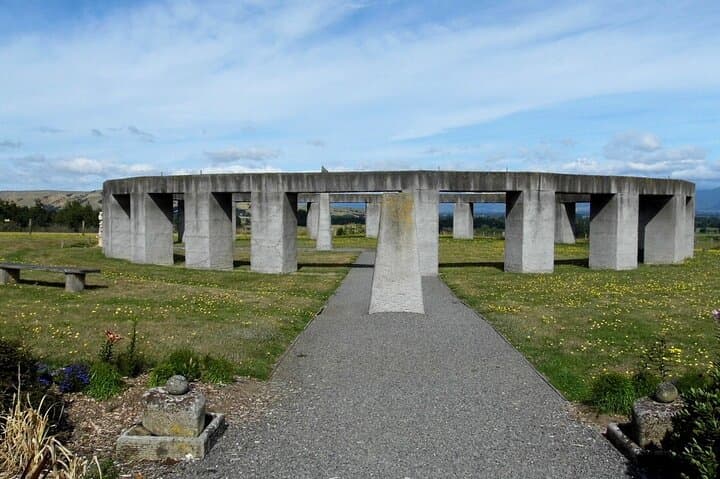
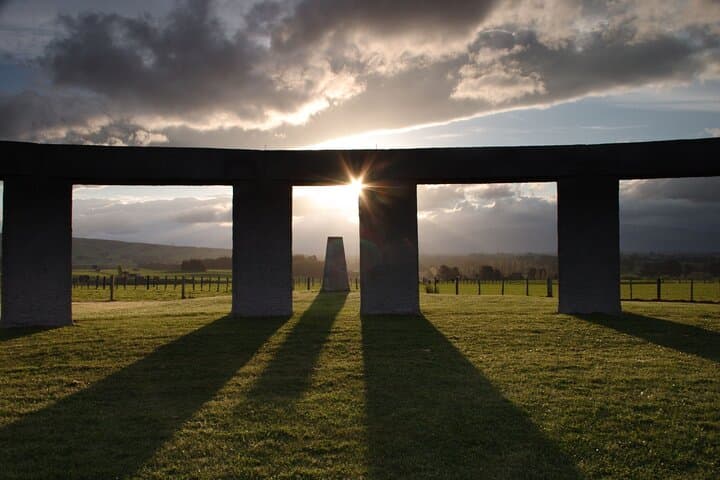
Stand inside a ring of timber and stone and look up: the southern sky slides across a dome tuned to these latitudes, constellations shifting like slow dancers. Stonehenge Aotearoa sits on a gentle rise in the Wairarapa countryside; on a clear evening the Milky Way pours over paddocks and the henge frames the arc of the Southern Cross.
Stand inside a ring of timber and stone and look up: the southern sky slides across a dome tuned to these latitudes, constellations shifting like slow dancers. Stonehenge Aotearoa sits on a gentle rise in the Wairarapa countryside; on a clear evening the Milky Way pours over paddocks and the henge frames the arc of the Southern Cross.
The site is a modern working observatory inspired by ancient sky-knowledge. Conceived in the early 2000s and opened as an educational monument, it reinterprets archaeoastronomy for the Southern Hemisphere, integrating Polynesian and Māori ways of mapping the heavens alongside Western celestial mechanics.
Geologically the Wairarapa is a low, rolling landscape shaped by tectonic uplift and river terraces; the flat foreground makes for unobstructed horizons—ideal for horizon-based markers and solar alignments. Locally, guides weave practical astronomy with cultural narratives, explaining how navigators read stars for voyaging and seasonal cues for planting.
Practical guidance: shared tours run about 90 minutes with an audiovisual introduction and guided walk-through. Tours are wheelchair accessible but sensible footwear is advised—paths are grass and can be uneven when wet. Arrive 10–15 minutes early to catch pre-show displays and secure a central spot in the ring. Sunset and clear-night slots offer the best sky viewing; cloudy nights shift the focus to the interpretive exhibit.
Bring layered clothing (wind and chill arrive fast after dark), a compact torch for the walk to the carpark, and binoculars for star detail. Expect an intimate, easy-paced experience that pairs cultural history with direct sky observation—an accessible night under the Southern sky.