THE ADVENTURE COLLECTIVE® · Independent discovery and booking for outdoor travel

Stand at a unique observatory-café where a Starbucks faces North Korea across a river. This short, coach-based tour to Aegibong Peace Ecopark mixes hands-on viewing, an ecology exhibit and a suspension-bridge approach to a boundary you can actually see.
Stand at a unique observatory-café where a Starbucks faces North Korea across a river. This short, coach-based tour to Aegibong Peace Ecopark mixes hands-on viewing, an ecology exhibit and a suspension-bridge approach to a boundary you can actually see.
You step off the coach and the air opens up — a wide river, a low agricultural plain, and across the water the flat, cultivated fields of North Korea sitting curiously still. A short suspension bridge leads to an elevated concrete observatory where a Starbucks now serves coffee to people who come to look outward: cups in one hand, binoculars in the other.
Verified experiences and guided adventures in the surrounding area.
Operated by SEOUL CITY TOUR CO. LTD. · Gimpo, Gyeonggi-do
You step off the coach and the air opens up — a wide river, a low agricultural plain, and across the water the flat, cultivated fields of North Korea sitting curiously still. A short suspension bridge leads to an elevated concrete observatory where a Starbucks now serves coffee to people who come to look outward: cups in one hand, binoculars in the other.
Aegibong Peace Ecopark repurposed an older lookout into a public ecology and peace site. The Peace Eco Exhibition Hall explains local history and the division of the peninsula; the observatory’s free telescopes and the adjacent Starbucks make the quiet act of watching another country part civic education, part everyday tourism.
Geologically this is an alluvial coastal plain fed by rivers that slow into tidal flats here — the open ground makes sightlines long and the seasons dramatic. Culturally, the spot sits on the edge of contested memory: fields that change with harvests, villages that watch across a border defined after the Korean War.
Practical guide: tours run about five hours from central Seoul with coach transport. Bring your passport (required), a telephoto or binoculars for better detail, and layered clothing — wind off the river can be sharp. Plan visits in clear weather; autumn harvest and late winter offer the most contrast for seeing activity on the far bank. Respect posted signs and restricted areas: the observatory is for viewing only. Snacks and restrooms are available at the exhibition hall; the Starbucks provides a convenient mid-stop. Time your visit for late afternoon light if you want depth in your photos and a quieter crowd at the viewpoint.
easy.
5 hours.
Minimal fitness required; expect short walks, some stairs, and a suspension bridge crossing that’s gentle but may feel unsteady to those with balance issues.
Yes — a current valid passport is required the day of travel and will be checked at pickup.
On clear days and especially during harvest season the view is surprisingly distinct; telescopes and binoculars improve visibility.
Access to the Jogang Observatory is included on this tour and the site provides free telescopes for public use.
The tour involves short walks, stairs, and a suspension bridge; those with severe mobility issues should check in advance as some paths are not fully wheelchair accessible.
The observatory overlooks lands shaped by post–Korean War border arrangements; the area now serves as a public site for observing and interpreting that history.
The tidal flats and riverbanks are ecologically sensitive — stick to trails, avoid disturbing birds, and carry out any trash to protect the habitat.
SEOUL CITY TOUR CO. LTD. operates guided outdoor trips and adventures with an emphasis on safety, stewardship, and memorable experiences.

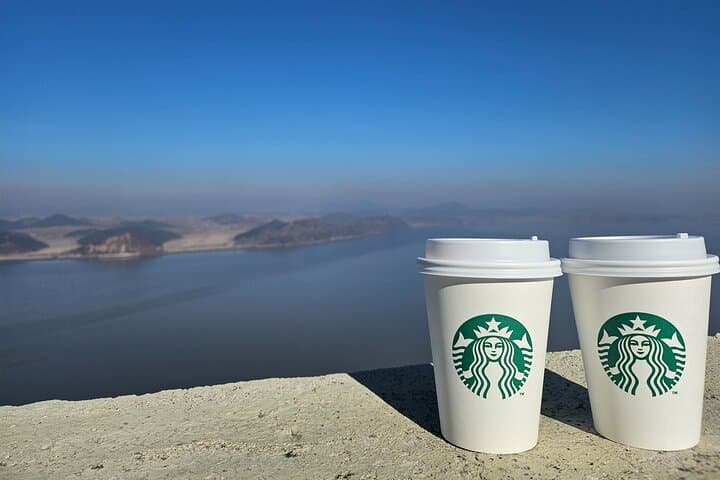


You step off the coach and the air opens up — a wide river, a low agricultural plain, and across the water the flat, cultivated fields of North Korea sitting curiously still. A short suspension bridge leads to an elevated concrete observatory where a Starbucks now serves coffee to people who come to look outward: cups in one hand, binoculars in the other.
You step off the coach and the air opens up — a wide river, a low agricultural plain, and across the water the flat, cultivated fields of North Korea sitting curiously still. A short suspension bridge leads to an elevated concrete observatory where a Starbucks now serves coffee to people who come to look outward: cups in one hand, binoculars in the other.
Aegibong Peace Ecopark repurposed an older lookout into a public ecology and peace site. The Peace Eco Exhibition Hall explains local history and the division of the peninsula; the observatory’s free telescopes and the adjacent Starbucks make the quiet act of watching another country part civic education, part everyday tourism.
Geologically this is an alluvial coastal plain fed by rivers that slow into tidal flats here — the open ground makes sightlines long and the seasons dramatic. Culturally, the spot sits on the edge of contested memory: fields that change with harvests, villages that watch across a border defined after the Korean War.
Practical guide: tours run about five hours from central Seoul with coach transport. Bring your passport (required), a telephoto or binoculars for better detail, and layered clothing — wind off the river can be sharp. Plan visits in clear weather; autumn harvest and late winter offer the most contrast for seeing activity on the far bank. Respect posted signs and restricted areas: the observatory is for viewing only. Snacks and restrooms are available at the exhibition hall; the Starbucks provides a convenient mid-stop. Time your visit for late afternoon light if you want depth in your photos and a quieter crowd at the viewpoint.