THE ADVENTURE COLLECTIVE® · Independent discovery and booking for outdoor travel

Spend a half-day learning to climb on Squamish’s famous granite with certified guides who rig, instruct and encourage you on single-pitch routes. Expect short approaches, 15–40m climbs, and hands-on coaching that turns first-timers into comfortable craggers.
Spend a half-day learning to climb on Squamish’s famous granite with certified guides who rig, instruct and encourage you on single-pitch routes. Expect short approaches, 15–40m climbs, and hands-on coaching that turns first-timers into comfortable craggers.
Morning light hits the granite face and the rock seems to breathe — cool, rough, ready. In Squamish, the vertical world arrives close to the shore: the Sea-to-Sky Highway drops you into a bowl of spruce and slickrock, and in a short walk you’re shoulder-to-shoulder with routes that make beginners feel immediately competent.
Verified experiences and guided adventures in the surrounding area.
Operated by Mountain Skills Academy & Adventures · Squamish, British Columbia
Morning light hits the granite face and the rock seems to breathe — cool, rough, ready. In Squamish, the vertical world arrives close to the shore: the Sea-to-Sky Highway drops you into a bowl of spruce and slickrock, and in a short walk you’re shoulder-to-shoulder with routes that make beginners feel immediately competent.
The Squamish Rock Climbing Taster is a four-hour primer designed to put newcomers on real single-pitch climbs with professional guides from Mountain Skills Academy. Guides manage the ropes, rig the anchors, and coach technique while climbers move through top-ropes and short lead-practice depending on group comfort. Most climbs are 15–40 metres, approaches 5–30 minutes along dirt and granite slabs, and the vertical gain is modest — this is about movement, balance and getting comfortable on rock.
Geologically, Squamish’s walls are carved from granodiorite, a dense, coarse-grained cousin of granite that offers friction and pockets for footholds. The cliffs are relatively young in human terms: First Nations people, including the Sḵwx̱wú7mesh (Squamish) Nation, have long used the valley for seasonal movement and resource gathering; the modern climbing scene took shape in the 1960s and exploded with sport routes in the late 20th century.
Culturally the area is a meeting point of outdoor subcultures — alpine guides, trail runners, and sailors share the town’s limited benches and coffee shops. Guides will often drop local beta: where to find a quieter route, which approaches avoid forest detritus in spring, and which exposed ledge gives the best view of Howe Sound.
Practicalities are straightforward. The operator supplies climbing shoes, harness, helmet and ropes; guests should wear durable pants or shorts, layered tops, and approach shoes with sticky soles for slab walking. Expect a brief orientation on knots and rope commands, then progressive coaching on hand and foot placement. Weather moves fast in the fjord — wind and rain can make granite slippery, so the company cancels if conditions are unsafe.
For first-timers, start early when the rock is cool and the light flat; midday sun bakes southern aspects in summer. Hydrate, protect against sun on exposed belays, and bring a small pack for camera, water and a wind layer. The experience balances thrill with safety: routes are chosen to fit ability and to build confidence, not ego. By the end of a session climbers often report a clean, tactile confidence — the simple joy of climbing up and looking back down at a world that suddenly feels reachable.
moderate.
3–4 hours.
Suitable for people in average fitness with mobility for short hikes and stair-like scrambling; no prior climbing fitness required.
No — the taster is built for beginners; guides teach belaying basics and climb technique on routes matched to your comfort.
Yes — the operator supplies harnesses, helmets, ropes and climbing shoes; bring your own shoes only if preferred.
Comfortable, flexible clothing and approach shoes or trail runners; avoid loose skirts or heavy boots that limit movement.
Approaches typically range from 5–30 minutes; most routes are single-pitch between 15–40 metres.
Yes — small cameras and phones are fine; keep them secured on a tether while climbing to prevent drops.
Trips may be canceled for rain or unsafe conditions; the company will confirm details before your tour and offers limited rescheduling policies.
The Sḵwx̱wú7mesh Nation has inhabited the Squamish valley for millennia; modern climbing culture grew here from the 1960s onward, shaping routes and access.
Stick to established trails and pack out waste; local groups work with land managers to limit erosion and protect cliffside vegetation.
Mountain Skills Academy & Adventures operates guided outdoor trips and adventures with an emphasis on safety, stewardship, and memorable experiences.
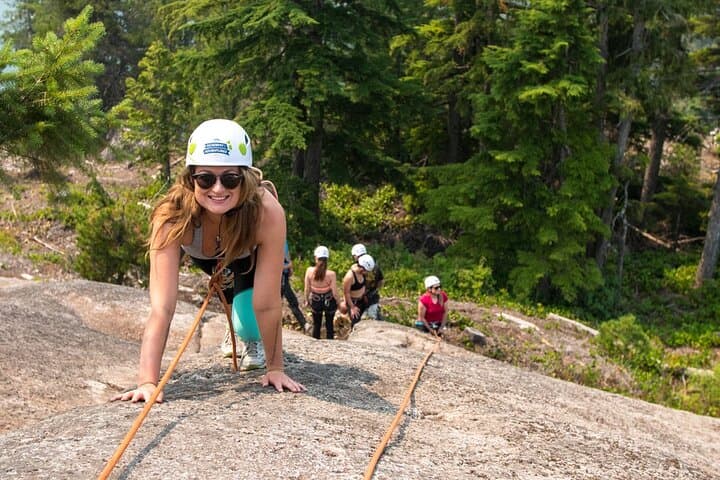


Morning light hits the granite face and the rock seems to breathe — cool, rough, ready. In Squamish, the vertical world arrives close to the shore: the Sea-to-Sky Highway drops you into a bowl of spruce and slickrock, and in a short walk you’re shoulder-to-shoulder with routes that make beginners feel immediately competent.
Morning light hits the granite face and the rock seems to breathe — cool, rough, ready. In Squamish, the vertical world arrives close to the shore: the Sea-to-Sky Highway drops you into a bowl of spruce and slickrock, and in a short walk you’re shoulder-to-shoulder with routes that make beginners feel immediately competent.
The Squamish Rock Climbing Taster is a four-hour primer designed to put newcomers on real single-pitch climbs with professional guides from Mountain Skills Academy. Guides manage the ropes, rig the anchors, and coach technique while climbers move through top-ropes and short lead-practice depending on group comfort. Most climbs are 15–40 metres, approaches 5–30 minutes along dirt and granite slabs, and the vertical gain is modest — this is about movement, balance and getting comfortable on rock.
Geologically, Squamish’s walls are carved from granodiorite, a dense, coarse-grained cousin of granite that offers friction and pockets for footholds. The cliffs are relatively young in human terms: First Nations people, including the Sḵwx̱wú7mesh (Squamish) Nation, have long used the valley for seasonal movement and resource gathering; the modern climbing scene took shape in the 1960s and exploded with sport routes in the late 20th century.
Culturally the area is a meeting point of outdoor subcultures — alpine guides, trail runners, and sailors share the town’s limited benches and coffee shops. Guides will often drop local beta: where to find a quieter route, which approaches avoid forest detritus in spring, and which exposed ledge gives the best view of Howe Sound.
Practicalities are straightforward. The operator supplies climbing shoes, harness, helmet and ropes; guests should wear durable pants or shorts, layered tops, and approach shoes with sticky soles for slab walking. Expect a brief orientation on knots and rope commands, then progressive coaching on hand and foot placement. Weather moves fast in the fjord — wind and rain can make granite slippery, so the company cancels if conditions are unsafe.
For first-timers, start early when the rock is cool and the light flat; midday sun bakes southern aspects in summer. Hydrate, protect against sun on exposed belays, and bring a small pack for camera, water and a wind layer. The experience balances thrill with safety: routes are chosen to fit ability and to build confidence, not ego. By the end of a session climbers often report a clean, tactile confidence — the simple joy of climbing up and looking back down at a world that suddenly feels reachable.