THE ADVENTURE COLLECTIVE® · Independent discovery and booking for outdoor travel

Walk the historic burial grounds of Galveston on a guided two-hour tour that pairs ghost stories with documented island history. Expect uneven paths, close-up views of 19th-century grave art, and a guide who separates folklore from fact.
Walk the historic burial grounds of Galveston on a guided two-hour tour that pairs ghost stories with documented island history. Expect uneven paths, close-up views of 19th-century grave art, and a guide who separates folklore from fact.
You step through iron gates into a grid of weathered stones and live oaks; the Gulf breeze moves like a quiet narrator, tugging at the edges of old epigraphs and daring you to look closer.
Verified experiences and guided adventures in the surrounding area.
Operated by Spooky Galveston · Galveston, Texas
You step through iron gates into a grid of weathered stones and live oaks; the Gulf breeze moves like a quiet narrator, tugging at the edges of old epigraphs and daring you to look closer.
The two-hour guided walk threads through Old City Cemetery and Trinity Episcopal Cemetery along Broadway — part of Galveston’s historic cemetery district where 19th-century merchant families, hurricane victims, and long-forgotten residents lie in rows. The island’s low-lying coastal geology and salty air shaped burial practices here: raised markers, family plots, and crypts that survived storms that reshaped the shoreline and cityscape.
Hear accounts of shipwrecks, yellow fever outbreaks, and the 1900 hurricane that rewrote Galveston’s history; guides pair the ghost stories with verifiable facts about tombstone iconography, Victorian mourning rituals, and the social hierarchies reflected in plot placement.
Culturally, the tour touches on Galveston’s identity as a port city — a crossroads of commerce, migration, and resilience. You’ll pass veteran markers and ornate mausoleums while the guide points out carving styles and inscriptions that reveal lives and trades.
Practical notes: expect uneven ground, narrow pathways and a slow walking pace suitable for most fitness levels. Tours meet at the cemetery gates (park on side streets; gates lock at dusk). Bring closed-toe shoes, a water bottle, and a light if the timing approaches twilight. Stay on paths, respect grave sites, and plan for sun or sudden rain; the nearby Strand and local museums provide dry escape routes if weather turns. This is a history-rich, low-strain evening walk that blends local lore with tangible island heritage.
easy.
2 hours.
Suitable for most fitness levels; requires standing and walking on uneven surfaces for up to two hours.
Yes—children can join but the material includes historic deaths and disasters; strollers may be difficult on narrow, uneven paths.
These are historic public cemeteries, but gates may be locked at dusk; check hours and follow posted rules.
Yes—photography is allowed on public paths; avoid flash on sensitive monuments and respect signs and private plots.
The tour is labeled easy but not recommended for travelers with limited mobility due to narrow, uneven pathways and occasional steps.
The cemetery district reflects Galveston’s growth as a 19th-century port and the catastrophic 1900 hurricane that reshaped the island’s population and burial practices.
Respecting plots and staying on paths preserves fragile stones; local groups periodically restore monuments and monitor erosion tied to coastal weather.
Spooky Galveston operates guided outdoor trips and adventures with an emphasis on safety, stewardship, and memorable experiences.
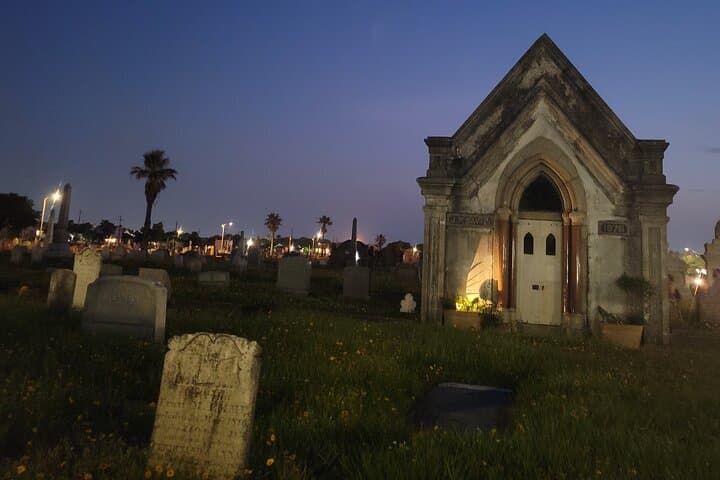


You step through iron gates into a grid of weathered stones and live oaks; the Gulf breeze moves like a quiet narrator, tugging at the edges of old epigraphs and daring you to look closer.
You step through iron gates into a grid of weathered stones and live oaks; the Gulf breeze moves like a quiet narrator, tugging at the edges of old epigraphs and daring you to look closer.
The two-hour guided walk threads through Old City Cemetery and Trinity Episcopal Cemetery along Broadway — part of Galveston’s historic cemetery district where 19th-century merchant families, hurricane victims, and long-forgotten residents lie in rows. The island’s low-lying coastal geology and salty air shaped burial practices here: raised markers, family plots, and crypts that survived storms that reshaped the shoreline and cityscape.
Hear accounts of shipwrecks, yellow fever outbreaks, and the 1900 hurricane that rewrote Galveston’s history; guides pair the ghost stories with verifiable facts about tombstone iconography, Victorian mourning rituals, and the social hierarchies reflected in plot placement.
Culturally, the tour touches on Galveston’s identity as a port city — a crossroads of commerce, migration, and resilience. You’ll pass veteran markers and ornate mausoleums while the guide points out carving styles and inscriptions that reveal lives and trades.
Practical notes: expect uneven ground, narrow pathways and a slow walking pace suitable for most fitness levels. Tours meet at the cemetery gates (park on side streets; gates lock at dusk). Bring closed-toe shoes, a water bottle, and a light if the timing approaches twilight. Stay on paths, respect grave sites, and plan for sun or sudden rain; the nearby Strand and local museums provide dry escape routes if weather turns. This is a history-rich, low-strain evening walk that blends local lore with tangible island heritage.