THE ADVENTURE COLLECTIVE® · Independent discovery and booking for outdoor travel

Skip the highway and arrive at Cu Chi by speedboat: a six‑hour, expert‑led visit that combines a riverside transfer, a guided walk through authentic tunnels, and a traditional Vietnamese lunch. Practical for most fitness levels, the tour offers a quieter, scenic approach and early access before large bus groups.
Skip the highway and arrive at Cu Chi by speedboat: a six‑hour, expert‑led visit that combines a riverside transfer, a guided walk through authentic tunnels, and a traditional Vietnamese lunch. Practical for most fitness levels, the tour offers a quieter, scenic approach and early access before large bus groups.
The river parts the city like a quick exhale as a sleek speedboat slips away from Bach Dang pier, leaving Saigon’s skyline behind and threading narrow canals where water plants press at the hull. The approach sets the tone: this is an access route once used for movement and concealment, now a dramatic entry to a subterranean world.
Verified experiences and guided adventures in the surrounding area.
Operated by Saigon River Tour · Ho Chi Minh City, Ho Chi Minh
The river parts the city like a quick exhale as a sleek speedboat slips away from Bach Dang pier, leaving Saigon’s skyline behind and threading narrow canals where water plants press at the hull. The approach sets the tone: this is an access route once used for movement and concealment, now a dramatic entry to a subterranean world.
At Cu Chi you’ll move from open water to narrow earth. The tunnel network—over a hundred kilometers connected in several zones—was dug into the region’s soft alluvial and lateritic soils and expanded into living space: kitchens, meeting rooms, wells and stoves such as the Hoang Cam. Exhibits and a licensed local guide place those engineering choices in historical context, explaining how supply lines, small-arm ambushes and improvised traps shaped guerrilla tactics.
Culturally the site mixes solemn history with rural life: try cassava the way tunnel villagers did, listen to veterans’ stories, and watch a short propaganda-era film that frames the conflict from local perspectives. Geology is practical here—the soil allows quick excavation but demands constant ventilation, which is why many crawlways are low and laddered.
Plan practically: the tour is about six hours total with roughly two hours on-site. Wear sturdy closed-toe shoes and be ready to crouch and climb short ladders; claustrophobic travelers should skip crawling sections. Bring insect repellent, sun protection and a small daypack; phone signal can be patchy. Morning departures beat bus crowds, and the river route offers a quieter, scenic alternative to a road transfer.
Respect the site—stay on paths, don’t remove artifacts—and expect a compact, educational experience that pairs dramatic history with straightforward logistics.
Yes — the tour includes round-trip transfer by speedboat from Saigon Waterbus Station (Bach Dang pier) as described on booking.
Children may enter shallow display tunnels but crawling sections are tight; strollers aren’t practical for the site itself.
The site offers a small firing range demonstration at many visitor centers; check locally as participation may be optional and additional fees or age restrictions can apply.
A traditional Vietnamese lunch is included, along with unlimited refreshments and local fruit during the tour.
Saigon River Tour operates guided outdoor trips and adventures with an emphasis on safety, stewardship, and memorable experiences.
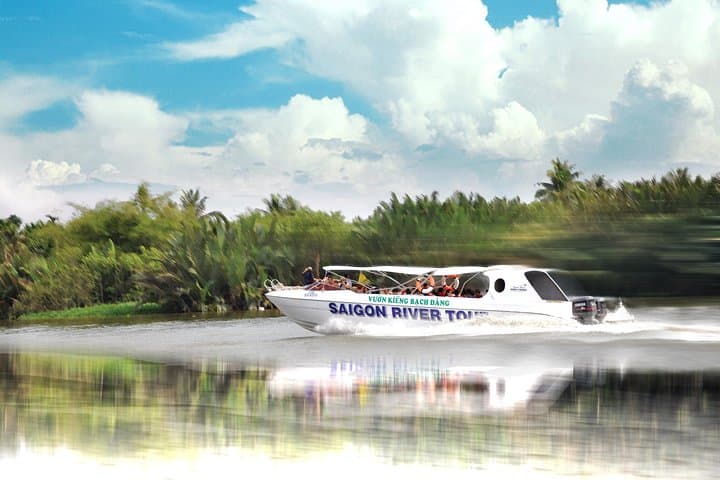
The river parts the city like a quick exhale as a sleek speedboat slips away from Bach Dang pier, leaving Saigon’s skyline behind and threading narrow canals where water plants press at the hull. The approach sets the tone: this is an access route once used for movement and concealment, now a dramatic entry to a subterranean world.
The river parts the city like a quick exhale as a sleek speedboat slips away from Bach Dang pier, leaving Saigon’s skyline behind and threading narrow canals where water plants press at the hull. The approach sets the tone: this is an access route once used for movement and concealment, now a dramatic entry to a subterranean world.
At Cu Chi you’ll move from open water to narrow earth. The tunnel network—over a hundred kilometers connected in several zones—was dug into the region’s soft alluvial and lateritic soils and expanded into living space: kitchens, meeting rooms, wells and stoves such as the Hoang Cam. Exhibits and a licensed local guide place those engineering choices in historical context, explaining how supply lines, small-arm ambushes and improvised traps shaped guerrilla tactics.
Culturally the site mixes solemn history with rural life: try cassava the way tunnel villagers did, listen to veterans’ stories, and watch a short propaganda-era film that frames the conflict from local perspectives. Geology is practical here—the soil allows quick excavation but demands constant ventilation, which is why many crawlways are low and laddered.
Plan practically: the tour is about six hours total with roughly two hours on-site. Wear sturdy closed-toe shoes and be ready to crouch and climb short ladders; claustrophobic travelers should skip crawling sections. Bring insect repellent, sun protection and a small daypack; phone signal can be patchy. Morning departures beat bus crowds, and the river route offers a quieter, scenic alternative to a road transfer.
Respect the site—stay on paths, don’t remove artifacts—and expect a compact, educational experience that pairs dramatic history with straightforward logistics.