THE ADVENTURE COLLECTIVE® · Independent discovery and booking for outdoor travel

Walk Aruba’s Spanish Lagoon to spot endemic burrowing owls, explore ancient shell middens and the Balashi smelter ruins. This 2–3 hour guided mangrove trail blends birding, history, and coastal geology for an accessible nature outing.
Walk Aruba’s Spanish Lagoon to spot endemic burrowing owls, explore ancient shell middens and the Balashi smelter ruins. This 2–3 hour guided mangrove trail blends birding, history, and coastal geology for an accessible nature outing.
You step off the coastal road and the island exhales — salty air touched with mangrove tannins, a low lagoon reflecting open sky. The trail starts near TeleAruba in Pos Chiquito and quickly narrows into a shaded ribbon through mangroves, where roots knot the shoreline and birds call from hidden perches.
Verified experiences and guided adventures in the surrounding area.
Operated by Aruba Nature Adventures · Oranjestad, Aruba
You step off the coastal road and the island exhales — salty air touched with mangrove tannins, a low lagoon reflecting open sky. The trail starts near TeleAruba in Pos Chiquito and quickly narrows into a shaded ribbon through mangroves, where roots knot the shoreline and birds call from hidden perches.
This is Aruba’s only inland water body, shaped by coral limestone and coastal uplift; the trail threads past carbon-dated Amerindian shell middens (c. 1465–1280 BC) and the rusted bones of the Balashi gold-smelter era. Guides point out Frenchman’s Pass and tell its stories as the path climbs a ridge with sweeping views of the lagoon and the low, scrubby hills that once fed gold barges.
Wildlife dominates the scene: the endemic burrowing owl (Shoco) crouches like a tiny sentry; troupials flash orange in the canopy. The mangroves themselves act as nursery and storm buffer — they push back against tide and weather and anchor a quarter of local biodiversity.
Practically: the walk runs about 2–3 hours on mostly flat, sometimes uneven ground; some short climbs to viewpoints. Wear sturdy shoes, sun protection, and bring 1–1.5 liters of water. Early morning delivers the best light and quiet for birding; mid-afternoon is hotter and windier. Respect protected zones around Shoco nests and stick to trails to avoid trampling fragile middens.
Expect an easy-paced, interpretive hike that mixes natural history, birding, and tangible traces of Aruba’s colonial and Amerindian past — compact, informative, and photo-ready.
easy.
2–3 hours.
Suitable for most fitness levels; be able to walk on uneven ground for up to three hours
The guided experience runs about 2–3 hours over mostly flat terrain with a short ridge climb; it’s rated easy and suitable for most fitness levels.
Yes; the route is family-friendly but people with limited mobility should check specific trail sections and notify the operator ahead of time.
Shoco sightings are common but never guaranteed — they’re sensitive to noise and movement, so the guide will advise quiet observation near protected nesting areas.
Pickup options vary by booking; many operators list pickup points from Oranjestad and major hotel zones—confirm transfer details when you reserve.
The trail passes multiple Amerindian shell middens (c. 1465–1280 BC) and the Balashi/Bushiribana-era gold smelter ruins tied to 19th-century mining activity.
Mangroves are fragile coastal buffers and wildlife nurseries; stay on designated paths, avoid disturbing nests, and pack out trash to protect habitat.
Aruba Nature Adventures operates guided outdoor trips and adventures with an emphasis on safety, stewardship, and memorable experiences.


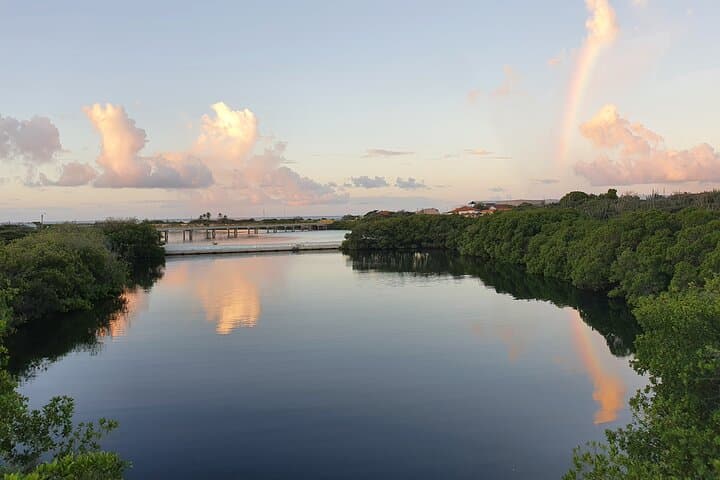
You step off the coastal road and the island exhales — salty air touched with mangrove tannins, a low lagoon reflecting open sky. The trail starts near TeleAruba in Pos Chiquito and quickly narrows into a shaded ribbon through mangroves, where roots knot the shoreline and birds call from hidden perches.
You step off the coastal road and the island exhales — salty air touched with mangrove tannins, a low lagoon reflecting open sky. The trail starts near TeleAruba in Pos Chiquito and quickly narrows into a shaded ribbon through mangroves, where roots knot the shoreline and birds call from hidden perches.
This is Aruba’s only inland water body, shaped by coral limestone and coastal uplift; the trail threads past carbon-dated Amerindian shell middens (c. 1465–1280 BC) and the rusted bones of the Balashi gold-smelter era. Guides point out Frenchman’s Pass and tell its stories as the path climbs a ridge with sweeping views of the lagoon and the low, scrubby hills that once fed gold barges.
Wildlife dominates the scene: the endemic burrowing owl (Shoco) crouches like a tiny sentry; troupials flash orange in the canopy. The mangroves themselves act as nursery and storm buffer — they push back against tide and weather and anchor a quarter of local biodiversity.
Practically: the walk runs about 2–3 hours on mostly flat, sometimes uneven ground; some short climbs to viewpoints. Wear sturdy shoes, sun protection, and bring 1–1.5 liters of water. Early morning delivers the best light and quiet for birding; mid-afternoon is hotter and windier. Respect protected zones around Shoco nests and stick to trails to avoid trampling fragile middens.
Expect an easy-paced, interpretive hike that mixes natural history, birding, and tangible traces of Aruba’s colonial and Amerindian past — compact, informative, and photo-ready.