THE ADVENTURE COLLECTIVE® · Independent discovery and booking for outdoor travel

Step into the public hub of NASA Johnson Space Center—where real lunar samples, authentic spacecraft and behind-the-scenes access combine into a day-long, museum-style expedition. Plan for multi-hour visits, timed tram tours and practical tips on when to arrive.
Step into the public hub of NASA Johnson Space Center—where real lunar samples, authentic spacecraft and behind-the-scenes access combine into a day-long, museum-style expedition. Plan for multi-hour visits, timed tram tours and practical tips on when to arrive.
You arrive under the big curved canopy of Space Center Houston and the air hums with engines that once were and missions that still call people forward. A Mercury capsule waits like a quiet storyteller; a lunar rock sits cool under glass, light sliding across its pitted surface. The visitor center opens the practical backstage of America’s human spaceflight program while keeping room for quiet wonder.
Verified experiences and guided adventures in the surrounding area.
Operated by Space Center Houston · Houston, Texas
You arrive under the big curved canopy of Space Center Houston and the air hums with engines that once were and missions that still call people forward. A Mercury capsule waits like a quiet storyteller; a lunar rock sits cool under glass, light sliding across its pitted surface. The visitor center opens the practical backstage of America’s human spaceflight program while keeping room for quiet wonder.
The site serves as the public face of NASA’s Johnson Space Center and ties directly to Mission Control and astronaut training. The collection includes extensive lunar samples—real pieces of the Moon that tell a geological story of impact, basalt flows and regolith—alongside artifacts from Mercury, Gemini, Apollo and the International Space Station era. Exhibits also explore spaceflight engineering, biomedical research in microgravity and the cultural shift that sent people off-planet.
Local insight: take the tram tour to get the operational campus on the other side of the fence, and arrive early to avoid school groups. The outdoor Rocket Park gives you scale—those rockets don’t merely point upward, they insist on it.
Practical guidance: expect several hours of indoor walking, interactive queues for popular exhibits and food options on-site. Bring a refillable water bottle, comfortable shoes, and a charged camera (some exhibits restrict flash). Check hours before you go—events, school groups and launches can change access. For families, audioguides and kid-friendly exhibits make this an accessible, low-impact visit that still feels like an expedition.
easy.
3–6 hours.
Light walking ability; suitable for most ages and fitness levels
Most visitors spend 3–6 hours to see main exhibits and take the tram; full exploration with special exhibits can take a full day.
Yes—Space Center Houston is wheelchair and stroller accessible; accessible tram seating and elevators are available.
Yes—cafeteria-style dining and grab-and-go options are available; you may also bring sealed snacks and refillable water bottles.
Photography is allowed in many areas, but flash and tripod use may be restricted near sensitive artifacts—follow posted signs and staff guidance.
Space Center Houston is the official visitor center for NASA’s Johnson Space Center, connected to Mission Control and astronaut training and housing an extensive public collection of lunar samples.
The center follows artifact conservation standards and encourages low-impact visitation—please respect exhibit barriers and refrain from touching artifacts. Recycling and reduced-plastic practices are promoted on site.
Space Center Houston operates guided outdoor trips and adventures with an emphasis on safety, stewardship, and memorable experiences.
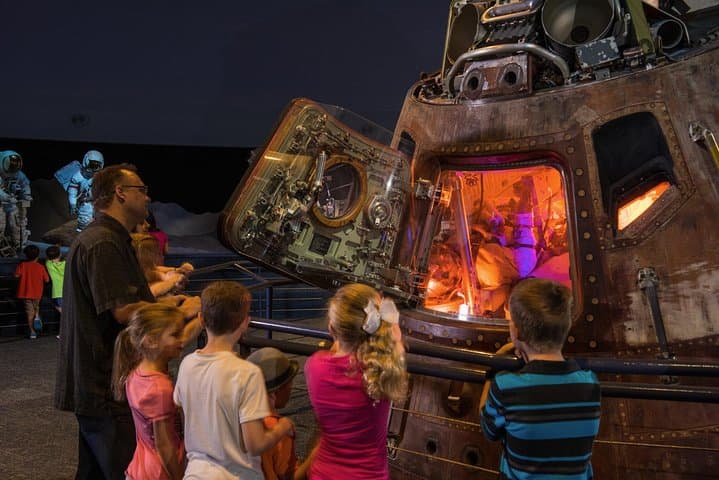



You arrive under the big curved canopy of Space Center Houston and the air hums with engines that once were and missions that still call people forward. A Mercury capsule waits like a quiet storyteller; a lunar rock sits cool under glass, light sliding across its pitted surface. The visitor center opens the practical backstage of America’s human spaceflight program while keeping room for quiet wonder.
You arrive under the big curved canopy of Space Center Houston and the air hums with engines that once were and missions that still call people forward. A Mercury capsule waits like a quiet storyteller; a lunar rock sits cool under glass, light sliding across its pitted surface. The visitor center opens the practical backstage of America’s human spaceflight program while keeping room for quiet wonder.
The site serves as the public face of NASA’s Johnson Space Center and ties directly to Mission Control and astronaut training. The collection includes extensive lunar samples—real pieces of the Moon that tell a geological story of impact, basalt flows and regolith—alongside artifacts from Mercury, Gemini, Apollo and the International Space Station era. Exhibits also explore spaceflight engineering, biomedical research in microgravity and the cultural shift that sent people off-planet.
Local insight: take the tram tour to get the operational campus on the other side of the fence, and arrive early to avoid school groups. The outdoor Rocket Park gives you scale—those rockets don’t merely point upward, they insist on it.
Practical guidance: expect several hours of indoor walking, interactive queues for popular exhibits and food options on-site. Bring a refillable water bottle, comfortable shoes, and a charged camera (some exhibits restrict flash). Check hours before you go—events, school groups and launches can change access. For families, audioguides and kid-friendly exhibits make this an accessible, low-impact visit that still feels like an expedition.