THE ADVENTURE COLLECTIVE® · Independent discovery and booking for outdoor travel

Climb through ancient coihue and Araucaria forest to the rim of Sollipulli — South America's largest volcanic crater — and stand above a glacier that feeds Araucanía. This guided ascent blends geology, Mapuche insight and alpine terrain into a long day in the Chilean highlands.
Climb through ancient coihue and Araucaria forest to the rim of Sollipulli — South America's largest volcanic crater — and stand above a glacier that feeds Araucanía. This guided ascent blends geology, Mapuche insight and alpine terrain into a long day in the Chilean highlands.
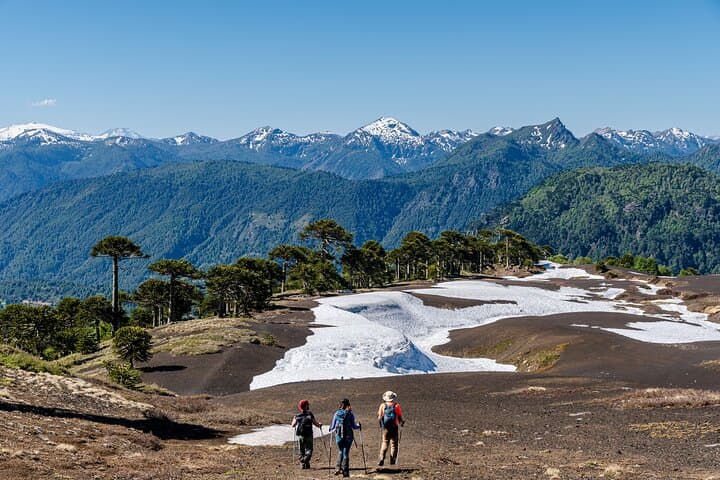
A wind-cold morning presses the air thin as the van drops you at the tree line of Villarrica National Reserve. The trail immediately shifts from damp understory to stands of towering coihue and the angular crowns of ancient Araucaria (monkey puzzle) trees, their trunks dark against fresh volcanic ash. As you climb, the forest thins and the slope shows the raw architecture of past eruptions — folded lava, pumice fields and the slow, blue hush of distant ice.
Verified experiences and guided adventures in the surrounding area.
Operated by Turismo FlorAnimal · Cunco, Araucanía Region
A wind-cold morning presses the air thin as the van drops you at the tree line of Villarrica National Reserve. The trail immediately shifts from damp understory to stands of towering coihue and the angular crowns of ancient Araucaria (monkey puzzle) trees, their trunks dark against fresh volcanic ash. As you climb, the forest thins and the slope shows the raw architecture of past eruptions — folded lava, pumice fields and the slow, blue hush of distant ice.
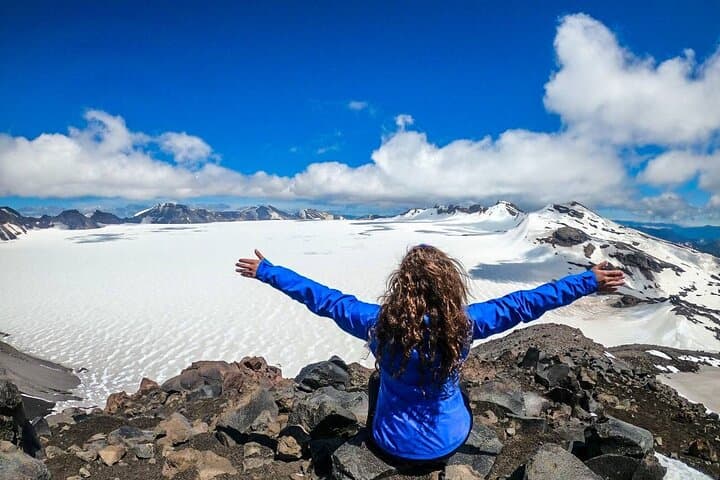
Sollipulli's crater is the largest in South America; inside it sits a glacier that sustains rivers and local agriculture across Araucanía. The landscape carries Mapuche stories and practical knowledge: certain ridgelines were used as seasonal markers, and the forest species here have adapted to repeated pyroclastic pulses. Geologically, Sollipulli is a complex stratovolcano with a collapsed summit basin that preserves glacial ice — a rare mix of fire and ice.
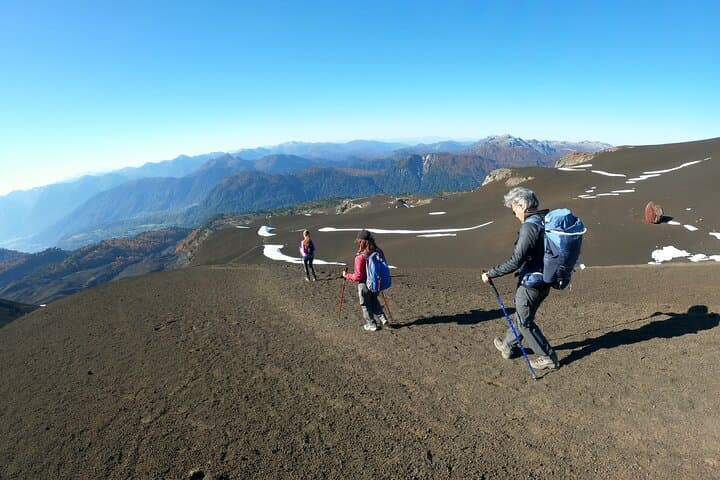
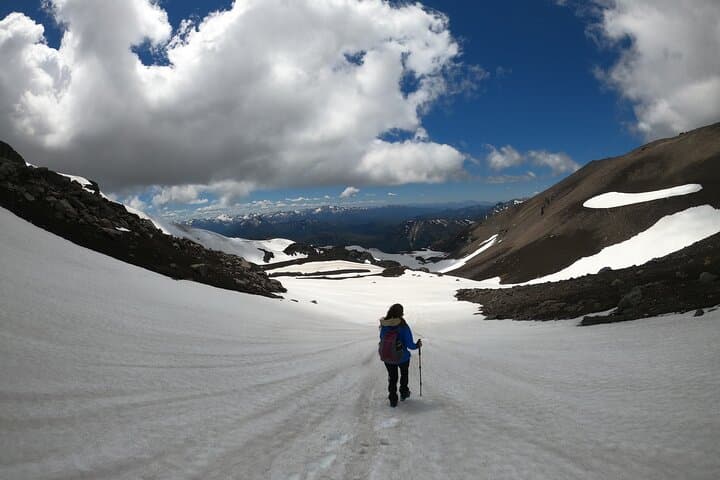
The guided ascent follows marked paths through mixed forest, volcanic scree and compacted snowfields. Guides interpret rock layers and point out wildlife — condors circling thermals, woodpeckers probing old trunks. Expect 7–9 hours of trail time (total trip up to ~11 hours including transport) with slopes that can approach 35–40° in places; the company provides poles, snowshoes/gaiters and helmets when conditions demand.
Practical notes: start early to avoid afternoon winds, dress in breathable layers for sun-to-snow transitions, and carry at least 2–3 liters of water and high-energy snacks. Respect Mapuche sites and leave no trace — the glacier and forests are fragile water sources for the region.
moderate.
7–11 hours.
Good aerobic fitness with experience on sustained uphill hikes and long days; comfortable on steep and uneven terrain.
Trail time is typically 7–9 hours; with transport from the meeting point the total outing can be 9–11 hours depending on road and weather conditions.
No technical ropes are required; guides provide snowshoes, gaiters and helmets when needed — bring crampon-compatible boots if you have them for icy conditions.
Participants should have a moderate to good fitness level, able to hike sustained climbs and handle uneven volcanic terrain for several hours.
Guides include respectful Mapuche cultural interpretation; visitors should avoid disturbing ceremonial areas and follow leave-no-trace rules to protect the glacier-fed watershed.
The area is within Mapuche territory; local stories and land use have shaped place names and seasonal travel patterns for generations.
Sollipulli's glacier is a major freshwater reservoir; visitors should minimize impact — pack out waste, stay on trails and heed guide instructions to protect fragile alpine vegetation.
Turismo FlorAnimal operates guided outdoor trips and adventures with an emphasis on safety, stewardship, and memorable experiences.
A wind-cold morning presses the air thin as the van drops you at the tree line of Villarrica National Reserve. The trail immediately shifts from damp understory to stands of towering coihue and the angular crowns of ancient Araucaria (monkey puzzle) trees, their trunks dark against fresh volcanic ash. As you climb, the forest thins and the slope shows the raw architecture of past eruptions — folded lava, pumice fields and the slow, blue hush of distant ice.
A wind-cold morning presses the air thin as the van drops you at the tree line of Villarrica National Reserve. The trail immediately shifts from damp understory to stands of towering coihue and the angular crowns of ancient Araucaria (monkey puzzle) trees, their trunks dark against fresh volcanic ash. As you climb, the forest thins and the slope shows the raw architecture of past eruptions — folded lava, pumice fields and the slow, blue hush of distant ice.
Sollipulli's crater is the largest in South America; inside it sits a glacier that sustains rivers and local agriculture across Araucanía. The landscape carries Mapuche stories and practical knowledge: certain ridgelines were used as seasonal markers, and the forest species here have adapted to repeated pyroclastic pulses. Geologically, Sollipulli is a complex stratovolcano with a collapsed summit basin that preserves glacial ice — a rare mix of fire and ice.
The guided ascent follows marked paths through mixed forest, volcanic scree and compacted snowfields. Guides interpret rock layers and point out wildlife — condors circling thermals, woodpeckers probing old trunks. Expect 7–9 hours of trail time (total trip up to ~11 hours including transport) with slopes that can approach 35–40° in places; the company provides poles, snowshoes/gaiters and helmets when conditions demand.
Practical notes: start early to avoid afternoon winds, dress in breathable layers for sun-to-snow transitions, and carry at least 2–3 liters of water and high-energy snacks. Respect Mapuche sites and leave no trace — the glacier and forests are fragile water sources for the region.