THE ADVENTURE COLLECTIVE® · Independent discovery and booking for outdoor travel

Fly above the Sacred Valley for a compact half-day of ziplines, sweeping views and local insight. This Cusco-based adventure pairs adrenaline with context—guides, hotel pickup, and a safety-first approach make it an efficient way to see the Andes from the air.
Fly above the Sacred Valley for a compact half-day of ziplines, sweeping views and local insight. This Cusco-based adventure pairs adrenaline with context—guides, hotel pickup, and a safety-first approach make it an efficient way to see the Andes from the air.
The day begins with the Andes arranged like a series of slow, patient waves—terraced fields stepping down toward the Urubamba River, pale llamas picking through stubbled grass, and a wind that seems to dare you to move faster. From a parking area on the Sacred Valley plateau the group gathers, clipped into harnesses, helmets checked twice by guides whose radios chatter against the mountains. Then comes the first run: a weightless moment over a fold of earth and culture, where the valley seems to inhale as riders slice across it.
Verified experiences and guided adventures in the surrounding area.
Operated by Conde Travel · Cusco, Cusco
The day begins with the Andes arranged like a series of slow, patient waves—terraced fields stepping down toward the Urubamba River, pale llamas picking through stubbled grass, and a wind that seems to dare you to move faster. From a parking area on the Sacred Valley plateau the group gathers, clipped into harnesses, helmets checked twice by guides whose radios chatter against the mountains. Then comes the first run: a weightless moment over a fold of earth and culture, where the valley seems to inhale as riders slice across it.
This is the Sacred Valley, the agricultural heartland of the Inca Empire. The steep terraces and irrigated fields you pass beneath on the ziplines are descendants of engineering that dates back centuries—careful stonework and water channels that turned Andean slopes into productive land. Geologically, the valley is a river-carved trough between ridgelines of volcanic and metamorphic rock; its dramatic relief is why both ancient farmers and modern adventurers favor these ridgelines for lines and lookouts.
Local Quechua communities still farm the valley; the zipline operators are a modern layer on a long-lived landscape. Many guides are bilingual locals who balance safety training with stories about nearby sites like Moray’s circular agricultural testing terraces and the salt pans at Maras. Respect for private fields and local rhythms is a quiet condition of the experience—this is recreation placed against active agricultural land.
Practically, expect a half-day out of Cusco: pickup at hotels near the Plaza de Armas, a 45–60 minute transfer into the valley, then about 40–90 minutes of zipline activity depending on group size. Lines vary in length and height; you’ll walk short sections between platforms—gravel or dirt, sometimes stepped with stone—so sturdy shoes and a small daypack are appropriate. Guides provide helmets, harnesses and a safety briefing; they’ll walk you through proper body position, braking techniques, and what to do at the landing platform.
Timing matters: mornings are calmer and tend to have clearer skies; afternoons can bring clouds or brief showers, and operators may cancel for weather. Hydrate before you go—the altitude around Cusco makes exertion feel heavier—and eat a light breakfast unless the operator includes snacks. If you’re traveling with medical concerns, declare them at booking; participants with significant spine, heart, or pregnancy-related issues are commonly advised not to take part.
For travelers who want both adrenaline and context, this half-day zipline is efficient—fast transit from Cusco, trained guides, and a sequence of aerial views that put the valley’s human and geological history in sharp relief. It’s a short adventure with a long memory: the sound of wind, the creak of the harness, and the river far below reminding you that you’re moving through a landscape shaped by both nature and centuries of human care.
moderate.
6 hours total (about 40–90 minutes of ziplines).
Light to moderate fitness; able to walk short uphill sections and tolerate harness pressure at altitude.
The group spends roughly 40–90 minutes on the ziplines depending on group size; the full half-day tour includes transfers and briefing, totaling about six hours.
Yes—operators typically provide pickup from hotels near Cusco’s Plaza de Armas; confirm your exact pickup point when booking.
Restrictions vary by operator—bookings request age and passport details; confirm specific height, weight and health restrictions directly with the supplier before arrival.
Hydrate well, avoid heavy meals right before the activity, and allow time to acclimatize in Cusco; if you have altitude-related health concerns consult your doctor.
The operator may cancel runs in poor weather for safety; their policy notes cancellations for bad weather and that all sales are final—ask about rebooking options at purchase.
Yes—guides provide training and full safety gear, and the activity is marketed as suitable for a broad range of fitness levels, but it’s not recommended for those with serious spinal, heart, or pregnancy-related conditions.
The Sacred Valley was central to Inca agriculture and administration; terraces and irrigation systems nearby reflect centuries of landscape engineering.
Operators work on private land and encourage staying on paths and respecting crops; travelers should avoid littering and follow guides’ directions to minimize impact.
Conde Travel operates guided outdoor trips and adventures with an emphasis on safety, stewardship, and memorable experiences.
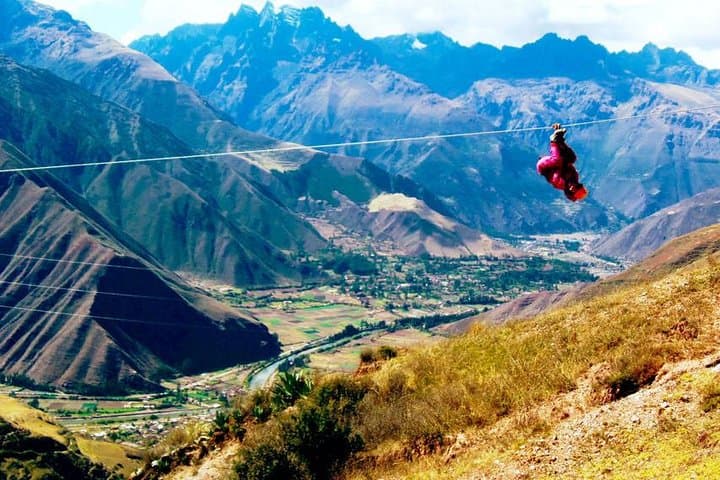


The day begins with the Andes arranged like a series of slow, patient waves—terraced fields stepping down toward the Urubamba River, pale llamas picking through stubbled grass, and a wind that seems to dare you to move faster. From a parking area on the Sacred Valley plateau the group gathers, clipped into harnesses, helmets checked twice by guides whose radios chatter against the mountains. Then comes the first run: a weightless moment over a fold of earth and culture, where the valley seems to inhale as riders slice across it.
The day begins with the Andes arranged like a series of slow, patient waves—terraced fields stepping down toward the Urubamba River, pale llamas picking through stubbled grass, and a wind that seems to dare you to move faster. From a parking area on the Sacred Valley plateau the group gathers, clipped into harnesses, helmets checked twice by guides whose radios chatter against the mountains. Then comes the first run: a weightless moment over a fold of earth and culture, where the valley seems to inhale as riders slice across it.
This is the Sacred Valley, the agricultural heartland of the Inca Empire. The steep terraces and irrigated fields you pass beneath on the ziplines are descendants of engineering that dates back centuries—careful stonework and water channels that turned Andean slopes into productive land. Geologically, the valley is a river-carved trough between ridgelines of volcanic and metamorphic rock; its dramatic relief is why both ancient farmers and modern adventurers favor these ridgelines for lines and lookouts.
Local Quechua communities still farm the valley; the zipline operators are a modern layer on a long-lived landscape. Many guides are bilingual locals who balance safety training with stories about nearby sites like Moray’s circular agricultural testing terraces and the salt pans at Maras. Respect for private fields and local rhythms is a quiet condition of the experience—this is recreation placed against active agricultural land.
Practically, expect a half-day out of Cusco: pickup at hotels near the Plaza de Armas, a 45–60 minute transfer into the valley, then about 40–90 minutes of zipline activity depending on group size. Lines vary in length and height; you’ll walk short sections between platforms—gravel or dirt, sometimes stepped with stone—so sturdy shoes and a small daypack are appropriate. Guides provide helmets, harnesses and a safety briefing; they’ll walk you through proper body position, braking techniques, and what to do at the landing platform.
Timing matters: mornings are calmer and tend to have clearer skies; afternoons can bring clouds or brief showers, and operators may cancel for weather. Hydrate before you go—the altitude around Cusco makes exertion feel heavier—and eat a light breakfast unless the operator includes snacks. If you’re traveling with medical concerns, declare them at booking; participants with significant spine, heart, or pregnancy-related issues are commonly advised not to take part.
For travelers who want both adrenaline and context, this half-day zipline is efficient—fast transit from Cusco, trained guides, and a sequence of aerial views that put the valley’s human and geological history in sharp relief. It’s a short adventure with a long memory: the sound of wind, the creak of the harness, and the river far below reminding you that you’re moving through a landscape shaped by both nature and centuries of human care.