THE ADVENTURE COLLECTIVE® · Independent discovery and booking for outdoor travel

Catch El Nido from above on a one-way zipline that drops you over turquoise shallows and jagged limestone. Short but thrilling, this guided ride pairs panoramic coastal views with strict safety briefings — ideal for travelers seeking a fast, aerial perspective of Palawan.
Catch El Nido from above on a one-way zipline that drops you over turquoise shallows and jagged limestone. Short but thrilling, this guided ride pairs panoramic coastal views with strict safety briefings — ideal for travelers seeking a fast, aerial perspective of Palawan.
You step onto the wooden platform and the wind takes the first breath — warm, salt-scented, tugging at your hair as the coastline drops away beneath you. Below, turquoise shallows and jagged limestone cliffs frame a ribbon of white sand; the zipline pulls you forward and the town of El Nido slides into a new angle, islands and coconut palms rearranging themselves like a living map.
Verified experiences and guided adventures in the surrounding area.
You step onto the wooden platform and the wind takes the first breath — warm, salt-scented, tugging at your hair as the coastline drops away beneath you. Below, turquoise shallows and jagged limestone cliffs frame a ribbon of white sand; the zipline pulls you forward and the town of El Nido slides into a new angle, islands and coconut palms rearranging themselves like a living map.
El Nido’s cliffs are karst limestone, long lifted by tectonic shifts and sculpted by sea and rain; Spanish explorers named the area “El Nido” (the nest) after seabird colonies that flocked here. The town is small, built around fishing and marine livelihoods, with Tagbanwa culture and more recent eco-tourism shaping local life. Ziplines in Palawan are relatively new additions to the adventure scene, offering an aerial perspective on the same bays island-hoppers have long admired from boats.
Expect a one-way descent: a short, intense run measured in seconds rather than hours, delivered with professional harnessing and guided staff. The experience is sensory — speed, the slap of wind, the ocean daring you below — but practical: operators brief participants, follow weight and health guidelines, and typically run groups every few minutes.
Plan early-morning or late-afternoon slots for softer light and calmer winds. Wear closed-toe shoes, bring a small water bottle, and secure phones or cameras (operators may offer lockers). If seas are rough or storms approach, ziplines close — check local weather and confirm bookings. For a compact burst of adrenaline and unbeatable coastal views, this one-way zipline gives you a fast, memorable way to see El Nido from above.
moderate.
30 minutes (activity window).
Light-to-moderate: must be able to climb ladders and stand on launch platforms; no advanced fitness required
The actual one‑way ride is typically under a minute; expect the full visit including briefing, gearing, and transit to take about 30 minutes.
Yes. Most operators enforce both minimum and maximum weight limits and set age/guardian requirements—check the provider’s policy when booking.
Rides close in strong winds or heavy rain for safety. Operators will reschedule or refund according to their cancellation policy.
Handheld cameras are discouraged unless secured; many operators offer staff photos or have approved mounts—ask ahead.
El Nido grew from fishing and small-scale agriculture; its limestone islands formed from coral uplift and have long supported local Tagbanwa communities.
The karst cliffs and surrounding reefs are ecologically sensitive; support operators who follow marine-protection rules, avoid littering, and respect turtle-nesting areas.
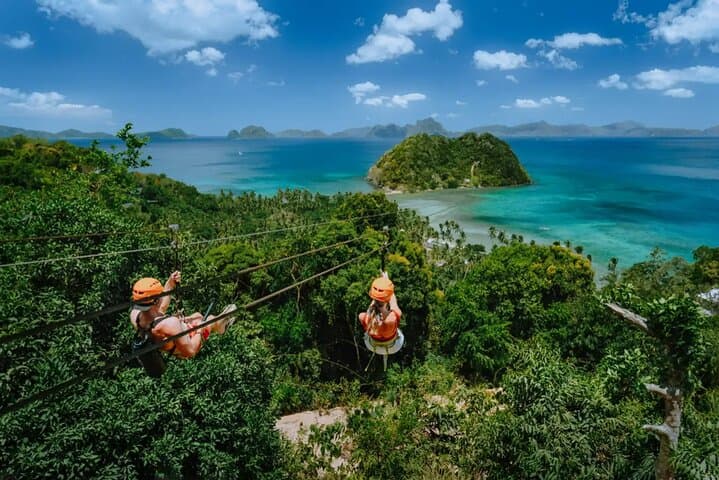
You step onto the wooden platform and the wind takes the first breath — warm, salt-scented, tugging at your hair as the coastline drops away beneath you. Below, turquoise shallows and jagged limestone cliffs frame a ribbon of white sand; the zipline pulls you forward and the town of El Nido slides into a new angle, islands and coconut palms rearranging themselves like a living map.
You step onto the wooden platform and the wind takes the first breath — warm, salt-scented, tugging at your hair as the coastline drops away beneath you. Below, turquoise shallows and jagged limestone cliffs frame a ribbon of white sand; the zipline pulls you forward and the town of El Nido slides into a new angle, islands and coconut palms rearranging themselves like a living map.
El Nido’s cliffs are karst limestone, long lifted by tectonic shifts and sculpted by sea and rain; Spanish explorers named the area “El Nido” (the nest) after seabird colonies that flocked here. The town is small, built around fishing and marine livelihoods, with Tagbanwa culture and more recent eco-tourism shaping local life. Ziplines in Palawan are relatively new additions to the adventure scene, offering an aerial perspective on the same bays island-hoppers have long admired from boats.
Expect a one-way descent: a short, intense run measured in seconds rather than hours, delivered with professional harnessing and guided staff. The experience is sensory — speed, the slap of wind, the ocean daring you below — but practical: operators brief participants, follow weight and health guidelines, and typically run groups every few minutes.
Plan early-morning or late-afternoon slots for softer light and calmer winds. Wear closed-toe shoes, bring a small water bottle, and secure phones or cameras (operators may offer lockers). If seas are rough or storms approach, ziplines close — check local weather and confirm bookings. For a compact burst of adrenaline and unbeatable coastal views, this one-way zipline gives you a fast, memorable way to see El Nido from above.