THE ADVENTURE COLLECTIVE® · Independent discovery and booking for outdoor travel

Step off Cartagena’s colonial streets for a short, tactile detour to El Totumo, a small mud volcano where visitors float in warm, mineral-rich clay and receive local massages and rinses. This practical guide explains what to expect, how to prepare, and local customs.
Step off Cartagena’s colonial streets for a short, tactile detour to El Totumo, a small mud volcano where visitors float in warm, mineral-rich clay and receive local massages and rinses. This practical guide explains what to expect, how to prepare, and local customs.
You approach El Totumo along a patchwork of mangrove-edged roads; the cone rises like a shallow kettle of dark earth, steam absent but the scent of minerals unmistakable. Visitors queue under a roofed platform while guides — often locals — shepherd groups down a short stair into the crater where warm, viscous mud holds the body upright.
Verified experiences and guided adventures in the surrounding area.
You approach El Totumo along a patchwork of mangrove-edged roads; the cone rises like a shallow kettle of dark earth, steam absent but the scent of minerals unmistakable. Visitors queue under a roofed platform while guides — often locals — shepherd groups down a short stair into the crater where warm, viscous mud holds the body upright.
Geologically the Totumo mud volcano is not molten lava but a small sedimentary cone fed by hydrothermal, mineral-rich clay and groundwater. Locals have long treated it as a curative site; the mud contains silica, sulfur, magnesium and iron, and stories of skin improvements and eased muscle aches are part of the place’s living culture. The operation today mixes community hospitality with tourism: optional massages, rinses in the adjacent swamp, and photos taken by attendants are common on-site services.
Expect 15–30 minutes immersed in the crater per person, and a total outing of roughly 2–3 hours including transfer from Cartagena. Terrain is flat but slippery: stairs and the rim are uneven. Mud stains clothing and fabrics; jewelry should be removed. Bring a swimsuit, a towel, and a change of clothes; plan for sun and insects at the parking area. Payment for extra services is typically voluntary and handled on site.
Practically, visit in the morning to avoid midday heat and tour buses. Respect local handlers, follow sanitation instructions (they rinse you with freshwater), and pack out plastic. For a brief, sensory encounter with an uncommon geomorphological feature, El Totumo is direct and unvarnished — a short, tactile detour from Cartagena’s colonial streets.
easy.
2–3 hours.
Minimal fitness required; short stair descent and low-impact standing in mud for up to 30 minutes.
Immersion is typically limited to 15–30 minutes per visitor to allow turnover and protect the local operation.
The mud contains minerals like sulfur and silica; many people tolerate it well but those with dermatological conditions or open wounds should avoid it and consult a doctor first.
Basic rinse stations and bucket rinses are common; full shower facilities are not guaranteed—bring a towel and expect a simple freshwater rinse.
Most visitors take a short organized transfer or taxi (roughly 30–60 minutes depending on traffic); private tours often include transport and guide services.
El Totumo has long been used by local communities for its mineral mud; its popularity as a visitor attraction grew with road access from Cartagena in the late 20th century.
Operators handle mud and rinse water locally; avoid introducing soaps and pack out plastic—support guides who follow local waste practices.
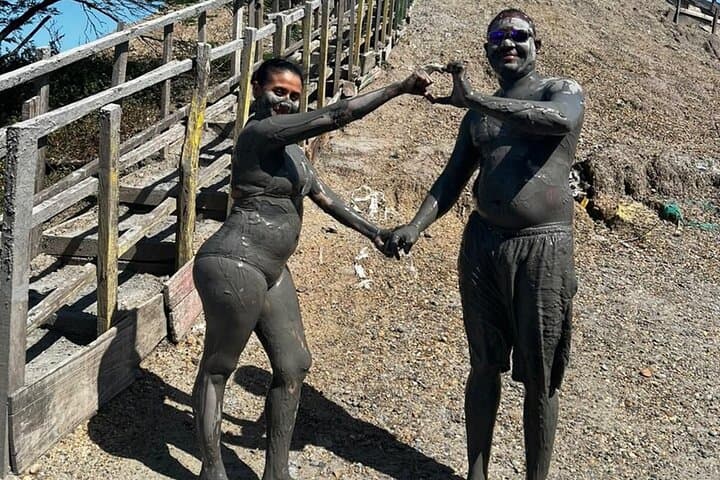
You approach El Totumo along a patchwork of mangrove-edged roads; the cone rises like a shallow kettle of dark earth, steam absent but the scent of minerals unmistakable. Visitors queue under a roofed platform while guides — often locals — shepherd groups down a short stair into the crater where warm, viscous mud holds the body upright.
You approach El Totumo along a patchwork of mangrove-edged roads; the cone rises like a shallow kettle of dark earth, steam absent but the scent of minerals unmistakable. Visitors queue under a roofed platform while guides — often locals — shepherd groups down a short stair into the crater where warm, viscous mud holds the body upright.
Geologically the Totumo mud volcano is not molten lava but a small sedimentary cone fed by hydrothermal, mineral-rich clay and groundwater. Locals have long treated it as a curative site; the mud contains silica, sulfur, magnesium and iron, and stories of skin improvements and eased muscle aches are part of the place’s living culture. The operation today mixes community hospitality with tourism: optional massages, rinses in the adjacent swamp, and photos taken by attendants are common on-site services.
Expect 15–30 minutes immersed in the crater per person, and a total outing of roughly 2–3 hours including transfer from Cartagena. Terrain is flat but slippery: stairs and the rim are uneven. Mud stains clothing and fabrics; jewelry should be removed. Bring a swimsuit, a towel, and a change of clothes; plan for sun and insects at the parking area. Payment for extra services is typically voluntary and handled on site.
Practically, visit in the morning to avoid midday heat and tour buses. Respect local handlers, follow sanitation instructions (they rinse you with freshwater), and pack out plastic. For a brief, sensory encounter with an uncommon geomorphological feature, El Totumo is direct and unvarnished — a short, tactile detour from Cartagena’s colonial streets.