THE ADVENTURE COLLECTIVE® · Independent discovery and booking for outdoor travel

Board a six-passenger vessel off Balboa Island for a quiet, small-group whale and dolphin watch along Orange County’s productive shelf. Expect intimate sightings, local natural history commentary, and practical tips for a comfortable two-hour outing.
Board a six-passenger vessel off Balboa Island for a quiet, small-group whale and dolphin watch along Orange County’s productive shelf. Expect intimate sightings, local natural history commentary, and practical tips for a comfortable two-hour outing.
You step off Balboa Island with the harbor breathing around you — a narrow channel of tugs, pleasure craft and kelp beds before the open Pacific. The boat hums quietly underfoot; with just six passengers the captain can ghost toward a spout or a pod without turning the ocean into a spectacle. The water here is a moving highway for migrants: whales cutting powerfully through blue, dolphins arcing in compact groups, and sea lions hauling out on distant breakwaters.
Verified experiences and guided adventures in the surrounding area.
You step off Balboa Island with the harbor breathing around you — a narrow channel of tugs, pleasure craft and kelp beds before the open Pacific. The boat hums quietly underfoot; with just six passengers the captain can ghost toward a spout or a pod without turning the ocean into a spectacle. The water here is a moving highway for migrants: whales cutting powerfully through blue, dolphins arcing in compact groups, and sea lions hauling out on distant breakwaters.
Geology and human use shape the scene. Newport Harbor is dredged and engineered, its inner coves giving way to the continental shelf where deep water and upwellings concentrate food. Orange County’s maritime history is a mix of ranching, shipping and recreation — Balboa’s waterfront developed in the early 20th century as a seaside escape that still launches modern wildlife excursions.
On this two-hour outing expect quiet approaches, close visual encounters (but not touch), and an interpretive narrative from a captain who reads currents and whale behavior. Views change fast: rolling swell, a blow on the horizon, then a dorsal fin slicing cleanly through glassy surface. Weather can flip from sun to fog; tides and season affect where animals concentrate.
Practical notes: wear windproof layers, bring binoculars and seasickness remedies if you’re prone, and arrive early for boarding on Balboa Island. Trips limit parties to six for comfort and a lower disturbance footprint — a small-boat approach that makes sightings more intimate and less intrusive. Cameras get great angles from low freeboard; keep lenses dry and respect wildlife-distance guidance.
easy.
2–2.5 hours.
Minimal fitness required—able to board a small vessel and stand for stretches; moderate mobility helps for low freeboard access.
Expect dolphins year-round, seasonal gray whale migrations (winter–spring), and occasional larger baleen whales; sea lions and seabirds are common.
Trips are limited to six passengers per vessel to allow quiet, close approaches and a more personal experience.
Yes — families commonly join; children should be supervised and able to sit or stand safely on a small craft.
Operators monitor conditions; trips may be delayed or canceled for safety with refunds or rebooking options — check the operator’s policy at booking.
Balboa Island and Newport Harbor developed in the early 1900s as recreational waterfronts; the harbor’s channels were engineered to support shipping and later leisure boating.
Operators follow distance and approach guidelines to minimize disturbance; limiting group size reduces noise and stress on marine mammals while supporting sustainable wildlife viewing.
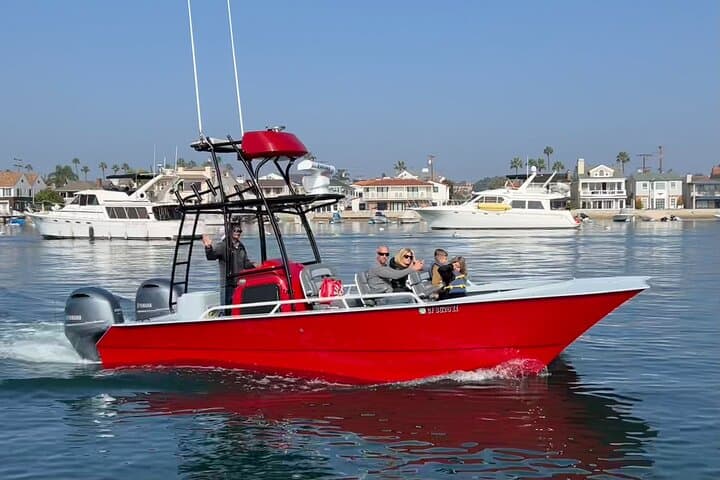
You step off Balboa Island with the harbor breathing around you — a narrow channel of tugs, pleasure craft and kelp beds before the open Pacific. The boat hums quietly underfoot; with just six passengers the captain can ghost toward a spout or a pod without turning the ocean into a spectacle. The water here is a moving highway for migrants: whales cutting powerfully through blue, dolphins arcing in compact groups, and sea lions hauling out on distant breakwaters.
You step off Balboa Island with the harbor breathing around you — a narrow channel of tugs, pleasure craft and kelp beds before the open Pacific. The boat hums quietly underfoot; with just six passengers the captain can ghost toward a spout or a pod without turning the ocean into a spectacle. The water here is a moving highway for migrants: whales cutting powerfully through blue, dolphins arcing in compact groups, and sea lions hauling out on distant breakwaters.
Geology and human use shape the scene. Newport Harbor is dredged and engineered, its inner coves giving way to the continental shelf where deep water and upwellings concentrate food. Orange County’s maritime history is a mix of ranching, shipping and recreation — Balboa’s waterfront developed in the early 20th century as a seaside escape that still launches modern wildlife excursions.
On this two-hour outing expect quiet approaches, close visual encounters (but not touch), and an interpretive narrative from a captain who reads currents and whale behavior. Views change fast: rolling swell, a blow on the horizon, then a dorsal fin slicing cleanly through glassy surface. Weather can flip from sun to fog; tides and season affect where animals concentrate.
Practical notes: wear windproof layers, bring binoculars and seasickness remedies if you’re prone, and arrive early for boarding on Balboa Island. Trips limit parties to six for comfort and a lower disturbance footprint — a small-boat approach that makes sightings more intimate and less intrusive. Cameras get great angles from low freeboard; keep lenses dry and respect wildlife-distance guidance.