THE ADVENTURE COLLECTIVE® · Independent discovery and booking for outdoor travel

Walk from the stone bridge through the Old Bazaar to the Kale Fortress on a two-hour guided tour that mixes Ottoman lanes, socialist brutalism, and riverside views. Perfect for travelers who want a compact, interpretive look at Skopje’s layered history and lively neighborhoods.
Walk from the stone bridge through the Old Bazaar to the Kale Fortress on a two-hour guided tour that mixes Ottoman lanes, socialist brutalism, and riverside views. Perfect for travelers who want a compact, interpretive look at Skopje’s layered history and lively neighborhoods.
You step off the stone bridge and the city rearranges itself: the Vardar slips past with a calm urgency, fountains mark the modern square, and the silhouette of Kale Fortress keeps watch on the hill above. This two-hour walking tour threads tight streets and broad plazas, bringing the visible layers of Skopje into focus — Ottoman alleys, socialist-era concrete, and boutiques spilling onto cobblestones.
Verified experiences and guided adventures in the surrounding area.
Operated by Opatrip.com Macedonia · Skopje, Skopje
You step off the stone bridge and the city rearranges itself: the Vardar slips past with a calm urgency, fountains mark the modern square, and the silhouette of Kale Fortress keeps watch on the hill above. This two-hour walking tour threads tight streets and broad plazas, bringing the visible layers of Skopje into focus — Ottoman alleys, socialist-era concrete, and boutiques spilling onto cobblestones.
Skopje’s Old Bazaar is one of the Balkans’ largest Ottoman-era market quarters, a place of mosques, baklava shops, and narrow lanes where trade and conversation have flowed for centuries. The Kale Fortress sits on ancient foundations with Byzantine and later Ottoman modifications, offering a compact lesson in the city’s strategic geography. In the 20th century, the 1963 earthquake and postwar reconstruction left a strong imprint of brutalist municipal architecture that contrasts with the bazaar’s organic streets.
Culturally, neighborhoods like Debar Maalo show the city’s youthful, kafana-style café life; local guides often point out the contested monuments and recent urban renovations that tell modern Macedonian identity stories.
Practical guidance: wear comfortable walking shoes for mixed cobbles and short stair sections, and bring a refillable water bottle. Start in the morning or late afternoon to avoid the hottest sun and to catch softer light on the fortress walls. Public transport and taxis reach the main square easily; the route includes short, level sections and a moderate climb to Kale. Expect clear narration from a local guide, opportunities to pause for coffee, and brief photo stops at the river and square. Keep modest dress for mosque exteriors and carry small bills for snacks or souvenirs.
easy.
2 hours.
Suitable for most fitness levels; involves standing, short climbs, and walking on uneven surfaces.
Yes — the pace is gentle with short stops; there are a few stair sections to Kale but no technical hiking.
No — the tour covers outdoor viewpoints and narration; paid museum entries or special sites are typically optional and not included.
Most tours meet near Skopje’s main city square by the Stone Bridge; the square is serviced by local buses and easy to reach by taxi.
Yes — this listing indicates a private guided tour, so the experience is typically just your party and the guide.
Skopje’s Old Bazaar dates to Ottoman rule and sits beneath Kale Fortress, whose origins reach back to Byzantine and early medieval fortifications; the 1963 earthquake and later reconstruction added a layer of brutalist civic architecture.
Tourists are encouraged to use refillable bottles and avoid littering; local initiatives focus on river cleanup of the Vardar and preserving historic bazaar facades.
Opatrip.com Macedonia operates guided outdoor trips and adventures with an emphasis on safety, stewardship, and memorable experiences.
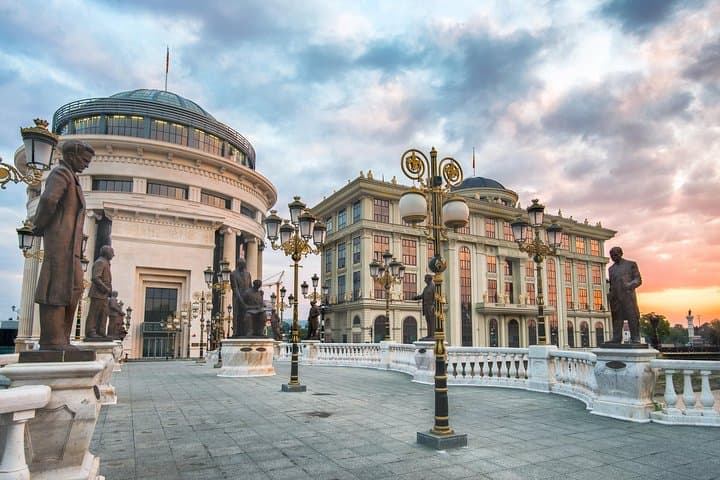


You step off the stone bridge and the city rearranges itself: the Vardar slips past with a calm urgency, fountains mark the modern square, and the silhouette of Kale Fortress keeps watch on the hill above. This two-hour walking tour threads tight streets and broad plazas, bringing the visible layers of Skopje into focus — Ottoman alleys, socialist-era concrete, and boutiques spilling onto cobblestones.
You step off the stone bridge and the city rearranges itself: the Vardar slips past with a calm urgency, fountains mark the modern square, and the silhouette of Kale Fortress keeps watch on the hill above. This two-hour walking tour threads tight streets and broad plazas, bringing the visible layers of Skopje into focus — Ottoman alleys, socialist-era concrete, and boutiques spilling onto cobblestones.
Skopje’s Old Bazaar is one of the Balkans’ largest Ottoman-era market quarters, a place of mosques, baklava shops, and narrow lanes where trade and conversation have flowed for centuries. The Kale Fortress sits on ancient foundations with Byzantine and later Ottoman modifications, offering a compact lesson in the city’s strategic geography. In the 20th century, the 1963 earthquake and postwar reconstruction left a strong imprint of brutalist municipal architecture that contrasts with the bazaar’s organic streets.
Culturally, neighborhoods like Debar Maalo show the city’s youthful, kafana-style café life; local guides often point out the contested monuments and recent urban renovations that tell modern Macedonian identity stories.
Practical guidance: wear comfortable walking shoes for mixed cobbles and short stair sections, and bring a refillable water bottle. Start in the morning or late afternoon to avoid the hottest sun and to catch softer light on the fortress walls. Public transport and taxis reach the main square easily; the route includes short, level sections and a moderate climb to Kale. Expect clear narration from a local guide, opportunities to pause for coffee, and brief photo stops at the river and square. Keep modest dress for mosque exteriors and carry small bills for snacks or souvenirs.