THE ADVENTURE COLLECTIVE® · Independent discovery and booking for outdoor travel

Skip the queue and ride both cable-car legs to Sugarloaf Mountain for sweeping views of Copacabana, Guanabara Bay and Rio’s skyline. This guide explains what to expect, plus practical tips for maximizing summit time.
Skip the queue and ride both cable-car legs to Sugarloaf Mountain for sweeping views of Copacabana, Guanabara Bay and Rio’s skyline. This guide explains what to expect, plus practical tips for maximizing summit time.
You step onto the cable car and the city slips beneath you: tiled rooftops, the curve of Copacabana, and Guanabara Bay opening like a hand. The first three-minute lift takes you to Morro da Urca; the second three-minute leg climbs to Pão de Açúcar (Sugarloaf), a granite dome that rises sharply from the water and rewards patience with a 360° panorama.
Verified experiences and guided adventures in the surrounding area.
Operated by Sugar Loaf · Rio de Janeiro, Rio de Janeiro
You step onto the cable car and the city slips beneath you: tiled rooftops, the curve of Copacabana, and Guanabara Bay opening like a hand. The first three-minute lift takes you to Morro da Urca; the second three-minute leg climbs to Pão de Açúcar (Sugarloaf), a granite dome that rises sharply from the water and rewards patience with a 360° panorama.
Sugarloaf’s cable car has been part of Rio’s skyline since the early 20th century, engineered to link two rocky outcrops for residents and visitors. The peak itself is a witness to ancient geology — exposed granite and quartzite carved by wind and sea over hundreds of millions of years — while the surrounding neighborhoods illustrate Rio’s layered cultural history, from beach life in Ipanema to the colonial-era port around the bay.
On-site, expect industrial-chic gondolas that run roughly every 20 minutes and carry up to 65 people; a skip-the-line ticket means you swap waiting in queue for extra time on the summit. The summit terraces are windy and exposed, so photography, short walks, and viewpoint circling are common activities. Amenities include accessible routes, rest areas, and light food vendors at both stops.
Practical guidance: bring sun protection, a lightweight layer for gusts, and your passport or ID for check-in — tickets are paper-only and all sales are final. Plan for 2–3 hours to account for transit, queues without skip-the-line, and time to soak the views; sunset times fill the platform, so arrive earlier if you prefer quieter light.
easy.
2–3 hours.
Minimal fitness required; mostly standing and short walks on paved/lookout areas.
Each leg takes about three minutes—three minutes to Morro da Urca, then three more to Sugarloaf—though boarding intervals are roughly every 20 minutes.
Skip-the-line minimizes queuing at the attraction but boarding still follows scheduled departures; it allows faster access compared with standard lines.
Yes—facilities, surfaces and transportation options are described as wheelchair accessible; staff can assist with boarding if needed.
Infants may ride but must sit on an adult’s lap; service animals are permitted. Note tickets are paper-only and require ID at check-in.
The cable car connection opened in the early 20th century to link Urca and Sugarloaf; it quickly became both a local transit improvement and a major tourist draw.
High foot traffic and coastal weather stress the rock and vegetation; visitors are encouraged to stay on designated paths and avoid littering to protect the fragile shoreline ecology.
Sugar Loaf operates guided outdoor trips and adventures with an emphasis on safety, stewardship, and memorable experiences.
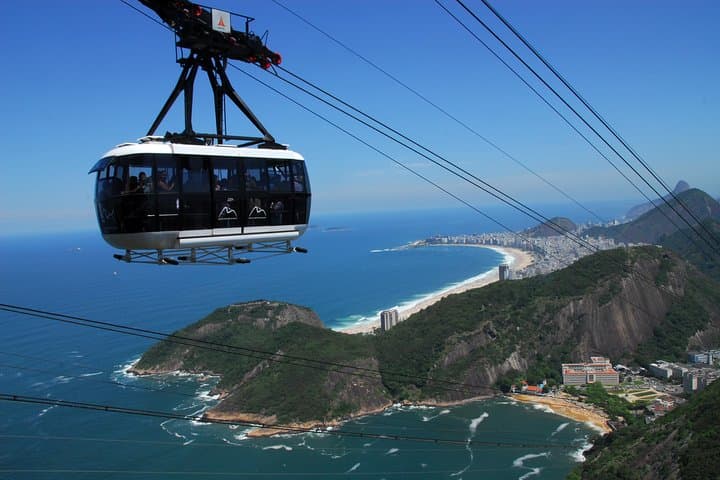


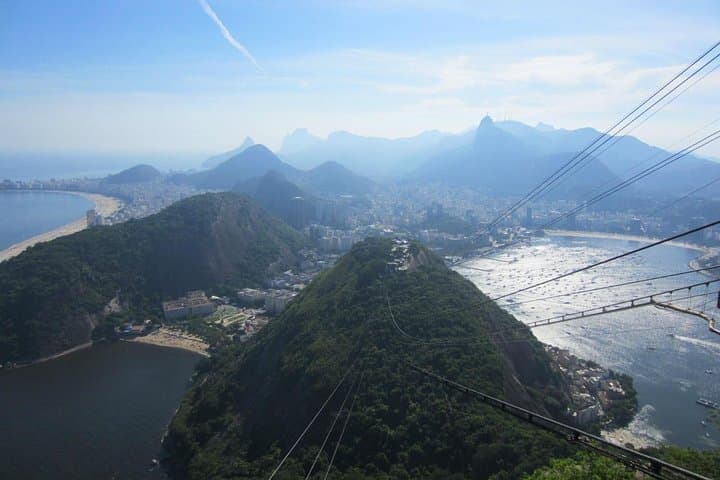
You step onto the cable car and the city slips beneath you: tiled rooftops, the curve of Copacabana, and Guanabara Bay opening like a hand. The first three-minute lift takes you to Morro da Urca; the second three-minute leg climbs to Pão de Açúcar (Sugarloaf), a granite dome that rises sharply from the water and rewards patience with a 360° panorama.
You step onto the cable car and the city slips beneath you: tiled rooftops, the curve of Copacabana, and Guanabara Bay opening like a hand. The first three-minute lift takes you to Morro da Urca; the second three-minute leg climbs to Pão de Açúcar (Sugarloaf), a granite dome that rises sharply from the water and rewards patience with a 360° panorama.
Sugarloaf’s cable car has been part of Rio’s skyline since the early 20th century, engineered to link two rocky outcrops for residents and visitors. The peak itself is a witness to ancient geology — exposed granite and quartzite carved by wind and sea over hundreds of millions of years — while the surrounding neighborhoods illustrate Rio’s layered cultural history, from beach life in Ipanema to the colonial-era port around the bay.
On-site, expect industrial-chic gondolas that run roughly every 20 minutes and carry up to 65 people; a skip-the-line ticket means you swap waiting in queue for extra time on the summit. The summit terraces are windy and exposed, so photography, short walks, and viewpoint circling are common activities. Amenities include accessible routes, rest areas, and light food vendors at both stops.
Practical guidance: bring sun protection, a lightweight layer for gusts, and your passport or ID for check-in — tickets are paper-only and all sales are final. Plan for 2–3 hours to account for transit, queues without skip-the-line, and time to soak the views; sunset times fill the platform, so arrive earlier if you prefer quieter light.