THE ADVENTURE COLLECTIVE® · Independent discovery and booking for outdoor travel

Skip the lines at Paris’s monumental Panthéon and move straight to its vaulted nave, crypts and rooftop views. This reserved-access visit pairs architectural history with practical tips for timing, stairs and where to continue your Latin Quarter exploration.
Skip the lines at Paris’s monumental Panthéon and move straight to its vaulted nave, crypts and rooftop views. This reserved-access visit pairs architectural history with practical tips for timing, stairs and where to continue your Latin Quarter exploration.
Step through the Panthéon’s portico and the Latin Quarter shifts from market chatter to hush—the stone beneath your soles cool, the dome drawing light down into the nave. Frescoes curve overhead and Foucault’s pendulum swings in steady arcs, a subtle reminder of the planet turning outside this grand neoclassical bowl.
Verified experiences and guided adventures in the surrounding area.
Step through the Panthéon’s portico and the Latin Quarter shifts from market chatter to hush—the stone beneath your soles cool, the dome drawing light down into the nave. Frescoes curve overhead and Foucault’s pendulum swings in steady arcs, a subtle reminder of the planet turning outside this grand neoclassical bowl.
Built by Jacques-Germain Soufflot in the late 18th century and repurposed after the Revolution, the Panthéon houses the crypt where Voltaire, Victor Hugo, Rousseau and Marie Curie rest. The building’s heavy limestone and iron bones reflect Paris’s layered geology and engineering choices from the Enlightenment era. Local life streams past: university students, florists, and café tables where Parisians debate politics the way the Panthéon once debated nationhood.
With reserved-access tickets you bypass long queues and move directly to the transept where Foucault’s Pendulum demonstrates Earth’s rotation. If you choose to climb, expect a narrow stair to the upper gallery and rooftop terrace—sweeping views take in the Seine, Île de la Cité and the green bar of Luxembourg Gardens.
Practical pointers: arrive early for softer light and smaller crowds, pack light—large backpacks aren’t permitted—and allow 1–3 hours to explore the nave, crypt and rooftop. Security screening is standard; photography is allowed in most areas but respect quiet zones. Combine a Panthéon visit with a walk through Saint-Étienne-du-Mont or the nearby Rue Mouffetard market to round out the day.
easy.
1–3 hours.
Light walking and standing; able to climb several flights of stairs for rooftop access
No—digital tickets on your phone are accepted, but have the confirmation ready and check entry window details.
The dome and rooftop may close for maintenance or due to weather; check the site’s schedule before you go.
Self-guided visits are standard with visitor guides in multiple languages; check for occasional guided tours that may be offered by third parties.
Ground-floor areas and the crypt are accessible, but the upper gallery and rooftop require stairs and are not wheelchair accessible.
Commissioned by Louis XV and completed by Jacques‑Germain Soufflot in the late 1700s, the Panthéon shifted from church to national mausoleum during the French Revolution and holds France’s revered intellectual and political figures.
Heavy foot traffic necessitates ongoing stone and fresco conservation; visitors are asked to stay on marked paths, avoid flash photography in sensitive areas, and respect quiet zones to help preserve the monument.
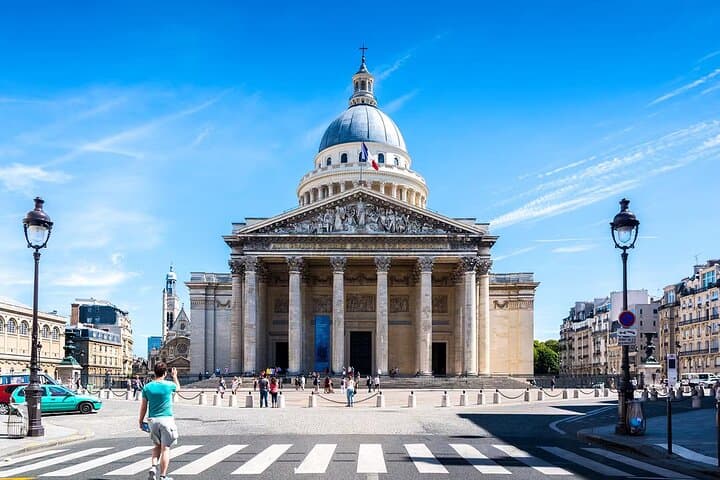
Step through the Panthéon’s portico and the Latin Quarter shifts from market chatter to hush—the stone beneath your soles cool, the dome drawing light down into the nave. Frescoes curve overhead and Foucault’s pendulum swings in steady arcs, a subtle reminder of the planet turning outside this grand neoclassical bowl.
Step through the Panthéon’s portico and the Latin Quarter shifts from market chatter to hush—the stone beneath your soles cool, the dome drawing light down into the nave. Frescoes curve overhead and Foucault’s pendulum swings in steady arcs, a subtle reminder of the planet turning outside this grand neoclassical bowl.
Built by Jacques-Germain Soufflot in the late 18th century and repurposed after the Revolution, the Panthéon houses the crypt where Voltaire, Victor Hugo, Rousseau and Marie Curie rest. The building’s heavy limestone and iron bones reflect Paris’s layered geology and engineering choices from the Enlightenment era. Local life streams past: university students, florists, and café tables where Parisians debate politics the way the Panthéon once debated nationhood.
With reserved-access tickets you bypass long queues and move directly to the transept where Foucault’s Pendulum demonstrates Earth’s rotation. If you choose to climb, expect a narrow stair to the upper gallery and rooftop terrace—sweeping views take in the Seine, Île de la Cité and the green bar of Luxembourg Gardens.
Practical pointers: arrive early for softer light and smaller crowds, pack light—large backpacks aren’t permitted—and allow 1–3 hours to explore the nave, crypt and rooftop. Security screening is standard; photography is allowed in most areas but respect quiet zones. Combine a Panthéon visit with a walk through Saint-Étienne-du-Mont or the nearby Rue Mouffetard market to round out the day.