THE ADVENTURE COLLECTIVE® · Independent discovery and booking for outdoor travel

Skip the line at the Musée d'Orsay and spend more time with Monet, Van Gogh, Renoir and Degas inside a restored Beaux-Arts railway station. This practical guide explains what to expect, how the museum fits into Parisian art history, and tips to make the most of a 1–3 hour visit.
Skip the line at the Musée d'Orsay and spend more time with Monet, Van Gogh, Renoir and Degas inside a restored Beaux-Arts railway station. This practical guide explains what to expect, how the museum fits into Parisian art history, and tips to make the most of a 1–3 hour visit.
You step across the Pont Royal and the museum’s grand clock face slices daylight into the former Gare d'Orsay; tile and ironwork frame a hall that once moved passengers, now moving viewers. The first room opens like a theater—Monet’s light edges the wall, Van Gogh’s brushwork tightens the air, Degas’s dancers seem to shift on their toes.
Verified experiences and guided adventures in the surrounding area.
You step across the Pont Royal and the museum’s grand clock face slices daylight into the former Gare d'Orsay; tile and ironwork frame a hall that once moved passengers, now moving viewers. The first room opens like a theater—Monet’s light edges the wall, Van Gogh’s brushwork tightens the air, Degas’s dancers seem to shift on their toes.
The Musée d'Orsay occupies a 1900 Beaux-Arts railway station on the left bank of the Seine, converted into a museum in the 1980s to house French art from 1848–1914. Its vaulted glass roof and iron trusses reveal the building’s industrial origins while gallery walls showcase the arc from realism through Impressionism to Post-Impressionism.
Culturally, the Orsay maps Paris’s modern break with academic tradition: crimean light studies, leisure on the Seine, and portraits that refuse idealization. Architecture fans will note the adaptive reuse—platform levels repurposed into sweeping galleries—and the deliberate staging that lets sculptures and canvases breathe together.
Practically: skip-the-line tickets save time but expect security screening and timed entry. Allow 1–3 hours to see highlights; prioritize the Impressionist rooms on the second floor and the clock-side viewpoints for photo-worthy city vistas. Weekday mornings are quieter; late afternoons fill with tour groups. Bring a small bag to speed through cloakroom lines, wear comfortable shoes for gallery climbs, and leave bulky luggage at your hotel. Photography is usually allowed without flash; check temporary-exhibit rules. The museum sits in central Paris—pair a visit with a walk along the Seine or a short metro ride to the Louvre for a full day of art.
easy.
1–3 hours.
Minimal fitness required; expect standing and walking across several floors and short stair sections.
Skip-the-line tickets grant timed-entry that minimizes queueing, but you’ll still pass through security and may wait briefly at peak times.
Most visitors spend 1–3 hours; allow more time if you want to read labels closely or include temporary exhibitions.
Non-flash photography is generally permitted in permanent collections; temporary exhibitions may prohibit photos—check signage on arrival.
The museum offers elevators and accessible routes; contact the museum ahead of time for specific assistance or to inquire about accessible entrances.
Housed in the former Gare d'Orsay (built for the 1900 Exposition Universelle), the museum opened in 1986 to bridge late 19th- and early 20th-century French art.
The Orsay follows strict conservation protocols, balancing public access with climate-controlled display to preserve delicate Impressionist pigments and paper works.
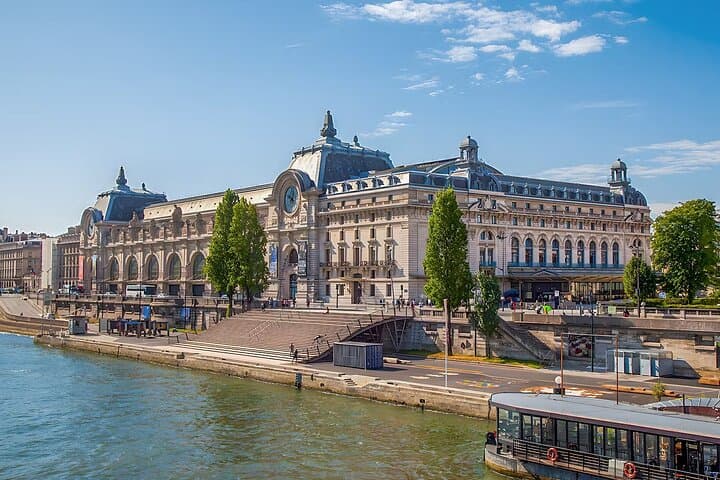
You step across the Pont Royal and the museum’s grand clock face slices daylight into the former Gare d'Orsay; tile and ironwork frame a hall that once moved passengers, now moving viewers. The first room opens like a theater—Monet’s light edges the wall, Van Gogh’s brushwork tightens the air, Degas’s dancers seem to shift on their toes.
You step across the Pont Royal and the museum’s grand clock face slices daylight into the former Gare d'Orsay; tile and ironwork frame a hall that once moved passengers, now moving viewers. The first room opens like a theater—Monet’s light edges the wall, Van Gogh’s brushwork tightens the air, Degas’s dancers seem to shift on their toes.
The Musée d'Orsay occupies a 1900 Beaux-Arts railway station on the left bank of the Seine, converted into a museum in the 1980s to house French art from 1848–1914. Its vaulted glass roof and iron trusses reveal the building’s industrial origins while gallery walls showcase the arc from realism through Impressionism to Post-Impressionism.
Culturally, the Orsay maps Paris’s modern break with academic tradition: crimean light studies, leisure on the Seine, and portraits that refuse idealization. Architecture fans will note the adaptive reuse—platform levels repurposed into sweeping galleries—and the deliberate staging that lets sculptures and canvases breathe together.
Practically: skip-the-line tickets save time but expect security screening and timed entry. Allow 1–3 hours to see highlights; prioritize the Impressionist rooms on the second floor and the clock-side viewpoints for photo-worthy city vistas. Weekday mornings are quieter; late afternoons fill with tour groups. Bring a small bag to speed through cloakroom lines, wear comfortable shoes for gallery climbs, and leave bulky luggage at your hotel. Photography is usually allowed without flash; check temporary-exhibit rules. The museum sits in central Paris—pair a visit with a walk along the Seine or a short metro ride to the Louvre for a full day of art.