THE ADVENTURE COLLECTIVE® · Independent discovery and booking for outdoor travel

Avoid the longest queues at the Louvre and make the most of your visit with timed access and an optional audioguide. This practical guide explains what to expect inside Europe’s largest museum and how to plan a focused visit.
Avoid the longest queues at the Louvre and make the most of your visit with timed access and an optional audioguide. This practical guide explains what to expect inside Europe’s largest museum and how to plan a focused visit.
The glass pyramid tilts light into a courtyard where centuries of stone and paint hold court. You step through that prism and into palace halls that once echoed with royal footsteps; now they hum with tourists, students, and the steady shuffle of people following the Mona Lisa’s gravitational pull.
Verified experiences and guided adventures in the surrounding area.
The glass pyramid tilts light into a courtyard where centuries of stone and paint hold court. You step through that prism and into palace halls that once echoed with royal footsteps; now they hum with tourists, students, and the steady shuffle of people following the Mona Lisa’s gravitational pull.
The Louvre began life as a 12th-century fortress before evolving into a royal palace and, after the French Revolution, one of the world’s first public museums. Its collections trace threads from ancient Mesopotamia and Egypt through Greek sculpture and European paintings, laid out inside Beaux-Arts wings and medieval foundations—Parisian layers visible in the very floorplan.
Expect long corridors, high vaulted rooms, and a flow that nudges visitors from dense Impressionist galleries to quieter antiquities. The Seine sits a short walk away, lending the museum a civic anchor; on clear days light from the river sharpens marble reliefs and gilded frames.
Practical guidance: timed access tickets remove the worst waits and let you target a window — crucial if you want to see key works in limited time. An audioguide gives context in tight quarters where labels can’t; use it for a focused 60–90 minute route or to enrich a longer visit. Wear comfortable shoes: a thorough route covers 2–4 km of walking and multiple staircases, though ramps and elevators make the itinerary accessible. Bring a small water bottle, a charged phone for photos (no flash), and patience for crowds at the Mona Lisa and Venus de Milo.
Plan: arrive 15 minutes before your slot, follow signage for timed entry, and map your priorities ahead of time to make the most of the museum’s mammoth collection.
easy.
1–3 hours.
Basic walking fitness; must be able to stand and walk for up to a few hours with short breaks
Timed tickets grant entry during your selected window; allow 10–20 minutes for security screening and pyramid queues.
Non-flash photography is generally allowed for most permanent collections, but specific rooms and temporary exhibits may prohibit photos—look for signage.
Yes—the Louvre has ramps, elevators, and accessible routes; contact the museum or check their website for details on assistance and adapted entrances.
A quick visit can be 1 hour focusing on select masterpieces; a more thorough tour is 3–4 hours or a full day for deeper exploration.
Originally a 12th-century fortress, the Louvre was transformed into a royal palace before opening as a public museum after the French Revolution, housing centuries of European and global art.
Heavy foot traffic necessitates strict visitor routes and no-touch policies; support preservation by following signage, avoiding flash photography where prohibited, and using marked paths.
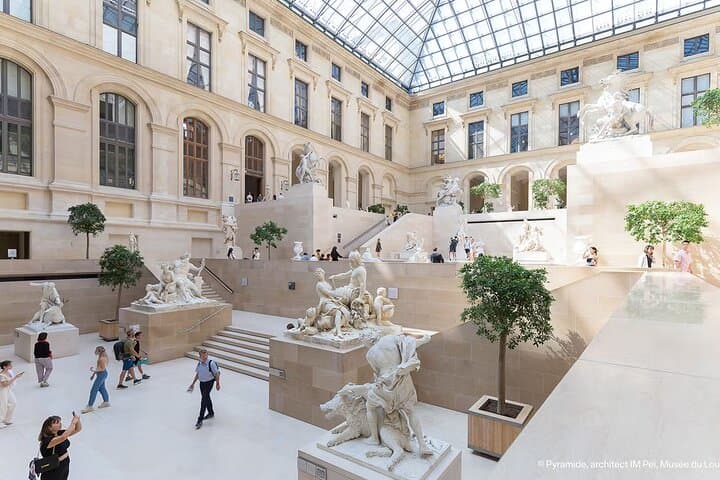
The glass pyramid tilts light into a courtyard where centuries of stone and paint hold court. You step through that prism and into palace halls that once echoed with royal footsteps; now they hum with tourists, students, and the steady shuffle of people following the Mona Lisa’s gravitational pull.
The glass pyramid tilts light into a courtyard where centuries of stone and paint hold court. You step through that prism and into palace halls that once echoed with royal footsteps; now they hum with tourists, students, and the steady shuffle of people following the Mona Lisa’s gravitational pull.
The Louvre began life as a 12th-century fortress before evolving into a royal palace and, after the French Revolution, one of the world’s first public museums. Its collections trace threads from ancient Mesopotamia and Egypt through Greek sculpture and European paintings, laid out inside Beaux-Arts wings and medieval foundations—Parisian layers visible in the very floorplan.
Expect long corridors, high vaulted rooms, and a flow that nudges visitors from dense Impressionist galleries to quieter antiquities. The Seine sits a short walk away, lending the museum a civic anchor; on clear days light from the river sharpens marble reliefs and gilded frames.
Practical guidance: timed access tickets remove the worst waits and let you target a window — crucial if you want to see key works in limited time. An audioguide gives context in tight quarters where labels can’t; use it for a focused 60–90 minute route or to enrich a longer visit. Wear comfortable shoes: a thorough route covers 2–4 km of walking and multiple staircases, though ramps and elevators make the itinerary accessible. Bring a small water bottle, a charged phone for photos (no flash), and patience for crowds at the Mona Lisa and Venus de Milo.
Plan: arrive 15 minutes before your slot, follow signage for timed entry, and map your priorities ahead of time to make the most of the museum’s mammoth collection.