THE ADVENTURE COLLECTIVE® · Independent discovery and booking for outdoor travel

Move beyond guidebook snapshots with a private, skip-the-line tour of Pompeii. In four hours a local expert turns streets, baths and frescoes into a living portrait of Roman daily life—without the queue.
Move beyond guidebook snapshots with a private, skip-the-line tour of Pompeii. In four hours a local expert turns streets, baths and frescoes into a living portrait of Roman daily life—without the queue.
You step through a modern gate and the city outside falls away—cobblestones change underfoot, plastered walls hold the silence of centuries, and Vesuvius watches as if counting time. The guide moves with purpose, drawing lines between fresco fragments and daily routines, turning ash and stone into a lived city.
Verified experiences and guided adventures in the surrounding area.
Operated by Tours of Pompeii with Lello & Co. · Pompeii, Campania
You step through a modern gate and the city outside falls away—cobblestones change underfoot, plastered walls hold the silence of centuries, and Vesuvius watches as if counting time. The guide moves with purpose, drawing lines between fresco fragments and daily routines, turning ash and stone into a lived city.
Pompeii was sealed under the 79 A.D. eruption of Mount Vesuvius; the sudden burial preserved houses, shops and graffiti that reveal Roman domestic life, commerce and ritual. Geologically, layers of pumice and pyroclastic flow created an anaerobic burial that slowed decay and fossilized organic details; you’ll notice the compacted ash beds in cross-section along excavated streets. Culturally, the site sits at the meeting point of Roman urban planning and Campanian traditions—forums, baths and bakeries arranged around social life.
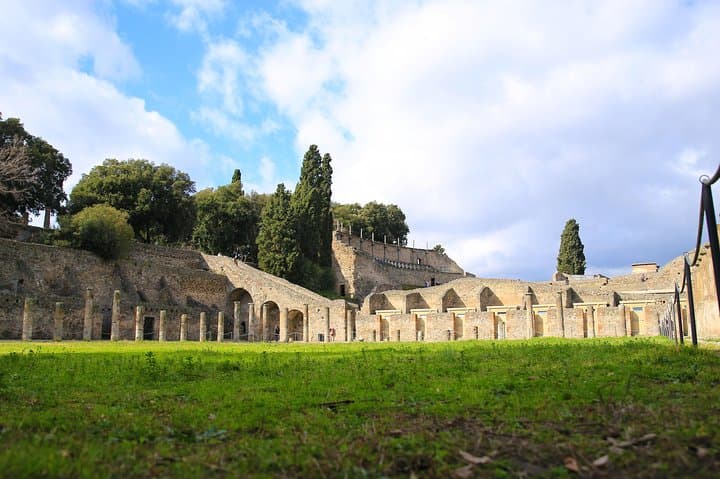
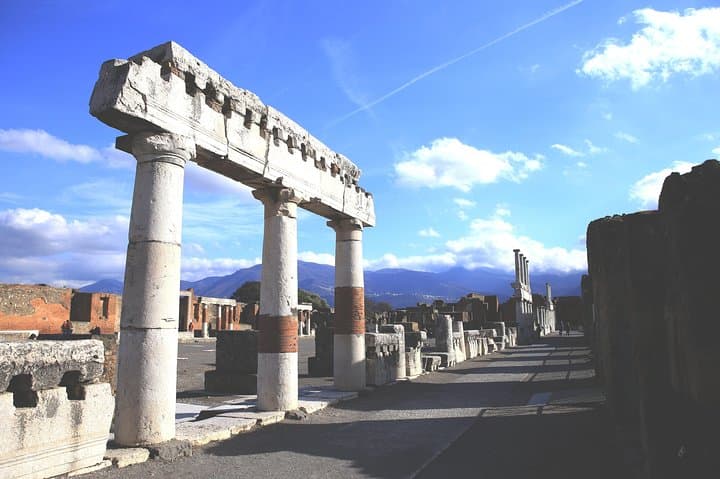
This private, skip-the-line walk covers major highlights in roughly four hours: the Forum, thermal baths, domus with vivid frescoes, the Gladiators’ training area and the Lupanare. Expect paved streets that can be uneven, sun-exposed plazas, and concentrated standing time at key ruins. Your guide can tailor stops and pause for questions, giving context that guidebooks can’t.
Practical notes: wear sturdy shoes with good soles, bring water and sun protection for summer, and plan for moderate walking—roughly 2–4 miles at a steady pace. Morning starts avoid crowds and intense heat. Respect barriers and do not touch frescoes; conservation relies on visitor discipline. With preparation, the site becomes not just a set of ruins but a clear window into an ancient day.
moderate.
3–4 hours.
Good walking fitness recommended—expect several miles on uneven surfaces and repeated standing.
The private skip-the-line tour is about four hours and typically includes 2–4 miles of walking over uneven, paved streets with frequent stops.
This tour includes priority admission; participants use a guided priority lane to bypass ticket-office lines.
Some areas have level pathways, but cobbles and steps make parts of Pompeii challenging for strollers; children should be supervised.
Yes—private guides can adjust the itinerary to emphasize archaeology, daily life, art or architecture according to your requests.
Pompeii preserves a snapshot of Roman urban life frozen by Vesuvius’ 79 A.D. eruption; graffiti, shops and homes offer unusually direct evidence of daily practices.
Ongoing conservation balances visitor access with preservation; follow barriers and photography rules to minimize impact and support long-term stability.
Tours of Pompeii with Lello & Co. operates guided outdoor trips and adventures with an emphasis on safety, stewardship, and memorable experiences.
You step through a modern gate and the city outside falls away—cobblestones change underfoot, plastered walls hold the silence of centuries, and Vesuvius watches as if counting time. The guide moves with purpose, drawing lines between fresco fragments and daily routines, turning ash and stone into a lived city.
You step through a modern gate and the city outside falls away—cobblestones change underfoot, plastered walls hold the silence of centuries, and Vesuvius watches as if counting time. The guide moves with purpose, drawing lines between fresco fragments and daily routines, turning ash and stone into a lived city.
Pompeii was sealed under the 79 A.D. eruption of Mount Vesuvius; the sudden burial preserved houses, shops and graffiti that reveal Roman domestic life, commerce and ritual. Geologically, layers of pumice and pyroclastic flow created an anaerobic burial that slowed decay and fossilized organic details; you’ll notice the compacted ash beds in cross-section along excavated streets. Culturally, the site sits at the meeting point of Roman urban planning and Campanian traditions—forums, baths and bakeries arranged around social life.
This private, skip-the-line walk covers major highlights in roughly four hours: the Forum, thermal baths, domus with vivid frescoes, the Gladiators’ training area and the Lupanare. Expect paved streets that can be uneven, sun-exposed plazas, and concentrated standing time at key ruins. Your guide can tailor stops and pause for questions, giving context that guidebooks can’t.
Practical notes: wear sturdy shoes with good soles, bring water and sun protection for summer, and plan for moderate walking—roughly 2–4 miles at a steady pace. Morning starts avoid crowds and intense heat. Respect barriers and do not touch frescoes; conservation relies on visitor discipline. With preparation, the site becomes not just a set of ruins but a clear window into an ancient day.